


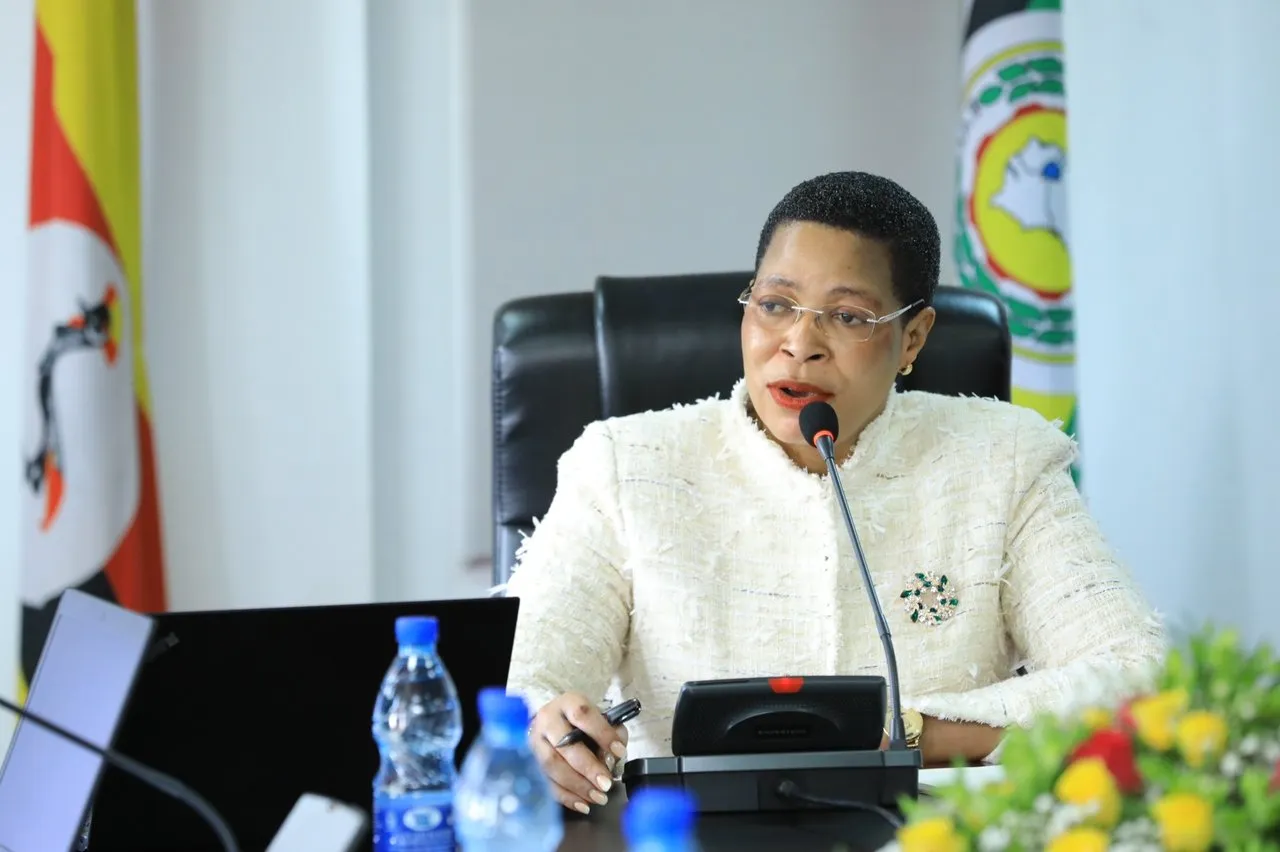
KAMPALA, Uganda — For the first time in several years, Uganda’s Parliament is entering a new political chapter without the commanding presence of former Speaker Anita Annet Among at its helm.
The transition in parliamentary leadership is more than a routine institutional change. It represents a significant moment in Uganda’s political evolution, one that could reshape power dynamics within the ruling National Resistance Movement (NRM), redefine relations between Parliament and the Executive, and influence the country’s political trajectory ahead of the next general election cycle.
The departure of Among from the Speakership has triggered renewed debate about the role Parliament plays in Uganda’s governance system, the balance of power within the ruling establishment, and whether the institution is entering a period of greater independence or simply a different phase of political management.
At stake is not merely who occupies the Speaker’s chair, but what kind of Parliament Uganda will have in the years ahead.
Why the Speaker’s office matters more than many realise
In many democracies, parliamentary speakers are viewed primarily as referees tasked with managing debates and maintaining order.
In Uganda, the office carries far greater political significance.
The Speaker controls parliamentary business, determines the pace at which legislation moves through the House, influences committee operations, and often serves as one of the most powerful figures in the country’s political hierarchy.
The position can shape national debates, affect government accountability, and determine how aggressively Parliament scrutinises the Executive.
As a result, transitions in parliamentary leadership often have implications far beyond legislative procedure.
They can signal broader shifts in political alliances, influence networks, and centres of power.
The rise of Anita Among
Few politicians have risen through Uganda’s political ranks as rapidly as Anita Among.
After serving as Deputy Speaker under Jacob Oulanyah, Among assumed the Speakership following Oulanyah’s death in 2022.
Her ascent came during a period of political uncertainty and institutional adjustment.
Within a relatively short time, she transformed herself from a parliamentary insider into one of the most influential figures in Ugandan politics.
Supporters portrayed her as a decisive leader capable of managing a complex legislature while defending parliamentary authority.
Critics, however, argued that her tenure reflected deeper concerns about legislative independence, transparency, and accountability.
Regardless of one’s political perspective, few would dispute that Among became one of the most powerful political actors in Uganda.
Her influence often extended beyond Parliament itself, placing her at the centre of national political conversations.
The return of old political forces
One of the most intriguing developments following the leadership transition has been the re-emergence of veteran political figures within parliamentary spaces.
The return of former Speaker and First Deputy Prime Minister Rebecca Kadaga to active parliamentary proceedings has attracted particular attention.
For several years, Kadaga’s relationship with the parliamentary leadership was widely perceived as strained following her unsuccessful bid to retain the Speakership in 2021.
Her recent reappearance in the House has therefore been interpreted by some observers as symbolic of a broader political recalibration.
Whether this signals reconciliation, strategic repositioning, or simply institutional normalisation remains open to interpretation.
What is clear is that old political rivalries have not disappeared.
They have merely entered a new phase.
The bigger question: Will Parliament become more independent?
This is arguably the most important question emerging from the transition.
Throughout Uganda’s recent political history, debates about parliamentary independence have remained a constant feature of national discourse.
Opposition politicians, civil society organisations, and governance analysts have frequently questioned whether Parliament exercises sufficient oversight over the Executive.
These concerns intensified during several contentious legislative processes in recent years.
The leadership transition has therefore revived hopes among some observers that Parliament could become more assertive in scrutinising government actions, public spending, and major policy decisions.
Others remain sceptical.
They argue that institutional behaviour is shaped less by individual leaders and more by broader political realities, including party discipline, electoral considerations, and the dominance of the ruling establishment.
In this view, changing the Speaker does not automatically change the political environment in which Parliament operates.
The truth likely lies somewhere between these positions.
Leadership matters, but institutions are rarely transformed overnight.
The NRM’s internal balancing act
To fully understand the significance of the transition, one must also examine it through the lens of internal NRM politics.
For decades, the ruling party has managed a delicate balance among competing interests, regional constituencies, generational groups, and political ambitions.
Parliament has often served as one of the arenas where these competing interests are negotiated.
Changes in parliamentary leadership can therefore reveal important clues about broader shifts occurring within the ruling party itself.
Questions that political observers are now asking include:
Who gains influence from the transition?
Which factions emerge stronger?
How will parliamentary leadership align itself with government priorities?
And how might these dynamics shape succession debates that increasingly occupy political discussions in Uganda?
The answers may not become clear immediately, but the transition has already become part of a larger conversation about the future direction of the NRM.
Parliament and public trust
Beyond elite political calculations lies another challenge: public confidence.
Across many democracies, legislatures face growing scrutiny from citizens who demand greater transparency, accountability, and responsiveness.
Uganda is no exception.
Parliament has periodically faced criticism over expenditure, governance controversies, and perceptions that it is disconnected from ordinary citizens’ concerns.
The new leadership therefore inherits not only institutional authority but also the responsibility of rebuilding and strengthening public trust.
How Parliament handles issues such as corruption oversight, service delivery, public finance, and constitutional governance will significantly influence how citizens judge its effectiveness.
In many ways, legitimacy may prove just as important as power.
What the opposition will be watching
Uganda’s opposition parties are also closely monitoring the transition.
For opposition lawmakers, parliamentary leadership plays a critical role in determining how dissenting voices are accommodated within legislative processes.
Questions about access to debate, committee representation, legislative scrutiny, and procedural fairness remain central concerns.
The opposition will likely assess the new leadership not by rhetoric but by actions.
Will parliamentary procedures become more inclusive?
Will oversight mechanisms become stronger?
Will controversial legislation receive more rigorous scrutiny?
These questions will shape perceptions of whether the transition represents substantive change or merely a change of personalities.
The road to 2026
It is impossible to separate the parliamentary transition from the broader political context in which it is unfolding.
Uganda’s next general elections continue to loom over virtually every major political development.
As political actors position themselves for future contests, Parliament will remain a crucial arena for shaping narratives, influencing public opinion, and demonstrating leadership credentials.
Also Read: Soft landing or political free fall? Anita Among’s next move in doubt
The decisions made within Parliament over the coming months may therefore have implications far beyond legislative chambers.
They could affect political alliances, policy priorities, and electoral strategies heading into one of the country’s most closely watched political periods.
A Parliament at a crossroads
The transition from the Among era marks an important moment in Uganda’s political story.
Yet the significance of the change will not ultimately be measured by ceremonial handovers, leadership titles, or parliamentary seating arrangements.
It will be measured by what follows.
Can Parliament strengthen its oversight role?
Can it improve public confidence?
Can it navigate increasingly complex political pressures while maintaining institutional credibility?
And perhaps most importantly, can it demonstrate that leadership transitions are opportunities for institutional renewal rather than merely shifts in political personalities?
The answers will emerge gradually.
For now, Uganda’s Parliament stands at a crossroads, caught between continuity and change, political reality and public expectation, institutional authority and democratic accountability.
The next chapter has begun, but its direction remains unwritten.
