


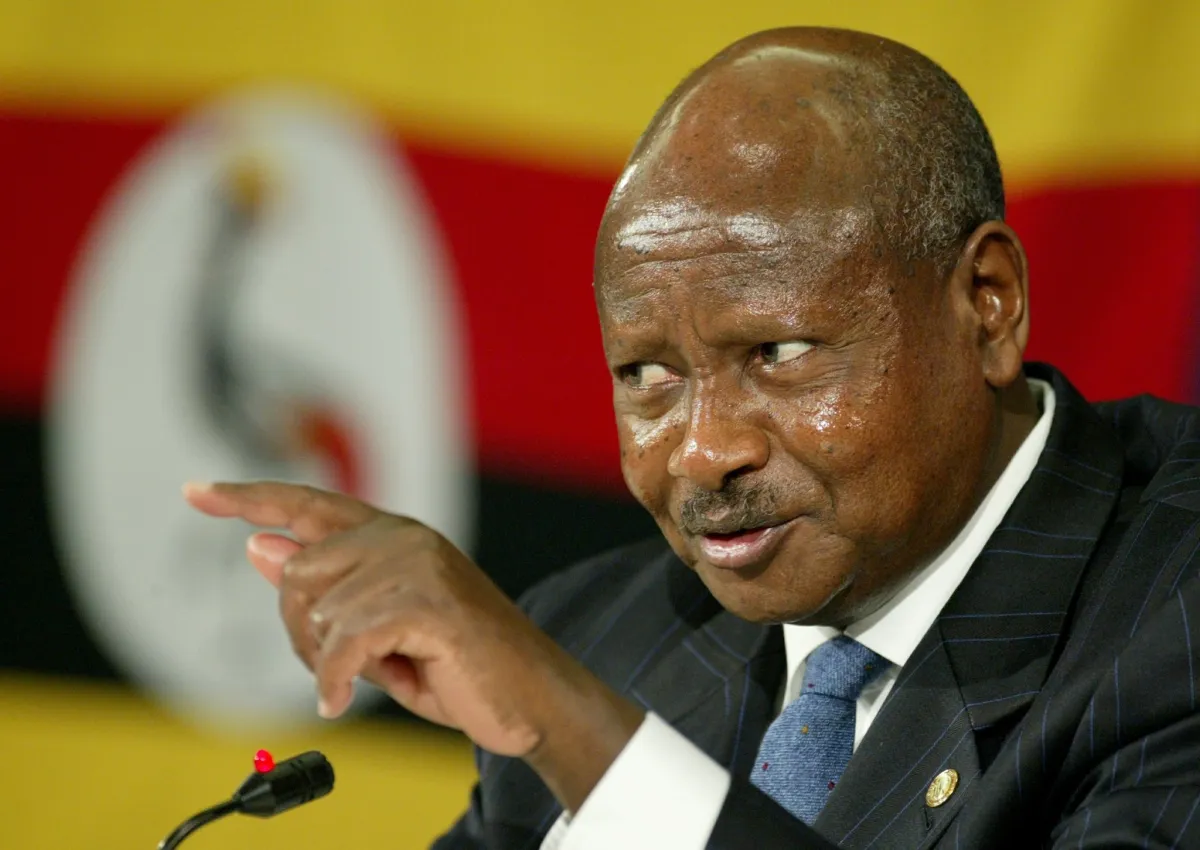
KAMPALA, Uganda — President Yoweri Museveni has dismissed six senior officials from the Ministry of Works and Transport and the Uganda Civil Aviation Authority (UCAA), accusing them of presiding over corruption, costly delays and failures that have plagued some of Uganda’s most important infrastructure projects.
But the significance of the move extends beyond the careers of six public servants.
It raises a broader question that many Ugandans have been asking for years: how has a country that has invested heavily in roads, bridges and airport expansion continued to struggle with unfinished projects, escalating costs and recurring investigations?
For motorists trapped in endless road diversions, travellers frustrated by operational challenges at Entebbe International Airport, and taxpayers who have watched project budgets swell while completion dates slip further into the future, Museveni’s intervention appears to be an acknowledgement that public frustration has reached a critical point.
In a strongly worded letter, the President described what he called “Massive Corruption” within the Ministry of Works and suggested that investigators had already gathered sufficient evidence to justify immediate action.
“I have been getting reports that there is massive corruption in the Ministry of Works. Proof of this Corruption has been the delays in road construction and maintenance,” Museveni wrote.
His letter read less like a routine administrative directive and more like an indictment of a system that, in his view, has repeatedly failed to deliver.
To support his argument, Museveni pointed to a list of projects that have become familiar examples of public dissatisfaction.
“There are abundant examples everywhere such as the Busega-Mpigi road, the investigations, the shameful Mubende-Fort-Portal road, the Masaka-Mutukula road, the Jinja road, the unfinished Ssezibwa bridge, the malfunctioning Scanners at Entebbe Airport…etc etc.”
Each project tells a story.
Not necessarily of collapse or abandonment, but of delays, disputes, revisions and mounting questions about value for money.
And together, they illustrate why infrastructure has become one of the most politically sensitive sectors in government.
Roads are among the most visible measures of state performance. Citizens experience them every day. When they are completed efficiently, they become symbols of progress. When they stall, they become daily reminders of government shortcomings.
The officials dismissed by Museveni occupied some of the most influential technical positions in Uganda’s infrastructure sector.
Among them is Eng. Steven Kitonsa, the Engineer-in-Chief and the Ministry of Works’ most senior engineer. Also removed is Eng. Ronald Olaki, who managed the Masaka–Kyotera–Mutukula highway project, and Eng. Rogers Kisambira, who has overseen major road infrastructure linked to Uganda’s preparations for the 2027 Africa Cup of Nations.
The dismissals extended beyond roads and into Uganda’s aviation sector.
Eng. Ronald Twesigye, who coordinated the multi-billion-shilling expansion of Entebbe International Airport and chaired the UCAA Contracts Committee, was among those removed. He was joined by Eng. Sooma Ayoub, Director of Airports, and Ms. Helen Wenene Mary, UCAA’s Head of Legal.
The inclusion of senior aviation officials signals that Museveni’s concerns are not confined to highways and bridges.
By specifically referencing malfunctioning scanners at Entebbe International Airport, the President appeared to highlight operational and procurement concerns at Uganda’s most important international gateway.
That matters because airports are more than transportation hubs.
For tourists, investors and business travellers, Entebbe often serves as the country’s first impression. Operational failures at such a strategic facility carry economic and reputational consequences that extend far beyond the aviation sector.
The President’s letter also offered insight into how the government intends to pursue accountability.
“Of additional interest, the investigators have got two weapons: The Criminal and the Administrative,” he wrote.
The statement suggests authorities are pursuing both criminal investigations and administrative sanctions simultaneously.
While criminal cases can take years to move through the courts, administrative action allows government to remove officials immediately if it believes public confidence has been compromised.
Invoking powers granted under Article 99 of the Constitution, Museveni ordered the officials retired in the public interest.
“In order to start on the clean-up, by the Authority given to the President by Articles 99 of the 1995 Constitution, I direct that the following employees of the Ministry of Works and Uganda Civil Aviation Authority are, with immediate effect, retired in the Public Interest.”
He then delivered a blunt instruction.
“They should vacate Office immediately. Organize for their handovers. I will look for Patriotic Ugandans to replace them.”
The dismissals became public shortly after State Minister for Works Fred Byamukama informed Parliament’s Committee on Physical Infrastructure that he had received the President’s directive.
“As I was leaving this morning my office, I saw a letter from the President sacking six engineers, including a few I’m seeing on this front bench here,” Byamukama told MPs.
His remarks suggested the action arrived with little warning, even within government circles.
According to the minister, the decision followed ongoing investigations into several major infrastructure projects, including the Busega–Mpigi Expressway, the Mubende–Fort Portal road and the Masaka–Mutukula highway.
Several engineers, he said, are already recording statements, while parts of the inquiry are being handled by the Inspector General of Government.
That indicates the dismissals may represent only the beginning of a wider probe.
Yet the deeper significance of Museveni’s intervention lies not in the identities of those removed but in what their removal says about the state of Uganda’s infrastructure sector.
For decades, infrastructure development has been central to the government’s economic agenda. New roads, bridges and airport facilities have been presented as essential tools for trade, tourism and industrial growth.
Billions of shillings have been invested.
Yet many projects have repeatedly encountered the same problems: delayed completion, contract disputes, cost overruns and allegations of corruption.
The challenge is not unique to Uganda. Across Africa, governments frequently struggle to ensure that large infrastructure investments are delivered on time and within budget.
What makes Uganda’s case politically sensitive is the visibility of these projects. Citizens see unfinished roads. Businesses experience transport bottlenecks. Travellers encounter operational inefficiencies.
The consequences are impossible to hide.
The President’s intervention therefore appears to reflect more than dissatisfaction with individual officials.
Also Read: Museveni urges NRM MPs to fight corruption at Kyankwanzi retreat
It suggests growing concern that infrastructure failures are beginning to undermine broader development goals.
Whether the dismissals ultimately lead to meaningful reform remains uncertain.
Replacing officials is often easier than fixing systems.
Corruption, procurement weaknesses and project management failures rarely emerge because of one individual alone. They typically reflect deeper institutional problems involving oversight, accountability and enforcement.
Those issues will not disappear simply because six officials have left office.
But politically, the dismissals send a powerful signal.
They demonstrate a willingness to hold senior technical officers accountable for projects that directly affect the public.
For now, Uganda’s roads remain unfinished, investigations continue and questions persist about how some of the country’s most important infrastructure projects reached this point.
What has changed is that the scrutiny is no longer focused solely on the projects themselves.
It is now focused on the people who were entrusted to deliver them.
And in Museveni’s view, the clean-up has only just begun.
