


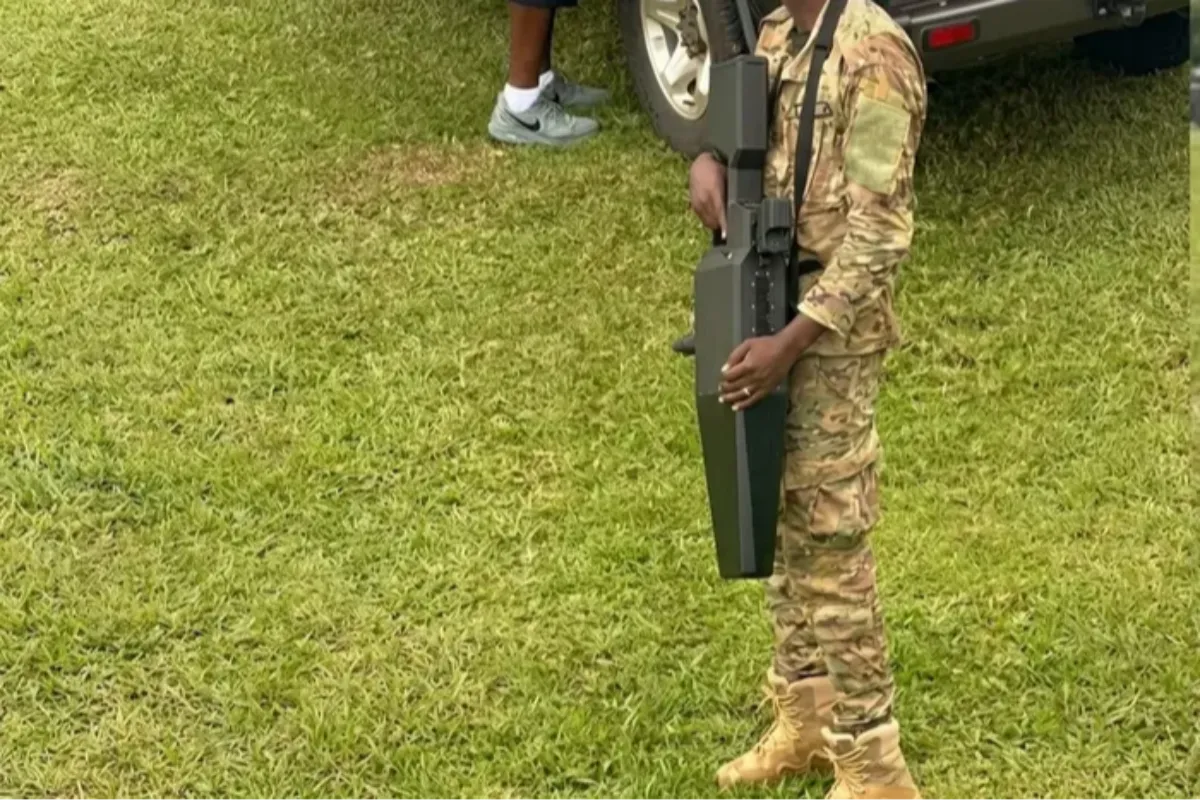
FORT PORTAL, Uganda — Images showing a member of President Yoweri Museveni’s security detail carrying a large rifle-shaped device at the Tooro coronation in Fort Portal have sparked speculation online about whether Uganda’s security agencies are deploying portable counter-drone equipment.
The photographs, taken during Tuesday’s ceremonies at Karuziika Palace, show a uniformed member of the Special Forces Command carrying a large black device resembling a rifle.
The equipment has attracted attention because of its unusual appearance, with some social media users initially assuming it was a conventional firearm.
However, the make, model and exact function of the device have not been officially confirmed by Ugandan authorities.
Its design is consistent with some types of portable counter-unmanned aircraft systems, commonly described as anti-drone guns or radio-frequency (RF) jammers. Such systems are designed to interfere with communications between drones and their operators rather than fire conventional ammunition.
For example, commercially available systems such as DroneShield’s DroneGun range are designed to disrupt control, video and satellite-navigation signals used by drones.
That does not establish that the device seen in Fort Portal was a DroneShield product or even that it was a counter-drone weapon.
Tight security around Museveni and Tooro coronation
The sighting came as Fort Portal was placed under heightened security for the coronation of Edward Rukidi Nyabongo I as the new Omukama of Tooro.
Ugandan authorities deployed the Uganda Police Force, UPDF, Special Forces Command and intelligence agencies for the ceremony, with road closures and traffic diversions imposed in parts of the city.
President Museveni presided over the ceremony at Karuziika Palace, where thousands gathered to witness Nyabongo’s formal installation following the death of his predecessor, Omukama Oyo Nyimba Kabamba Iguru Rukidi IV, in August.
The level of security around the event provided the backdrop for the photographs that prompted the online discussion.
But there has been no official statement confirming that the particular device was deployed specifically to protect Museveni from drones.
Drone allegations in Besigye treason case
The speculation has also drawn attention because of allegations heard recently in the ongoing treason case against opposition politician Dr Kizza Besigye.
Andrew Wilson, an American private security contractor who testified as a prosecution witness, told Uganda’s High Court in August that an alleged plan involving Besigye and his associates included the use of a drone to attack Museveni and subsequently implicate the Allied Democratic Forces.
Wilson said the alleged discussions took place during a meeting in Geneva, Switzerland, in January 2024.
The witness also told the court that individuals allegedly involved in the plan were expected to conduct surveillance around State House in Entebbe while posing as tourists.
Besigye and his co-accused deny the charges. The allegations presented by the prosecution have not been established by the court.
The reported drone allegations have nevertheless provided additional context for renewed public interest in counter-drone capabilities around the President.
How counter-drone systems work
Portable counter-drone systems can use radio-frequency disruption to interfere with the links connecting an unmanned aircraft to its operator.
Depending on the system and the drone, disrupting those signals can interfere with control, live video transmission or satellite-navigation functions. DroneShield says its DroneGun Mk4, for example, is designed to disrupt control, video and GNSS navigation signals across multiple frequency bands.
Also Read: Witness tells court how hidden camera in ‘power bank’ recorded alleged Besigye coup plot
Some counter-drone systems are instead designed primarily to detect and identify drones, while others combine detection with electronic disruption.
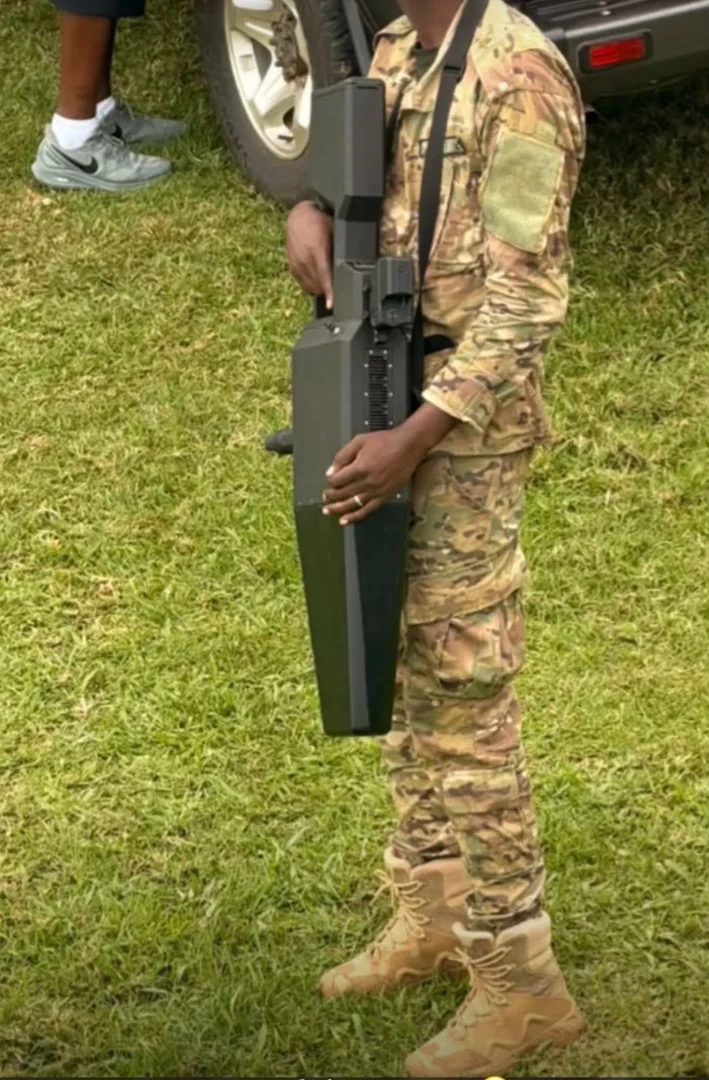
The equipment seen in Fort Portal cannot therefore be conclusively classified from photographs alone.
Growing focus on drone threats
The increased attention to counter-drone technology reflects the growing use of unmanned aircraft in security and military environments.
Governments and security agencies increasingly use counter-unmanned aircraft systems to protect sensitive locations, public events, military installations and senior officials.
DroneShield, one manufacturer in the sector, describes portable counter-drone equipment as part of security measures for public-safety and other high-risk environments.
In Uganda, however, there has been no public confirmation that the device seen alongside Museveni represents a newly acquired counter-drone capability.
For now, the photographs provide evidence only that a member of the President’s security detail was carrying the unusual rifle-shaped device during a heavily secured national ceremony.
Its exact purpose remains unconfirmed.
