


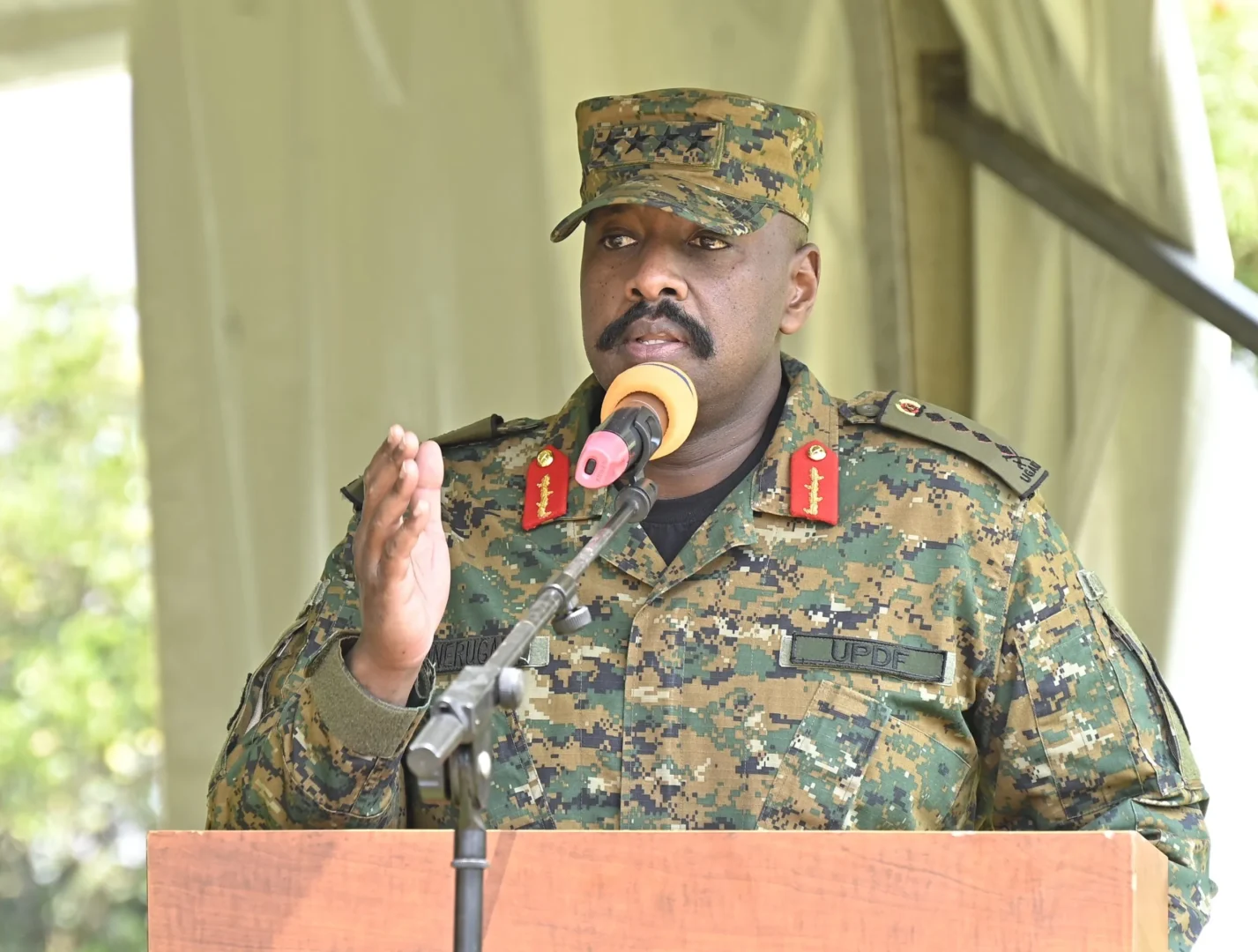
KAMPALA, Uganda — Uganda’s Chief of Defence Forces (CDF), Gen Muhoozi Kainerugaba, has ruled out political dialogue with detained opposition leader Dr Kizza Besigye, deepening divisions over a proposed national reconciliation initiative spearheaded by Gen Salim Saleh.
Gen. Muhoozi made his position known on X after reactivating his account on Tuesday morning, November 17, 2026, dismissing the prospect of negotiations with Besigye over Uganda’s political future.
“You cannot have ‘National Dialogue’ with a traitor who was planning to shoot down Mzee’s helicopter. We will not accept that,” Gen. Muhoozi wrote.
He further suggested that Dr. Besigye should be returned to his cell at Luzira Prison.
The remarks came as Dr. Besigye’s People’s Front for Freedom (PFF) rejected Saleh’s proposed Consociational Democracy Agreement (CDA), arguing that negotiations on national unity and power-sharing cannot be meaningful while opposition leaders remain detained and fundamental political questions remain unresolved.
Dr. Besigye, a former presidential candidate and long-time critic of President Yoweri Museveni, has been in detention since November 2024. He faces treason-related charges but has not been convicted.
The disagreement exposes the widening divisions over how Uganda should approach political reconciliation, particularly as discussions about a possible transition from Museveni’s leadership gain prominence.
PFF rejects Saleh’s proposed agreement
PFF has said it will not participate in political negotiations that exclude questions surrounding the detention of opposition leaders, alleged abductions, human rights violations, electoral reforms and Uganda’s political transition.
The party maintains that its founding leader, retired Col Dr Kizza Besigye, must be part of any meaningful national dialogue.
On Monday, November 16, the party marked 730 days since Besigye and his associate, Hajji Obeid Lutale, were taken from Nairobi, Kenya, on November 16, 2024, and transferred to Uganda to face criminal charges.
Speaking at a press conference in Kampala, PFF vice-president for Western Uganda, Dr Nicholas Kamara, said the party deliberately stayed away from a meeting hosted by Saleh at Kirema Heritage Farm in Nakaseke District on November 13.
The meeting brought together representatives of political parties and other organisations to discuss the proposed Consociational Democracy Agreement.
“For us as PFF, we have never supported the consociation. So when they called a meeting about consociation, we sat and said, of course, we can never attend such a meeting, and we did not go,” Kamara said.
His clarification followed differing published accounts of the Nakaseke meeting, some of which listed PFF among the organisations represented.
Kamara insisted that the party had not sent representatives and would not attend future meetings on the proposal.
He argued that the agreement focuses on political accommodation without adequately addressing opposition detentions, human rights, electoral reforms or the question of who succeeds Museveni.
He also questioned how the government could invite opposition parties into a government of national unity when some of their leaders remain in detention while others are in exile.
“Unity with who? Even if we talk about NUP, their leader is in exile. But they want to bring us this consociation,” he said.
PFF has outlined several conditions for participating in national dialogue, including the appointment of a neutral convener, an agenda jointly developed by participating parties, inclusive representation and an independent guarantor to ensure that any commitments reached are implemented.
What the Nakaseke meeting agreed
The November 13 meeting at Kirema Heritage Farm brought together representatives of political parties under the Inter-Party Organisation for Dialogue (IPOD), the National Consultative Forum (NCF) and the CDA initiative.
Participants agreed to incorporate the proposed Consociational Democracy Agreement into the Uganda National Dialogue Framework, established in 2018 under Museveni’s authority and chaired by former Prime Minister Ruhakana Rugunda.
The CDA initiative is being led by Prof Ogenga Otunnu.
Its proponents argue that the arrangement could provide a platform for political reconciliation, national consensus and discussions on Uganda’s governance challenges.
However, the proposal has faced resistance from sections of the opposition.
The Forum for Democratic Change (FDC) has raised concerns about the neutrality of the meeting venue and the procedures followed, while the National Unity Platform (NUP) has also questioned the process.
PFF’s rejection adds to the uncertainty surrounding efforts to bring opposition groups and government-linked political actors into a common negotiating framework.
Besigye’s detention and the legal battle
Dr. Besigye and Lutale were taken from Nairobi in November 2024 and brought to Uganda, triggering questions about the circumstances of their transfer and the legal procedures followed.
Kamara questioned why the two men were not handled through established arrest and extradition procedures, arguing that their transfer raised concerns about the rule of law and respect for Kenya’s sovereignty.
They were initially arraigned before a military court alongside UPDF Capt Denis Oola.
However, following a Supreme Court decision barring the trial of civilians in military courts, their case was transferred to the High Court.
The prosecution alleges that Dr. Besigye and his co-accused participated in meetings in Uganda and abroad as part of a plan to overthrow the government. The allegations remain subject to determination by the court.
The proceedings have continued amid disputes over evidence, legal representation and Besigye’s health.
In July 2026, the High Court dismissed an application by Besigye and Lutale seeking to terminate the proceedings over alleged human rights violations, allowing the trial to continue.
Amnesty International has called for Dr. Besigye’s release, raising concerns about his prolonged detention and access to medical care.
Kamara also cited earlier confrontations between Dr. Besigye and the state, including the 2005 Black Mamba incident, when armed security personnel stormed the High Court during proceedings involving the opposition leader.
He argued that the successive legal battles and prolonged detention reflected a pattern of political persecution.
Kamara rejected suggestions that Besigye was responsible for delaying his trial, accusing the state of failing to conclude the proceedings within a reasonable period.
Concerns over Besigye’s health
The dispute over national dialogue has also been complicated by growing concerns about Dr. Besigye’s health.
On July 29, 2026, Besigye collapsed during proceedings at the High Court in Kampala and was taken to hospital.
He was admitted to Mulago National Referral Hospital before being discharged to a Uganda Prisons Service medical facility at Luzira.
His wife, Winnie Byanyima, has repeatedly raised concerns about his condition and the adequacy of the medical care available to him, calling for his release on bail to enable him to access specialist treatment.
Kamara, who described himself as a practising consultant doctor and medical educator, said Besigye required specialised medical assessment and treatment.
He cited reported difficulties with walking and speaking and called for medical bail for Dr. Besigye and former Kampala Lord Mayor Erias Lukwago.
PFF maintains that Dr. Besigye’s health should not be used as a bargaining tool in negotiations over national unity.
PFF links political concerns to wider security operations
Kamara argued that Dr. Besigye’s case should be viewed against a wider pattern of arrests and security operations involving individuals perceived to be opposed to the government.
He cited the arrest of retired Lt Gen Peter Elwelu in Soroti on November 2, 2026.
The UPDF has accused Elwelu of involvement in subversive activities and alleged plans to destabilise the Teso sub-region. The army also said troops recovered 15 firearms, military fatigues and two pickup trucks allegedly linked to him.
The allegations had not been tested in court when the military announced them.
Also Read: Museveni’s brother Salim Saleh says he found Besigye ‘almost dead’ in prison
Elwelu previously commanded the November 2016 military raid on the Rwenzururu Kingdom palace in Kasese, during which more than 100 people were reportedly killed and the kingdom’s cultural leader, Omusinga Charles Wesley Mumbere, was arrested.
Meanwhile, NUP also marked the anniversary of Besigye’s detention, with the party’s secretary-general, David Lewis Rubongoya, warning that his case raised wider concerns about the treatment of ordinary Ugandans caught up in the criminal justice system.
“If this can happen to Dr Kizza Besigye, then what about the other ordinary citizens who end up trapped in the criminal justice system, especially if their cases are political in nature?” he asked.
“We stand in solidarity with all those who fight for freedom and democracy in Uganda.”
A widening divide over Uganda’s political future
The competing positions illustrate the difficulties facing efforts to establish a national dialogue framework acceptable to both government-linked actors and the opposition.
Gen. Muhoozi’s remarks rule out the prospect of dialogue with Besigye, while PFF insists that any credible negotiations must address political freedoms, access to justice, electoral reforms and the country’s political transition.
Proponents of Saleh’s Consociational Democracy Agreement maintain that incorporating it into the existing national dialogue framework could create a platform for reconciliation and consensus.
However, without the participation of major opposition groups and agreement on the conditions for negotiations, the initiative faces significant political challenges.
The dispute also raises a fundamental question about the proposed dialogue: whether Uganda’s political differences can be resolved through power-sharing arrangements alone, or whether negotiations must first address the legal, political and human rights grievances that have deepened mistrust between the government and its opponents.
