


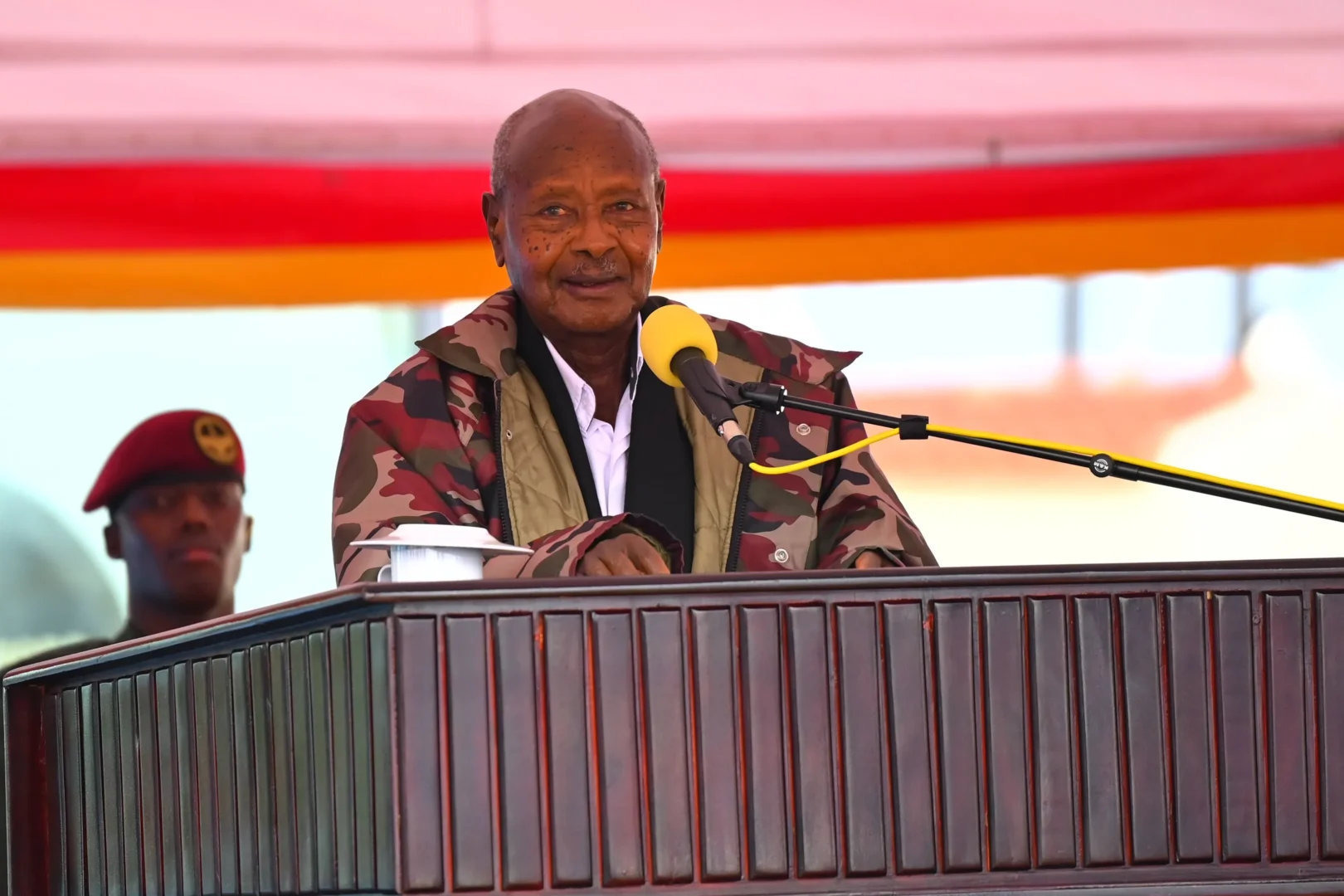
FORT PORTAL, Uganda — Ugandan President Yoweri Museveni has called for greater attention to traditional cultural practices in the country’s HIV response, arguing that some communities have retained social norms that may help limit transmission.
Museveni made the remarks at Karuziika Palace in Fort Portal during the enthronement of Tooro’s 14th Omukama, His Majesty Edward Rukidi Nyabongo I.
The President pointed to Karamoja as an example of a community that, in his view, has retained traditional practices while recording relatively low HIV prevalence.
“In Karamoja, they are still traditional. They are polygamous; they have got many women but no AIDS. Here, where we have got Christians and kingdoms and so on, we are not doing very well,” Museveni said.
He urged Ugandans to compare HIV prevalence in Karamoja with rates in Fort Portal, Mbarara and Kampala, arguing that communities that have maintained traditional ways of life may have lessons for the national HIV response.
Museveni said traditional societies had preserved cultural expectations around relationships and family life that he believed could help reduce risky sexual behaviour.
He also encouraged cultural institutions to preserve indigenous knowledge and practices, arguing that some traditional systems could offer lessons for dealing with contemporary social challenges.
HIV burden varies sharply across Uganda
Official data confirm that HIV prevalence varies considerably between different parts of Uganda.
The Uganda AIDS Commission’s 2025 estimates put Fort Portal City’s adult HIV prevalence at about 14.3 per cent, while Mbarara City was estimated at 9.9 per cent.
Earlier Uganda AIDS Commission and Ministry of Health estimates also recorded a substantially lower prevalence in Karamoja. A UAC document based on 2023 Ministry of Health estimates put prevalence in the region at 1.4 per cent, compared with 5.3 per cent in the Toro region and 7.4 per cent in Kampala.
The figures support Museveni’s observation that HIV prevalence differs significantly between regions, but they do not establish that traditional marriage practices are responsible for the differences.
Uganda’s HIV epidemic is influenced by a range of demographic, behavioural, social and economic factors. UAC documents have identified significant differences by sex, age and population group, while HIV prevalence is also particularly high in some urban areas and among certain key populations.
The Commission has also warned that the epidemic remains geographically diverse, with some districts and cities experiencing substantially higher prevalence than the national average.
Museveni questions reliance on modern institutions
Museveni contrasted traditional communities with parts of Uganda where Christianity, kingdoms and other institutions have become more prominent.
He argued that the presence of those institutions had not necessarily translated into lower HIV prevalence.
The President said he had data showing HIV prevalence in Karamoja at about three per cent, compared with between 10 and 15 per cent in some areas elsewhere in the country.
The latest official figures available publicly, however, put Karamoja’s regional prevalence lower than the figure cited by Museveni, at about 1.4 per cent in the 2023 estimates.
Similarly, current estimates for Fort Portal City put prevalence at 14.3 per cent, while Mbarara City is at 9.9 per cent.
The differences illustrate the broader geographic variation in Uganda’s epidemic but do not, on their own, demonstrate that one marriage system is responsible for a particular HIV outcome.
Cultural practices in the HIV response
Museveni’s comments place cultural institutions at the centre of a longstanding debate about how Uganda should approach HIV prevention.
The country has made significant progress in reducing the overall HIV burden, but new infections continue to occur. The Uganda AIDS Commission has maintained that prevention remains critical to achieving the national goal of ending AIDS as a public-health threat by 2030.
In recent years, health authorities have continued to emphasise testing, treatment, prevention services, condom availability, viral-load suppression and targeted interventions for groups experiencing higher transmission.
Also Read: Museveni praised in Rakai for pioneering Uganda’s HIV/AIDS fight
The Ministry of Health launched the 2024–2025 Uganda Population-based HIV Impact Assessment to generate updated evidence on prevalence, incidence, viral-load suppression and other indicators of the epidemic.
Museveni’s proposal for greater use of traditional cultural values therefore adds another dimension to the HIV debate, but public-health evidence will be needed to determine which specific cultural practices contribute to reducing transmission.
Tooro ceremony brings cultural debate into focus
Museveni’s remarks came as Tooro formally welcomed Edward Rukidi Nyabongo I as the kingdom’s 14th Omukama.
The ceremony brought together political leaders, cultural figures and residents in Fort Portal, providing the President with a platform to argue that traditional institutions should play a greater role in addressing social problems.
His comments reflect his broader argument that Uganda should preserve aspects of indigenous culture rather than abandoning them as the country modernises.
But as Uganda continues its HIV response, the challenge for policymakers will be to distinguish cultural practices that can support prevention from assumptions about their effects that require stronger epidemiological evidence.
