


ENTEBBE, Uganda — When Uganda Airlines returned to the skies in 2019 after an 18-year absence, the challenge was not simply to restart a national carrier.
It was to prove that Uganda could sustain one.
Six years later, the airline has taken what may be its most significant step since relaunching operations, committing to the largest fleet expansion in its modern history and signalling ambitions that extend far beyond transporting passengers between regional capitals.
At the Farnborough International Airshow in the United Kingdom, Uganda Airlines announced an agreement with American aerospace giant Boeing to acquire eight new aircraft, including four Boeing 737-8 jets and four Boeing 787-9 Dreamliners.
The deal marks the national carrier’s first direct purchase from Boeing and reflects a broader strategy aimed at transforming Entebbe into a regional aviation gateway capable of competing more aggressively for passenger, cargo and transit traffic.
For Uganda Airlines, the announcement is about more than adding aircraft.
It is about redefining its place in a fiercely competitive African aviation market.
From revival to expansion
National airlines often carry symbolic importance.
They project national identity, facilitate connectivity and are frequently viewed as instruments of economic development.
Yet history also shows they can become expensive burdens when commercial realities fail to match political aspirations.
Uganda Airlines understands that history better than most.
The original carrier ceased operations in 2001 after years of financial difficulties, leaving Uganda without a national airline for nearly two decades.
When the government revived the airline in 2019, sceptics questioned whether a relatively small economy could sustain a state-backed carrier in a region already dominated by established airlines such as Ethiopian Airlines, Kenya Airways and RwandAir.
The airline’s leadership now argues that the Boeing acquisition represents evidence that the recovery phase is largely complete and that the focus has shifted toward long-term growth.
Uganda Airlines Chief Executive Officer Ato Girma Wake described the agreement as a defining moment in the carrier’s evolution.
“This commitment with Boeing marks a defining step in Uganda Airlines’ growth journey and in our broader ambition to position Entebbe as a strategic aviation hub for the region,” Wake said.
“The aircraft will strengthen our ability to connect Uganda more efficiently to regional, continental and international markets, while supporting trade, tourism, investment and cargo development.”
His remarks highlight a reality increasingly shaping aviation strategies across Africa.
Airlines are no longer competing solely for local passengers.
They are competing to become gateways.
Why aircraft matter beyond aviation
The acquisition arrives at a time when governments across Africa are placing greater emphasis on air connectivity as a driver of economic growth.
Air transport affects far more than tourism.
It influences trade, investment flows, business travel, logistics and the movement of high-value goods.
Countries with stronger aviation networks often enjoy advantages in attracting international conferences, multinational companies and export-oriented industries.
For a landlocked country such as Uganda, those connections are particularly important.
Economist Dr Fred Muhumuza argues that efficient air transport increasingly functions as critical economic infrastructure.
“Modern economies depend heavily on connectivity,” he has observed in previous analyses of Uganda’s transport sector.
“Aviation is no longer just about moving people. It supports trade, investment and integration into global markets.”
The Boeing purchase appears designed with that broader objective in mind.
A two-tier expansion strategy
The structure of the order reveals how Uganda Airlines intends to expand.
The Boeing 737-8 aircraft will primarily strengthen regional and medium-haul operations, including routes within Africa as well as services to destinations in the Middle East and India.
The larger Boeing 787-9 Dreamliners are intended to support long-haul ambitions.
Those aircraft could play a key role in expanding connections to Europe, Asia and additional destinations across the Middle East.
Together, they create a two-tier fleet strategy that mirrors approaches used by larger international carriers.
Shorter routes feed passengers into long-haul services.
Long-haul services generate additional traffic that strengthens regional networks.
The model is central to the concept of developing Entebbe as a connecting hub rather than merely a point of origin or destination.
The race for East African skies
Uganda’s ambitions unfold within an intensely competitive regional environment.
East Africa has become one of the continent’s most dynamic aviation markets.
Ethiopian Airlines has built the largest network in Africa and continues expanding globally.
Kenya Airways remains a major regional player despite financial challenges.
RwandAir has pursued an aggressive growth strategy focused on turning Kigali into a transit hub.
Against that backdrop, Uganda Airlines faces the difficult task of carving out a distinctive position.
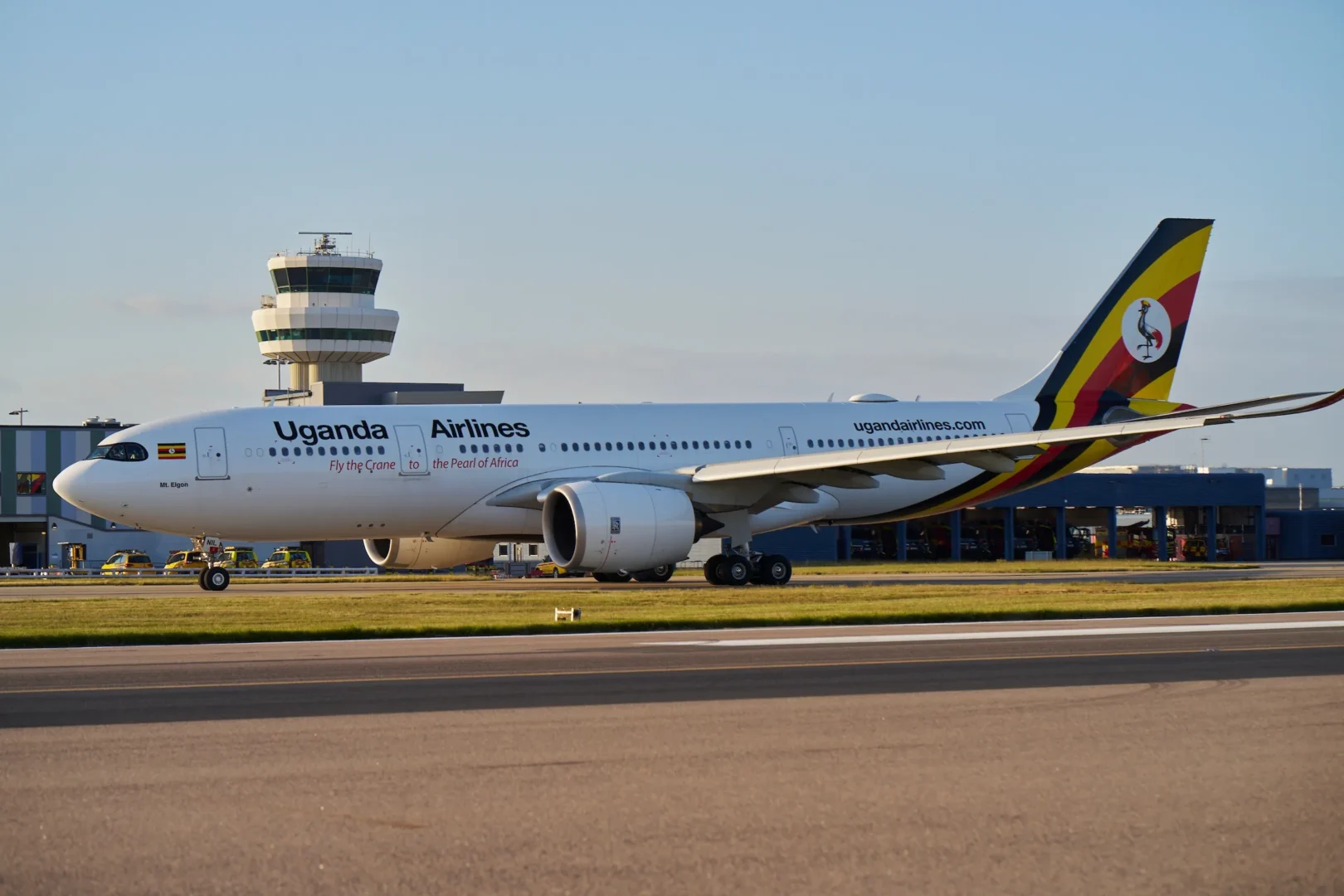
The carrier currently serves 17 destinations across 13 countries using a fleet that includes four Bombardier CRJ-900 regional jets, two Airbus A330-800neo aircraft and a leased Boeing 737-800.
The new aircraft significantly increase operational flexibility and create opportunities for network expansion.
Industry analysts note that aircraft selection is itself a strategic statement.
The Boeing 787-9 is among the world’s most widely used long-haul aircraft, valued for its fuel efficiency and operational range.
The 737-8 similarly offers airlines the ability to operate routes more economically than many older aircraft types.
Boeing says the new aircraft can reduce fuel consumption by between 20 and 25 per cent compared with the models they are expected to replace.
In an industry where fuel often represents the largest operating expense, such efficiencies can substantially affect profitability.
Beyond aircraft: Building expertise
The announcement also points to a less visible but equally important objective.
Skills development.
Modern aviation depends not only on aircraft but also on the engineers, technicians, pilots and operational specialists who keep them flying safely and efficiently.
Wake indicated that the partnership with Boeing would include long-term collaboration on training and technical capacity building.
“Just as importantly, this partnership brings together Uganda Airlines and Boeing in a long-term relationship focused not only on fleet growth, but also on technical excellence, training and capacity building,” he said.
For Uganda, that aspect may prove particularly valuable.
Many African airlines continue to depend heavily on foreign expertise in specialised technical areas.
Building domestic capacity could reduce costs and strengthen the sustainability of future growth.
Boeing’s African opportunity
For Boeing, the agreement reflects the growing importance of African aviation markets.
Although the continent currently accounts for a relatively small share of global air traffic, demand is expected to increase significantly over the coming decades as populations grow, urbanisation accelerates and middle-class incomes expand.
Boeing Senior Vice President for Commercial Sales and Marketing Brad McMullen welcomed Uganda Airlines as a new customer.
“We’re pleased to welcome Uganda Airlines as a Boeing customer and support the airline’s next phase of growth with the 737-8 and 787-9,” he said.
“These airplanes offer efficiency, range and versatility to help Uganda Airlines strengthen and expand its network.”
The relationship gives Boeing another foothold in a region where airlines are increasingly modernising fleets and seeking more fuel-efficient aircraft.
The bigger test begins now
The significance of the announcement is difficult to overstate.
Fleet expansion is often among the clearest indicators of confidence in an airline’s future.
Yet aircraft orders alone do not guarantee success.
The real challenge lies ahead.
Uganda Airlines must translate additional capacity into sustainable passenger growth, profitable routes and stronger commercial performance.
Also Read: State House, CID open major probe into Uganda Airlines corruption allegations
It must compete with larger and more established carriers while navigating the volatility that has become common across the global aviation industry.
At the same time, the airline will face growing expectations at home.
Supporters see the carrier as a symbol of national progress.
Critics will continue asking whether public investment in aviation delivers sufficient returns.
For now, however, the message from Farnborough is unmistakable.
Uganda Airlines is no longer focused primarily on survival.
It is planning for expansion.
And with eight new Boeing aircraft on the horizon, it is betting that Uganda’s future in aviation will be considerably larger than its past.
