


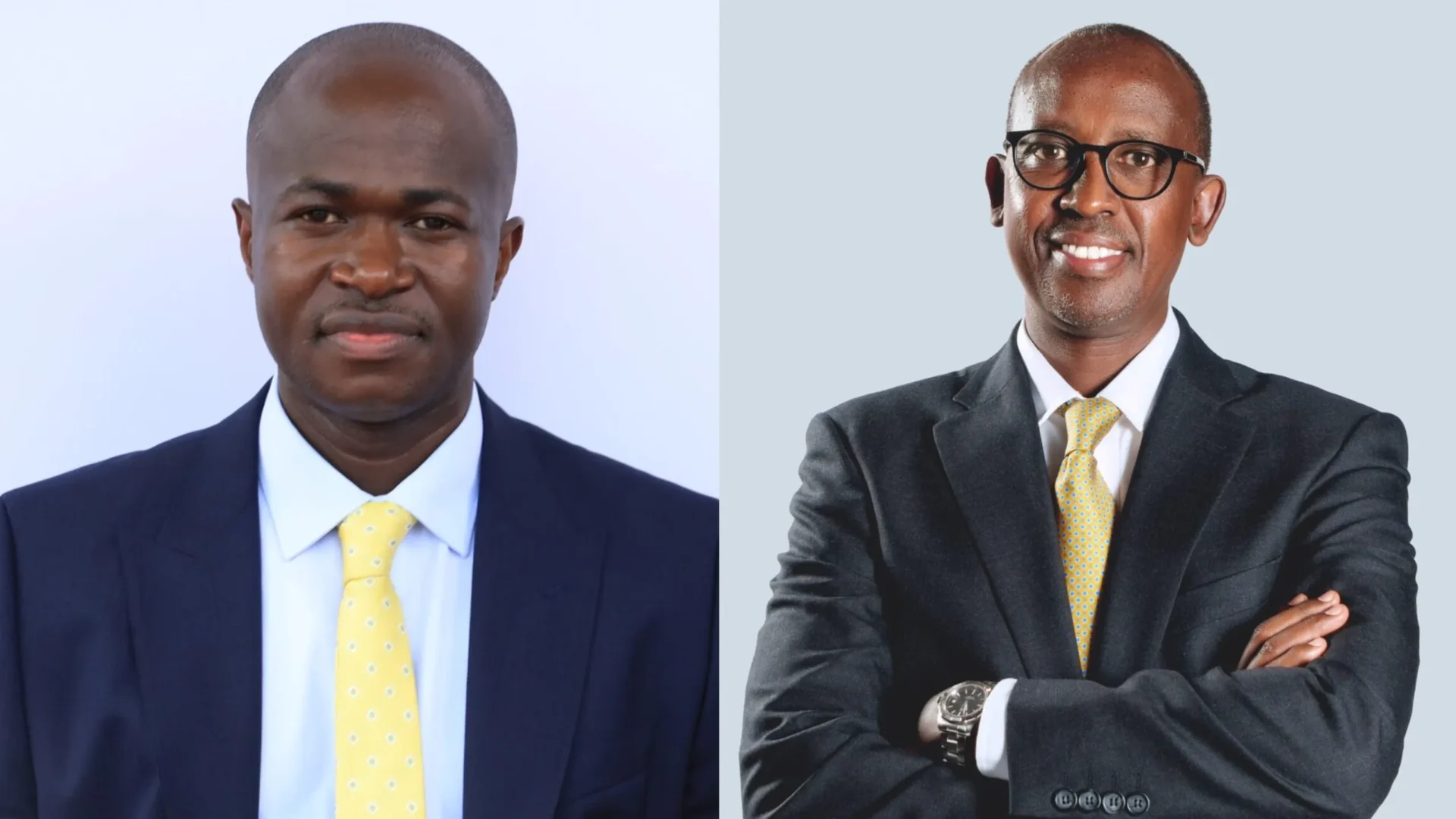
KAMPALA, Uganda — Ugandan politics has long been defined by rivalries between parties. Increasingly, however, some of the country’s most consequential battles are unfolding within the ruling National Resistance Movement (NRM) itself.
The latest confrontation pits two figures who represent very different strands of influence within President Museveni’s political orbit: Kasambya County MP Daudi Kabanda, one of the most outspoken defenders of the Patriotic League of Uganda (PLU), and Presidential Adviser Odrek Rwabwogo, the businessman, strategist and chairman of the Presidential Advisory Committee on Exports and Industrial Development.
What began as a series of social media attacks has evolved into something larger.
It is now a public dispute involving allegations of political sabotage, questions about influence around the presidency and growing speculation about the competing centres of power emerging inside Uganda’s ruling establishment.
And now, according to Kabanda, President Museveni himself has been drawn into the conflict.
A conflict that has moved closer to State House
The latest escalation came when Kabanda claimed that Rwabwogo had personally approached President Museveni over his criticism on social media.
In a lengthy statement posted online, Kabanda alleged that Rwabwogo had compiled several of his social media posts and presented them to the President, seeking intervention.
“I have reliably been informed that Rwaboogo went to the President with a number of my tweets about him and asked him to restrain me from speaking about him or condemn me publicly by referring to me as a CROOK so that I can maybe lose credibility in the society and in my Constituency,” Kabanda wrote.
The allegation immediately transformed what had largely been a public war of words into a dispute touching the highest levels of Uganda’s political leadership.
Whether the claimed meeting occurred exactly as described remains unverified.
Neither State House nor Rwabwogo has publicly commented on Kabanda’s assertions.
Yet the significance lies less in the allegation itself than in what it reveals about the intensity of the confrontation.
Kabanda is no longer merely criticising a fellow political figure.
He is suggesting that a struggle over influence has reached the President’s doorstep.
More than a personal disagreement
On the surface, the feud appears personal.
Kabanda has repeatedly targeted Rwabwogo in public statements, social media posts and media interviews.
He has accused him of corruption, questioned his political motives and portrayed him as an obstacle to forces aligned with Gen Muhoozi Kainerugaba and the Patriotic League of Uganda (PLU).
In response to reports that Rwabwogo visited veteran journalist Timothy Kalyegira at Luzira Prison earlier this month, Kabanda intensified his criticism, describing him as a “serious enemy” and questioning the purpose of the visit.
But political analysts argue that the dispute cannot be understood simply as a clash of personalities.
Instead, it reflects deeper tensions inside the ruling movement.
Dr Frederick Golooba-Mutebi, a political analyst and governance researcher, has previously argued that Uganda’s politics increasingly involves competition between overlapping networks of influence rather than traditional ideological divisions.
Within that framework, figures such as Kabanda and Rwabwogo represent different political constituencies, different visions of succession and different approaches to power.
The conflict therefore becomes symbolic of broader struggles unfolding beneath the surface.
The emergence of competing power centres
For decades, President Museveni has remained the undisputed centre of Uganda’s political system.
Yet as the country gradually moves toward an eventual post-Museveni future, attention has increasingly shifted toward individuals perceived as influential within the next generation of leadership.
Few names attract more scrutiny than Odrek Rwabwogo.
Beyond his role as a presidential adviser, Rwabwogo has built a reputation as an influential policy advocate, business leader and strategist with significant access to the presidency.
His position is strengthened by family ties.
Rwabwogo is married to Patience Museveni Rwabwogo, one of the President’s daughters.
At the same time, Gen Muhoozi Kainerugaba’s growing political profile has created another influential centre of gravity within the ruling establishment.
The rise of PLU has further amplified that dynamic.
Kabanda has frequently positioned himself as a vocal defender of Muhoozi and PLU-related interests.
That context helps explain why what appears to be a personal feud has attracted so much attention.
The confrontation touches sensitive questions about influence, loyalty and the future direction of Uganda’s ruling movement.
Rwabwogo’s contrasting message
Interestingly, Rwabwogo has largely avoided responding directly to Kabanda’s accusations.
Rather than engage publicly, he has continued focusing on broader themes during speeches, interviews and policy discussions.
In recent months, he has repeatedly called for action against corruption, electoral malpractice and abuse of public office.
He has also spoken extensively about economic transformation, export-led development and institutional reform.
At various public events, he has warned that internal divisions, dishonesty and short-term political interests threaten Uganda’s long-term progress.
He has similarly defended media freedom and argued for reforms within the NRM itself.
The contrast between the two men has become increasingly apparent.
While Kabanda’s attacks have been personal and direct, Rwabwogo’s public interventions have largely remained institutional and policy-oriented.
That difference has shaped perceptions of the dispute.
Supporters of Kabanda view him as confronting powerful interests.
Supporters of Rwabwogo see him as focused on governance while refusing to be distracted by political provocations.
Why Museveni’s role matters
The central figure in the dispute remains the one who has said nothing publicly about it.
President Museveni’s silence is itself politically significant.
Throughout his decades in power, Museveni has often acted as the ultimate arbiter of disputes within the ruling movement.
Competing factions frequently seek legitimacy through proximity to the President or through claims of his support.
Kabanda’s allegation that Rwabwogo sought presidential intervention reflects that reality.
In Uganda’s political system, access to Museveni remains one of the most valuable forms of influence.
That is why claims about meetings, conversations and presidential reactions often become political weapons in their own right.
Whether Museveni chooses to intervene publicly could determine whether the dispute escalates further or gradually fades.
The shadow of succession politics
Although neither side frames the conflict in those terms, succession politics inevitably hangs over the debate.
Museveni remains firmly in control of the state and the ruling party.
Yet discussions about Uganda’s future leadership have become increasingly difficult to separate from political disputes involving senior figures around him.
Political scientist Dr Sabiti Makara has previously observed that succession contests in dominant-party systems often emerge long before formal transitions occur.
Also Read: Muhoozi reshuffles PLU leadership, replaces Kabanda in major shake-up
They manifest through alliances, rivalries, narratives and contests for influence.
The Kabanda–Rwabwogo feud fits comfortably within that pattern.
It is less about one social media post or one prison visit.
It is about competing interpretations of who holds influence today and who might shape Uganda tomorrow.
A battle worth watching
For now, the confrontation shows little sign of ending.
Kabanda remains defiant.
“What can actually stop me from talking about the thieves like him is DEATH nothing else. Kabanda whom he wants to refer to as a CROOK actually got for NRM 71% in Mubende with zero budget from NRM,” he wrote.
Rwabwogo has maintained his public silence regarding the allegations.
Neither side appears willing to retreat.
What makes the dispute notable is not merely its intensity but what it reveals about the evolving dynamics inside Uganda’s ruling establishment.
For years, political observers focused on competition between government and opposition.
Increasingly, some of the most important political contests appear to be unfolding within the government itself.
The Kabanda–Rwabwogo feud may ultimately fade like many political disagreements before it.
Or it may prove to be an early glimpse into larger struggles that will shape Uganda’s political future.
Either way, it has already become more than a personal quarrel.
It has become a window into the shifting power dynamics of a movement preparing, however cautiously, for a future beyond the politics that have defined Uganda for nearly four decades.
