


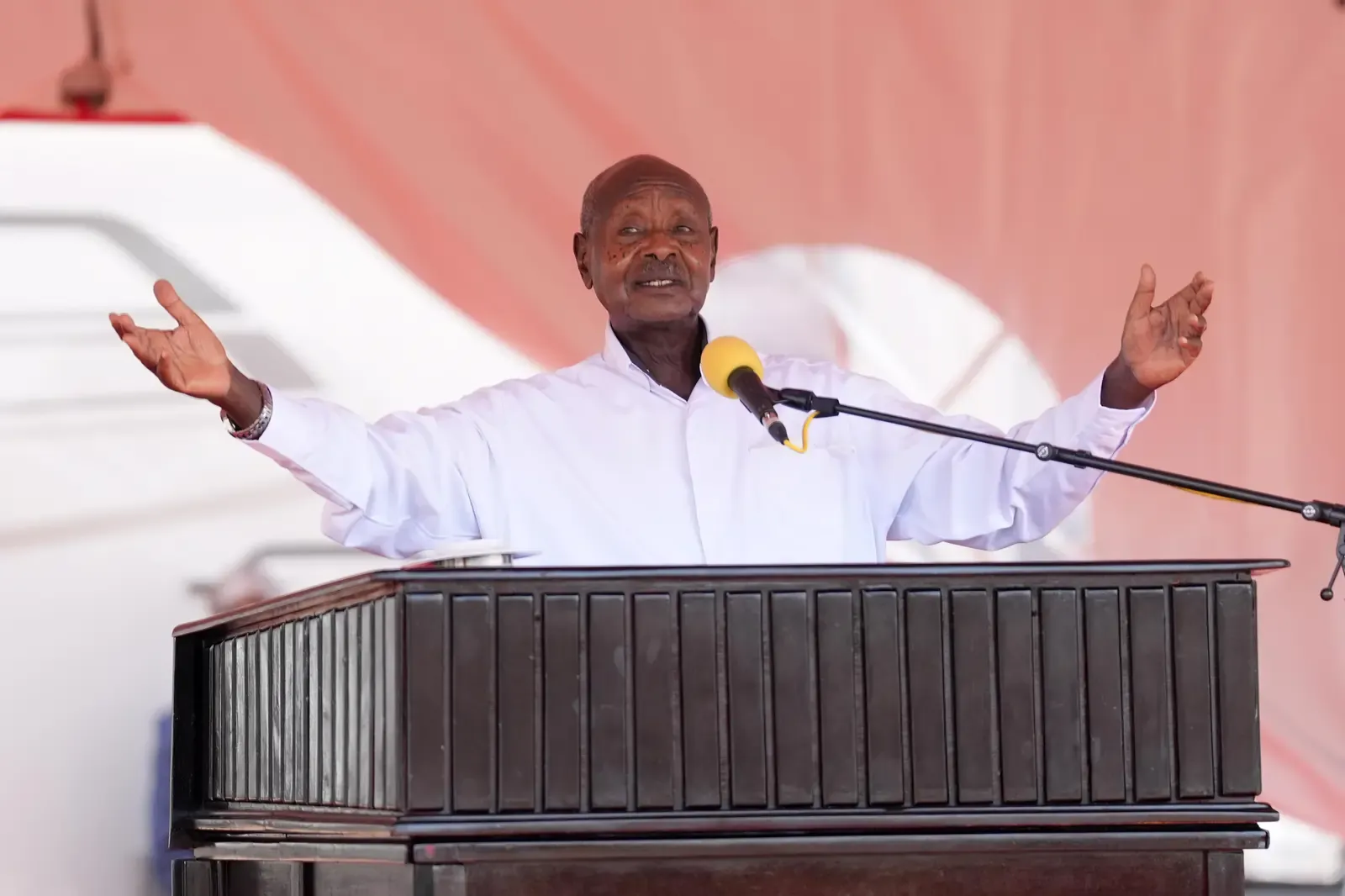
KAMPALA, Uganda — President Yoweri Museveni’s State of the Nation Address (SONA) has long functioned less as a moment of policy rupture than as a reaffirmation of an established development doctrine. The 2025 edition reinforced this pattern, presenting Uganda’s economic trajectory as structurally anchored on agro-industrialisation, mineral development, tourism, and science-led transformation.
At the centre of that framing was a familiar proposition: that Uganda is steadily transitioning from subsistence production to a modern, integrated, and export-oriented economy.
This transition was to be accelerated through state-led programmes such as the Parish Development Model (PDM), Emyooga, and Operation Wealth Creation (OWC), which together were positioned as the institutional bridge between household production and market participation.
A year later, the 2026 address did not alter this architecture. It largely reaffirmed the same economic worldview, with continued emphasis on production, infrastructure expansion, industrialisation, and productivity enhancement.
There was no substantive departure in policy direction, no reordering of priorities, and no shift away from the long-standing belief that macroeconomic stability and expanded production will gradually translate into broad-based prosperity.
What emerges from reading the two addresses side by side is therefore not change, but continuity. Yet this continuity is not merely rhetorical; it rests on a set of economic assumptions that merit closer scrutiny.
At the heart of both speeches is the expectation that aggregate economic growth will automatically filter through into improved household welfare.
Uganda continues to present itself as a stable and growing economy, with macroeconomic indicators framed as evidence of structural progress.
However, the transmission of that growth into the labour market remains uneven.
Formal employment creation has not expanded at a pace commensurate with economic output, and wage growth across sectors remains inconsistent.
The result is a widening gap between macroeconomic performance and lived economic experience.
This gap becomes more visible when examined through the Parish Development Model (PDM), which stood at the core of the 2025 domestic economic agenda.
The programme was designed as a direct intervention into household-level production, intended to reorganise rural economic activity by providing parish-based financing and integrating households into structured market systems.
In principle, it represented the final link between subsistence and monetised production.
By 2026, the programme had expanded significantly in reach and administrative coverage. Financial disbursements had been rolled out widely, and the institutional framework was firmly in place. Yet the central evaluative question has shifted from rollout to impact.
While implementation is visible, the depth and consistency of productivity gains remain uneven across regions.
The absence of robust, consistently verifiable output data at household level continues to complicate efforts to assess whether the programme is achieving structural economic transformation or primarily functioning as a redistribution mechanism.
A similar pattern is evident in agro-industrialisation, which both speeches consistently identify as the backbone of Uganda’s long-term transformation strategy.
The 2025 address emphasised value addition across key agricultural commodities, including coffee, dairy, beef, fish, cocoa, tea, and cotton, with the stated objective of shifting the economy up the value chain through domestic processing and industrial integration.
By 2026, that ambition remains intact, but the structural constraints remain equally persistent. Agriculture continues to be dominated by fragmented smallholder production systems, limiting the scale at which mechanisation, aggregation, and industrial processing can be effectively implemented.
Value addition activities exist and are expanding, but they have not yet fundamentally reorganised the underlying structure of the agricultural economy. The transition remains gradual rather than transformative.
Infrastructure development, by contrast, presents a more coherent picture of continuity and execution. Both addresses place sustained emphasis on roads, energy expansion, transport corridors, and oil and gas infrastructure as foundational enablers of economic transformation.
Physical infrastructure is visibly expanding across the country, and major strategic projects, particularly in the energy and Albertine oil region, continue to advance.
However, even in this relatively strong-performing area, a critical question persists: the extent to which infrastructure investment is translating into industrial diversification and sustainable employment creation. Physical expansion is evident, but its downstream economic multiplier effects remain uneven and incomplete.
The minerals, oil, and gas sector follows a similar trajectory of advancement without full maturation.
The 2025 address positioned Uganda’s mineral wealth as a central pillar of future industrialisation, with expectations of downstream processing in sectors such as steel, cement, and refined hydrocarbons.
By 2026, institutional and infrastructural readiness has advanced, particularly in oil development, but actual production and full-scale industrial output remain in transition. The sector is structurally prepared for expansion, but its economic impact is still largely prospective.
In health and education, both addresses reflect continuity in policy intent but persistent constraints in system performance. Access to services has improved, particularly in education where enrolment levels remain high.
However, quality constraints remain significant. Health systems continue to experience pressure in staffing and supply chains, especially in rural areas, while education faces overcrowding and uneven learning outcomes.
The expansion of access has not been matched by equivalent improvements in system quality, revealing structural capacity limitations in public service delivery.
Governance and institutional performance remain the most persistent underlying constraint across both years.
While anti-corruption messaging and efficiency narratives are repeatedly emphasised, the gap between policy articulation and enforcement remains significant.
Institutional capacity varies across sectors, and coordination challenges within decentralised implementation systems continue to affect programme outcomes, particularly in initiatives such as the Parish Development Model (PDM.
Taken together, the two State of the Nation Addresses do not reveal a shift in direction but a deepening of continuity.
Uganda’s development model remains anchored on a consistent set of strategic pillars: infrastructure expansion, macroeconomic stability, agro-industrialisation, and mineral-led growth. The policy framework is coherent and sustained.
Also Read: Museveni declares ‘No More Sleep’ in push for economic transformation
Yet coherence is not the same as convergence. The central tension that emerges is between strategic continuity and implementation depth.
While the macroeconomic narrative remains stable and infrastructure expansion continues, the translation of these gains into broad-based employment, improved service delivery, and consistent household income growth remains uneven.
The defining feature of Uganda’s development trajectory is therefore not policy uncertainty, but implementation asymmetry. The vision remains intact.
The challenge lies in the speed and consistency with which that vision is converted into measurable and inclusive economic outcomes.
On the evidence of both 2025 and 2026 addresses, that conversion remains a work in progress.
