


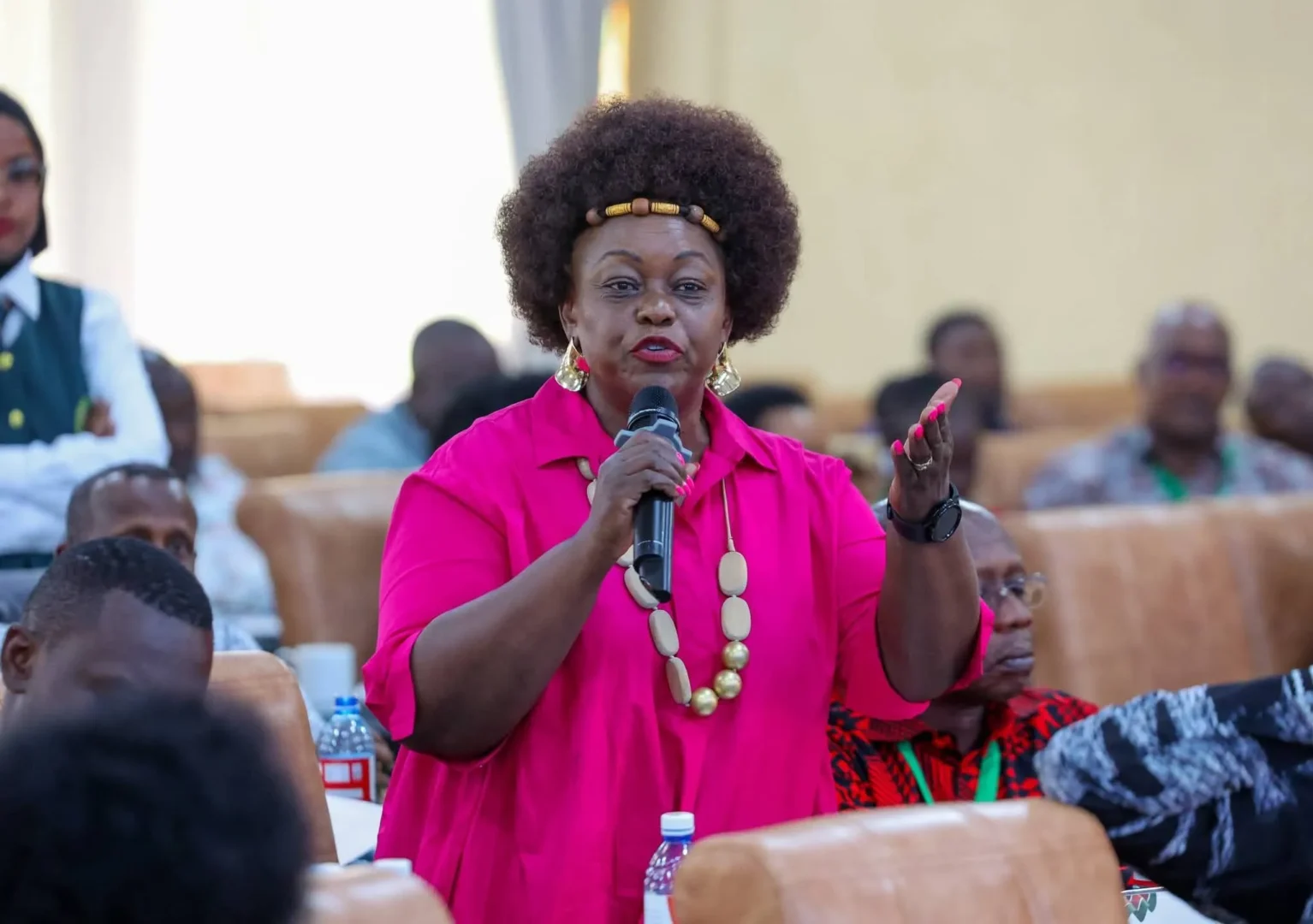
NAIROBI, Kenya — Suba North MP Millie Odhiambo has acknowledged that the Orange Democratic Movement (ODM) made a political miscalculation in its handling of Nairobi Senator Edwin Sifuna, warning that the fallout has left the party weakened and exposed divisions within its support base.
Odhiambo, who serves as the National Assembly Minority Whip, said ODM leaders effectively pushed Sifuna out of the party, turning him into a political casualty whose departure has since strengthened his appeal among sections of the electorate.
Her remarks offer a rare admission from within the party that its handling of the dispute may have damaged its political standing, particularly in Western Kenya, where ODM has traditionally enjoyed considerable support.
Speaking during an interview on a local podcast, Odhiambo suggested that Sifuna had taken a significant section of the party’s supporters with him, although she acknowledged that the precise size of that following was difficult to establish.
“We are the ones who pushed him out, made him a victim and the public accepted it. He’s gone with a third. I do not know whether it’s a third or whatever of the party of people who are supporting him,” she said.
Her assessment comes as Sifuna builds a political platform outside ODM through the Linda Mwananchi Movement (LMM), positioning himself as one of the emerging figures in the opposition’s preparations for the 2027 General Election.
The senator’s departure has therefore become more than an internal party disagreement. It has raised questions about ODM’s ability to retain influential figures, manage competing political interests and maintain its support among voters as the country approaches another election cycle.
Odhiambo warns ODM has lost ground in Western Kenya
Odhiambo was particularly critical of the party’s position in Western Kenya, describing its political standing in the region as seriously weakened.
She argued that ODM had failed to manage internal disagreements effectively, allowing differences that could have been resolved through engagement to develop into a wider political rupture.
“Western Kenya… ODM in Western Kenya is gravely wounded, and many parts of the country. ODM is gravely wounded. The areas that sometimes want to leave but we bring them back. But we handled things… not very well,” she said.
The remarks are significant because Western Kenya has long been an important part of ODM’s political base. Any sustained erosion of support in the region could complicate the party’s efforts to maintain its national influence ahead of 2027.
However, Odhiambo’s assessment should not be taken as evidence that a third of ODM’s supporters have formally defected. She herself expressed uncertainty about the size of Sifuna’s following, and the extent of any shift would need to be established through voter surveys, membership records and election results.
What her comments do establish is that some senior figures within ODM are concerned about the political consequences of the dispute.
Internal democracy under scrutiny after Raila Odinga’s death
Beyond Sifuna’s departure, Odhiambo raised concerns about the state of internal democracy within ODM following the death of its longtime leader, Raila Odinga.
She suggested that the party was becoming less tolerant of dissent, with members who question leadership decisions increasingly being encouraged to leave rather than allowed to challenge positions from within.
“The tragedy also is that our internal democracy is at its lowest, post-Baba. Everybody… when you say a different opinion… if you don’t want to leave… the word leave is very common. Very soon if we are not careful, you’ll just be saying ‘ODM, leave’,” she said.
Her criticism points to a difficult leadership transition for a party whose political identity and organisational cohesion were closely associated with Raila’s leadership for decades.
The challenge facing ODM is not simply replacing a prominent political figure. It is maintaining the structures, alliances and internal mechanisms that allowed the party to accommodate different political interests while retaining a common political identity.
The dispute over Sifuna has brought that challenge into sharper focus. If disagreements over the party’s relationship with President William Ruto’s broad-based government arrangement cannot be managed internally, ODM risks allowing political differences to develop into competing centres of influence.
For a party preparing for 2027, the ability to accommodate dissent could prove as important as its campaign strategy.
Oburu Oginga reportedly uncomfortable with Sifuna’s exit
Odhiambo also disclosed that ODM leader and Siaya Senator Oburu Oginga appeared to have reservations about the way the party handled Sifuna’s departure.
According to her account, Oburu did not necessarily agree with Sifuna’s political position but appeared uncomfortable with the decision to push him out.
“He said he doesn’t agree with Sifuna politically, but he seems to regret that we sent Sifuna away. The same thing I said: ‘Why are we hounding this young man out of the party?’ He brought strength to the party,” Odhiambo said.
The account suggests that disagreement over Sifuna’s political direction did not necessarily mean his continued presence in ODM was untenable.
Odhiambo argued that the party could have allowed the senator to criticise the government from within, particularly because ODM’s participation in the broad-based arrangement had created competing political expectations among its supporters.
Instead, she believes the leadership allowed the dispute to escalate until Sifuna became a rallying point for those dissatisfied with the party’s direction.
“Nobody gave him that chance. Now we have to deal with that,” she said.
Her remarks are particularly notable because they suggest that concern about the consequences of Sifuna’s departure extends beyond his political allies.
Sifuna takes Linda Mwananchi campaign to the United States
Since the fallout with ODM, Sifuna has become a leading figure in the Linda Mwananchi Movement, which is seeking to establish a broader political alternative ahead of the 2027 elections.
The Nairobi senator has also announced his intention to challenge President William Ruto, giving his political activities a national rather than purely party-based focus.
He is currently in the United States as part of a diaspora mobilisation tour that began on November 21 and is scheduled to conclude on December 7, 2026.
The programme includes engagements with Kenyans in New Jersey, Pennsylvania, Maryland, Washington DC, Texas, Seattle and California. Activities include town hall meetings, community gatherings, political discussions and business engagements.
Also Read: Millie Odhiambo says ODM attacks have elevated Sifuna into Ruto’s political league
The tour provides Sifuna with an opportunity to popularise the movement beyond Kenya, engage diaspora communities and strengthen networks ahead of the election campaign. It also places him among opposition figures seeking to build political support and resources outside the country’s traditional party structures.
However, the challenge for Sifuna will be translating public attention and diaspora enthusiasm into a sustainable political organisation with nationwide structures, a clear policy agenda and support across Kenya’s diverse voting blocs.
ODM faces a difficult political test ahead of 2027
Odhiambo’s intervention comes at a sensitive moment for ODM as it navigates questions about its leadership, political alliances and future relationship with the government.
The party’s participation in the broad-based government arrangement has created tensions among supporters who expected it to maintain a more confrontational opposition role.
Sifuna’s disagreement with that political direction has helped give the Linda Mwananchi Movement a distinct identity, particularly among those demanding stronger opposition oversight and accountability.
But the wider political consequences remain uncertain. ODM retains an established national organisation and political networks, while Sifuna’s emerging movement must demonstrate that it can build a durable alternative beyond the public profile of its leading figures.
For ODM, the immediate challenge is whether it can restore confidence among members who feel their views are no longer accommodated.
Odhiambo’s comments suggest that at least some within the party believe the handling of Sifuna’s exit was avoidable and politically costly.
As the 2027 election approaches, the dispute could become a defining test of whether ODM can preserve its unity after Raila Odinga’s death or whether internal divisions will reshape the opposition landscape.
