


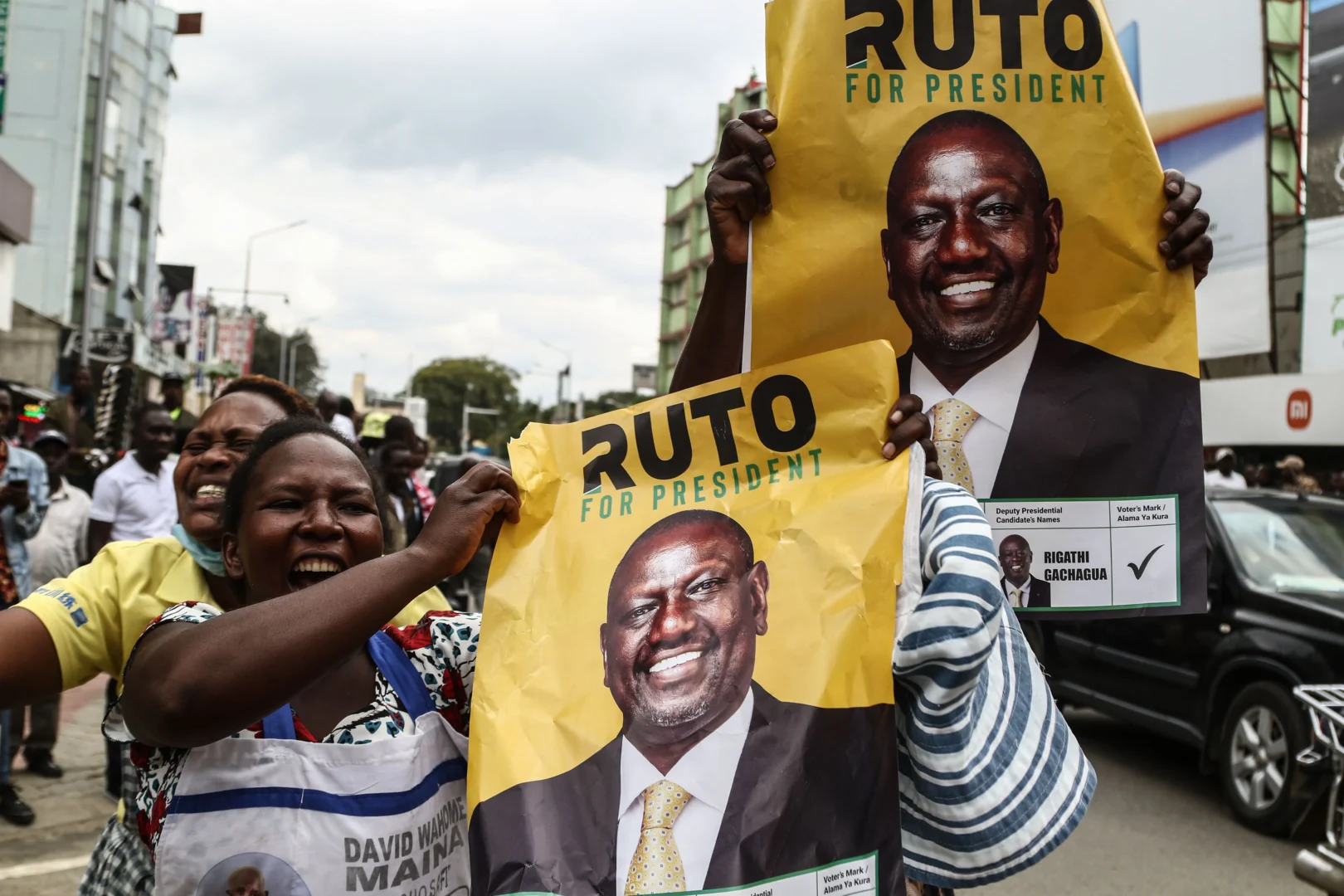
NAIROBI, Kenya — President William Ruto may have the advantage heading into Kenya’s August 2027 General Election, but securing another five years in State House could prove considerably more difficult than his supporters might expect.
With less than a year before Kenyans return to the ballot, the political landscape is taking shape around two competing forces: an incumbent determined to defend his record and an opposition increasingly aware that its best chance of defeating him lies in putting aside personal ambitions and building a common political front.
On paper, Ruto remains a formidable candidate. He commands the advantages of incumbency, an established political machinery, access to national campaigning platforms and a government capable of presenting its development record to voters.
However, elections are rarely decided by political machinery alone. They are also shaped by public confidence, household economic conditions, the credibility of competing candidates and the ability of political leaders to connect their promises with the everyday experiences of ordinary citizens.
That is where Ruto’s re-election campaign faces its biggest test.
The question is no longer simply whether the opposition can assemble enough political heavyweights to challenge the President.
It is whether those leaders can transform their growing cooperation into a credible national movement capable of persuading voters that a change of government would deliver something better.
Ruto’s incumbency advantage is real, but not guaranteed
Ruto enters the contest with an advantage that should not be underestimated.
Since taking office in September 2022, his administration has pursued an ambitious development programme centred on affordable housing, agricultural reforms, healthcare financing, education and infrastructure.
During his State of the Nation Address on November 18, 2026, the President used government achievements to make a case for another term, highlighting developments in agriculture, education, healthcare, housing and employment.
He also presented economic indicators and government programmes as evidence that his administration was moving the country in the right direction.
For an incumbent seeking re-election, such a record provides a political platform from which to campaign. Ruto can point to completed projects, ongoing investments and programmes that he argues require continuity.
His administration is also benefiting from a broad-based political arrangement involving the United Democratic Alliance (UDA) and sections of the Orange Democratic Movement (ODM).
That arrangement has complicated the traditional distinction between government and opposition politics, bringing former political rivals closer to the administration and potentially weakening the opposition’s ability to present itself as a unified alternative.
But incumbency is not an automatic guarantee of electoral victory.
The central weakness in Ruto’s political argument is the gap between government achievements and the economic experiences of many households.
The cost of living could become Ruto’s biggest political liability
For millions of Kenyans, the most important measure of government performance is not the number of projects announced during presidential tours. It is whether they can afford food, rent, transport, healthcare and education.
The cost of living remains a politically sensitive issue, particularly among households whose earnings have struggled to keep pace with rising expenses.
Recent economic reporting has highlighted pressure from fuel prices, food costs and transport charges.
The November 2026 inflation debate has therefore placed renewed attention on whether economic improvements claimed by the government are being felt beyond official statistics.
Youth unemployment and the difficulty of securing stable incomes also remain significant political concerns.
This creates a difficult contradiction for Ruto.
His administration can point to economic stabilisation, development investments and employment initiatives. Yet voters experiencing financial pressure may judge those achievements differently from the government’s presentation.
The President’s challenge is therefore not merely to defend his economic policies. It is to demonstrate that the policies are improving living standards in measurable ways before election day.
Opposition leaders are likely to exploit this disconnect, presenting the 2027 election as an opportunity for voters to reconsider the government’s economic priorities.
However, criticising Ruto’s record will not automatically make the opposition a credible alternative. It must explain how it would address the same economic problems without making promises that cannot be financed or implemented.
Opposition unity is becoming Ruto’s biggest political headache
Perhaps the most significant development in Kenya’s emerging 2027 political contest is the renewed determination among opposition figures to explore a common front.
Former Deputy President Rigathi Gachagua, Wiper leader Kalonzo Musyoka, Jubilee’s Fred Matiang’i, Nairobi Senator Edwin Sifuna, Narc Kenya’s Martha Karua, DAP-K leader Eugene Wamalwa and other political figures are part of an evolving opposition equation.
Their political interests are not identical, but they share an increasingly important objective: preventing Ruto from securing another term.
The involvement of different political personalities has given the opposition a broader political profile than a campaign built around a single regional power centre.
Gachagua brings considerable political influence in parts of the Mount Kenya region, while Kalonzo has an established political base in Ukambani.
Matiang’i is seeking to consolidate support in the Gusii region, while Sifuna has emerged as an influential voice among sections of younger voters and the Linda Mwananchi movement.
Karua and Wamalwa also bring political experience and established networks that could contribute to a wider national campaign.
If these political figures manage to coordinate their support, agree on a presidential candidate and develop a common policy programme, they could present Ruto with a substantially more difficult contest.
But political arithmetic is not the same as electoral reality.
The assumption that influential politicians can automatically transfer their supporters to a coalition candidate is one of the biggest risks facing the opposition.
Kenyans are not political possessions. Their voting decisions can change depending on the candidates, campaign messages, economic conditions and confidence in the alternatives being presented.
The opposition must therefore do more than bring prominent politicians into the same room. It must convince voters that their partnership represents a genuine political and policy agreement.
The opposition’s biggest weakness remains its competing ambitions
Despite growing cooperation, the opposition has yet to demonstrate that it can resolve its internal leadership disagreements.
The contest over who should carry the presidential ticket remains particularly sensitive.
Gachagua has repeatedly emphasised the importance of political numbers and grassroots mobilisation, while other leaders have cautioned against language that appears to reduce national leadership to ethnic voting blocs.
The disagreement became increasingly visible in November when Matiang’i and Democratic Party leader Justin Muturi criticised what they viewed as Gachagua’s approach to opposition negotiations.
The dispute exposed a deeper problem: opposition leaders may agree that Ruto should leave office, but they have not necessarily agreed on who should replace him or how power would be shared.
A November 12 TIFA Research survey, reported by the Daily Nation, found that 43 per cent of respondents identified Gachagua as the biggest obstacle to opposition unity. Ruto followed at 15 per cent, with Sifuna at seven per cent and Kalonzo at six per cent.
The findings are a warning that public expectations of unity are not necessarily matched by confidence in the politicians negotiating it.
Former President Uhuru Kenyatta has also publicly urged opposition leaders to put aside their differences and organise themselves around a common political objective.
His intervention is significant because it reflects the political pressure building around the opposition to move beyond consultations and demonstrate tangible progress.
There is a lesson in Kenya’s political history.
The National Rainbow Coalition (NARC) demonstrated in 2002 that previously competing political interests could unite behind a common presidential candidate and defeat a long-serving governing party.
However, replicating that success requires more than bringing together political personalities. It requires a workable coalition agreement, a credible candidate, grassroots coordination and a shared understanding of what happens if the alliance wins.
Without those elements, opposition unity could become another temporary arrangement held together by the desire to remove an incumbent rather than a commitment to govern together.
The Gen Z factor could disrupt traditional election calculations
Another important question is whether Kenya’s younger electorate will follow the political choices of established opposition leaders.
The political environment following the 2024 Gen Z-led protests demonstrated that young Kenyans could mobilise around issues beyond traditional party loyalties and ethnic political affiliations.
Their grievances brought taxation, accountability, governance, unemployment and the cost of living into the centre of national debate.
For Ruto, the challenge is that some of the issues raised during that period remain relevant to the country’s political conversation.
For the opposition, however, the opportunity is not guaranteed.
Younger voters may be dissatisfied with the administration, but dissatisfaction with one government does not necessarily translate into support for politicians who have been part of Kenya’s established political system.
The opposition must demonstrate that it understands the concerns of younger Kenyans and is prepared to offer more than familiar political personalities and election-season promises.
A campaign built around accountability, economic opportunity, constitutional rights, job creation and responsible public spending could attract wider interest.
But if opposition leaders concentrate primarily on negotiating positions and dividing political territories, they risk losing voters whose priorities extend far beyond the presidential contest.
Ruto could benefit if the opposition fails to settle on one candidate
The incumbent’s strongest opportunity may ultimately come from the opposition’s inability to agree on a common presidential candidate.
A divided opposition would give Ruto a significant advantage by splitting votes among competing candidates and weakening the possibility of a coordinated national challenge.
The President also has an opportunity to consolidate support in regions where his administration retains influence while expanding political relationships in areas traditionally associated with opposition parties.
The broad-based arrangement with ODM is particularly important in this calculation because it complicates the opposition’s efforts to build a straightforward anti-government coalition.
However, the arrangement also carries political risks.
Some voters may interpret the cooperation as an attempt to broaden national representation, while others may see it as a weakening of opposition accountability.
The TIFA findings reported in November indicated that 43 per cent of respondents opposed the broad-based arrangement, compared with 32 per cent who supported it.
That suggests the arrangement has not yet secured overwhelming public approval and could become an issue in the campaign.
Ruto must therefore demonstrate that political cooperation is delivering tangible national benefits rather than simply expanding the government’s political base.
What could actually decide the 2027 election?
Three issues could prove decisive.
First, the economy. Voters will assess whether their living standards have improved, whether employment opportunities have expanded and whether government policies have made essential goods and services more affordable.
Second, opposition unity. The ability of opposition leaders to settle on a credible presidential candidate without alienating important political constituencies could determine whether they emerge as a serious electoral threat.
Third, public trust. Kenyans will want to know which leaders can be trusted to protect public resources, respect constitutional institutions, uphold accountability and govern in the interests of the wider population.
Also Read: Ruto’s unfulfilled promises put his 2027 re-election bid under pressure
The integrity of the electoral process will also matter. Confidence in the Independent Electoral and Boundaries Commission (IEBC), transparent vote management and credible dispute-resolution mechanisms will be essential to ensuring that the contest is accepted as legitimate.
Neither side should assume that political popularity automatically translates into votes.
Ruto must defend his record, while the opposition must prove that it has the leadership, organisation and policy capacity to govern.
Is Ruto heading for a second term, or could Kenya be approaching a political upset?
At this stage, Ruto remains a formidable contender for the 2027 presidency, and his incumbency gives him an advantage that opposition leaders cannot afford to underestimate.
But describing his re-election as inevitable would be premature.
The opposition is showing greater willingness to coordinate, political alliances are evolving and public dissatisfaction over economic and governance issues continues to create opportunities for an alternative political message.
A recent TIFA presidential preference finding reported by Vellum on November 20 placed Ruto and Sifuna jointly at 31 per cent, with Ruto improving from 24 per cent in June and Sifuna rising from 15 per cent. Although one opinion poll cannot determine an election outcome, the findings illustrate why the President cannot assume that the opposition lacks competitive figures.
The coming months will reveal whether the opposition can convert its political meetings into a functioning coalition or whether competing presidential ambitions will once again undermine its efforts.
Ultimately, the 2027 election may be less about which political leader commands the loudest crowds and more about which side understands the priorities of ordinary Kenyans.
Ruto has the machinery, the advantage of incumbency and a record he believes deserves another mandate.
His opponents have an opportunity to build a formidable coalition, but they must overcome personal ambitions, regional rivalries and questions about their own credibility.
The biggest question facing Kenya is no longer whether Ruto can win another term. It is whether the opposition can organise itself well enough to make voters seriously consider an alternative.
If it cannot, Ruto’s path to a second term could become considerably easier. If it can, the 2027 election could develop into one of the most competitive political contests of his presidency.
