


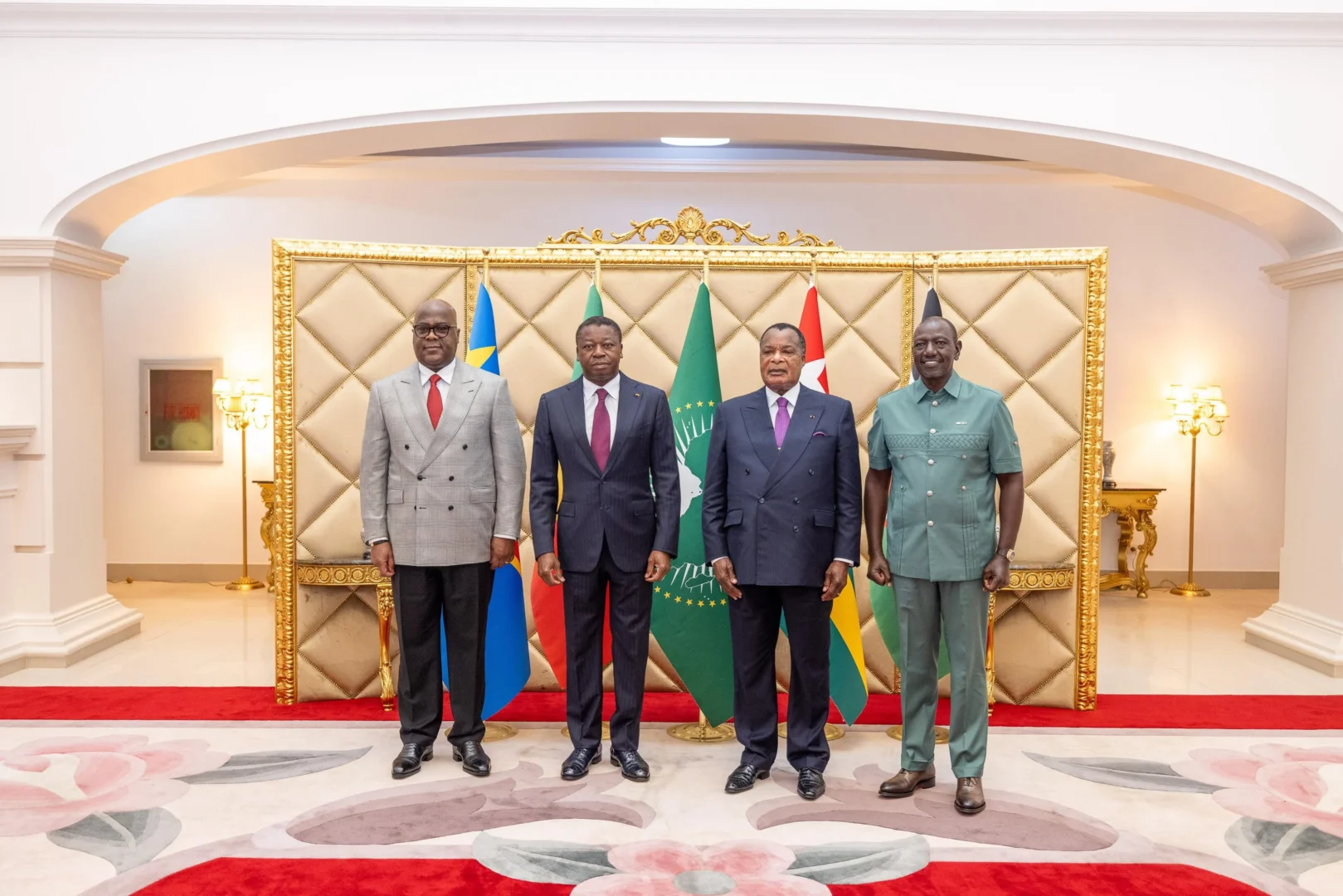
OYO, DR Congo — Kenya and the Democratic Republic of Congo (DRC) have taken a significant step towards repairing strained diplomatic relations after Presidents William Ruto and Félix Tshisekedi agreed to pursue the restoration of ambassadorial representation following nearly three years of disagreements over the conflict in eastern Congo.
The breakthrough followed a high-level meeting in Oyo, Republic of the Congo, on Sunday, November 22, 2026, where the two leaders committed to rebuilding trust, strengthening bilateral cooperation and resolving future disputes through diplomatic channels.
The meeting was held during a Quadripartite Summit convened by Republic of the Congo President Denis Sassou Nguesso, with Togo’s President of the Council of Ministers, Faure Essozimna Gnassingbé, participating as the African Union-appointed mediator in the eastern DRC conflict.
In a joint communiqué, Ruto and Tshisekedi reaffirmed their commitment to respecting national sovereignty, territorial integrity and the principle of non-interference in the internal affairs of other states.
They also agreed to prioritise dialogue, good neighbourliness and peaceful dispute resolution while strengthening cooperation through regional and continental institutions.
A central commitment was the return of ambassadors to Nairobi and Kinshasa, signalling an effort to restore normal diplomatic representation after a prolonged period of strained relations.
However, the agreement does not mean ambassadors have already returned. The leaders committed to pursuing the restoration of diplomatic representation, although no specific timetable was announced.
How the M23 conflict strained Kenya-DR Congo relations
The diplomatic fallout between Nairobi and Kinshasa dates back to December 2023, when the Congolese government recalled its ambassador to Kenya following the launch of the Congo River Alliance (AFC) in Nairobi.
The alliance, announced by former Democratic Republic of Congo electoral commission president Corneille Nangaa, brought together several Congolese armed and political groups, including the M23 rebel movement.
Kinshasa objected to Nairobi hosting the launch, accusing Kenya of providing a platform for individuals and groups seeking to destabilise the Congolese government.
Kenya, however, maintained that it could not restrict political expression through its territory.
The disagreement placed Nairobi in a delicate diplomatic position, particularly because Kenya had previously played a prominent role in regional efforts to address insecurity in eastern Congo.
Relations deteriorated further in 2025 when Kenya nominated a consul-general to Goma, the capital of North Kivu province, after the city fell under M23 control in January that year.
Kinshasa strongly objected to the appointment, arguing that establishing diplomatic representation in territory controlled by the rebels risked legitimising their occupation and undermining the country’s territorial integrity.
The dispute also involved Kenya’s proposed ambassador to Kinshasa, whose accreditation was not accepted by the Congolese government.
Tensions were further aggravated in October 2025 when Kenya hosted a meeting of Congolese opposition figures, including former President Joseph Kabila.
Kabila subsequently became associated with a new political-military coalition that emerged from the AFC, deepening Kinshasa’s concerns about the activities of Congolese political figures operating from outside the country.
The latest agreement therefore addresses a diplomatic dispute rooted in the wider conflict over political authority, territorial control and the future of eastern Congo.
Why restoring diplomatic relations matters to East Africa
The agreement carries significance beyond the relationship between the two presidents.
Kenya and the DRC are members of the East African Community (EAC), a regional bloc whose integration agenda depends on cooperation among member states in trade, security, infrastructure and cross-border movement.
DR Congo joined the EAC in March 2022, expanding the bloc’s economic reach into Central Africa and creating additional opportunities for regional commerce.
However, the conflict in eastern Congo has complicated regional cooperation, particularly because of competing positions among neighbouring countries over the M23 rebellion and allegations of external support for armed groups.
Rwanda has repeatedly denied allegations that it backs M23, while the conflict has continued to attract regional and international diplomatic attention.
For Kenya, maintaining constructive relations with Kinshasa is important given its economic and diplomatic interests across the Great Lakes region.
The DRC also represents a significant market for Kenyan businesses, while the port of Mombasa serves as an important trade gateway for goods destined for several landlocked countries in the region.
Restoring ambassadorial relations could therefore improve diplomatic coordination, support commercial engagement and create channels for addressing disagreements before they escalate into wider disputes.
The two presidents also committed to strengthening cooperation through the International Conference on the Great Lakes Region (ICGLR), which provides a regional framework for addressing peace and security challenges.
Ruto and Tshisekedi agree to deepen trade and economic cooperation
Beyond resolving diplomatic differences, the Oyo discussions focused on expanding economic cooperation and strengthening regional integration.
The two leaders agreed to pursue closer collaboration in trade, economic development, security and cultural relations.
They also committed to resuming the Joint Grand Commission for Cooperation, a bilateral framework intended to coordinate engagement between the two governments.
Regular diplomatic consultations were identified as another important mechanism for preventing misunderstandings and resolving future disagreements.
The commitments could provide fresh opportunities for businesses operating between the two countries, particularly in trade, transport and investment.
However, their impact will depend on whether the governments translate the summit’s declarations into practical arrangements, including the return of ambassadors and the resumption of bilateral cooperation mechanisms.
Ebola outbreak adds urgency to regional cooperation
The summit also addressed the worsening Ebola outbreak in the DRC, with the two presidents calling for stronger cooperation among countries to contain the epidemic.
The health emergency has become an increasingly important regional concern because of population movement, cross-border trade and the risk of infections spreading beyond affected communities.
According to the World Health Organization (WHO), the outbreak of Bundibugyo virus disease had resulted in 11,613 confirmed cases and 5,678 deaths in the DRC as of November 17, 2026.
The outbreak had spread across 68 health zones in eight provinces, with Ituri and North Kivu among the most affected areas.
The WHO has maintained that insecurity remains a major obstacle to containing the disease, with violence disrupting surveillance, treatment and other response operations.
On Sunday, WHO Director-General Tedros Adhanom Ghebreyesus warned that intensified fighting in eastern Congo was seriously affecting efforts to contain the epidemic.
He said clashes near a hospital in Ituri province had forced health workers and humanitarian partners to shelter inside a maternity ward for more than 24 hours.
The fighting occurred close to the area where the outbreak first emerged, placing patients, medical personnel and their families at risk.
The security situation presents a serious challenge because effective Ebola control depends on timely case detection, contact tracing, treatment, infection prevention and cooperation with affected communities.
Kenya has also experienced cases linked to the outbreak. However, the WHO reported that the country had recorded no new confirmed infections since October 19 and had begun a 42-day countdown towards declaring the end of its outbreak after discharging its last confirmed patient on November 11.
Also Read: Kabila faces backlash as former allies reject new rebel coalition in DR Congo
Nigeria also reported an imported case, but its identified contacts completed the required 21-day follow-up period without confirmed secondary transmission. Uganda’s outbreak had been declared controlled in August.
The developments underline the importance of regional surveillance, information sharing and coordinated public health preparedness even as individual countries approach the end of their outbreaks.
A diplomatic breakthrough, but implementation remains the test
The Oyo agreement provides an opportunity for Kenya and the DRC to move beyond years of diplomatic disagreements and rebuild cooperation around shared regional interests.
For Ruto and Tshisekedi, the immediate challenge will be demonstrating that their commitments can translate into concrete diplomatic and economic outcomes.
The return of ambassadors, resumption of bilateral consultations and revival of the Joint Grand Commission will be important indicators of whether relations are genuinely improving.
The wider security situation in eastern Congo will also remain a major factor, particularly as regional governments continue to navigate disagreements over the M23 rebellion and the involvement of neighbouring states.
Ultimately, restoring diplomatic ties between Nairobi and Kinshasa could strengthen cooperation within the Great Lakes region, but lasting progress will depend on more than statements of goodwill.
The two governments must demonstrate that mutual respect, territorial sovereignty and regional cooperation can guide their engagement even when disagreements over security and political interests emerge.
