


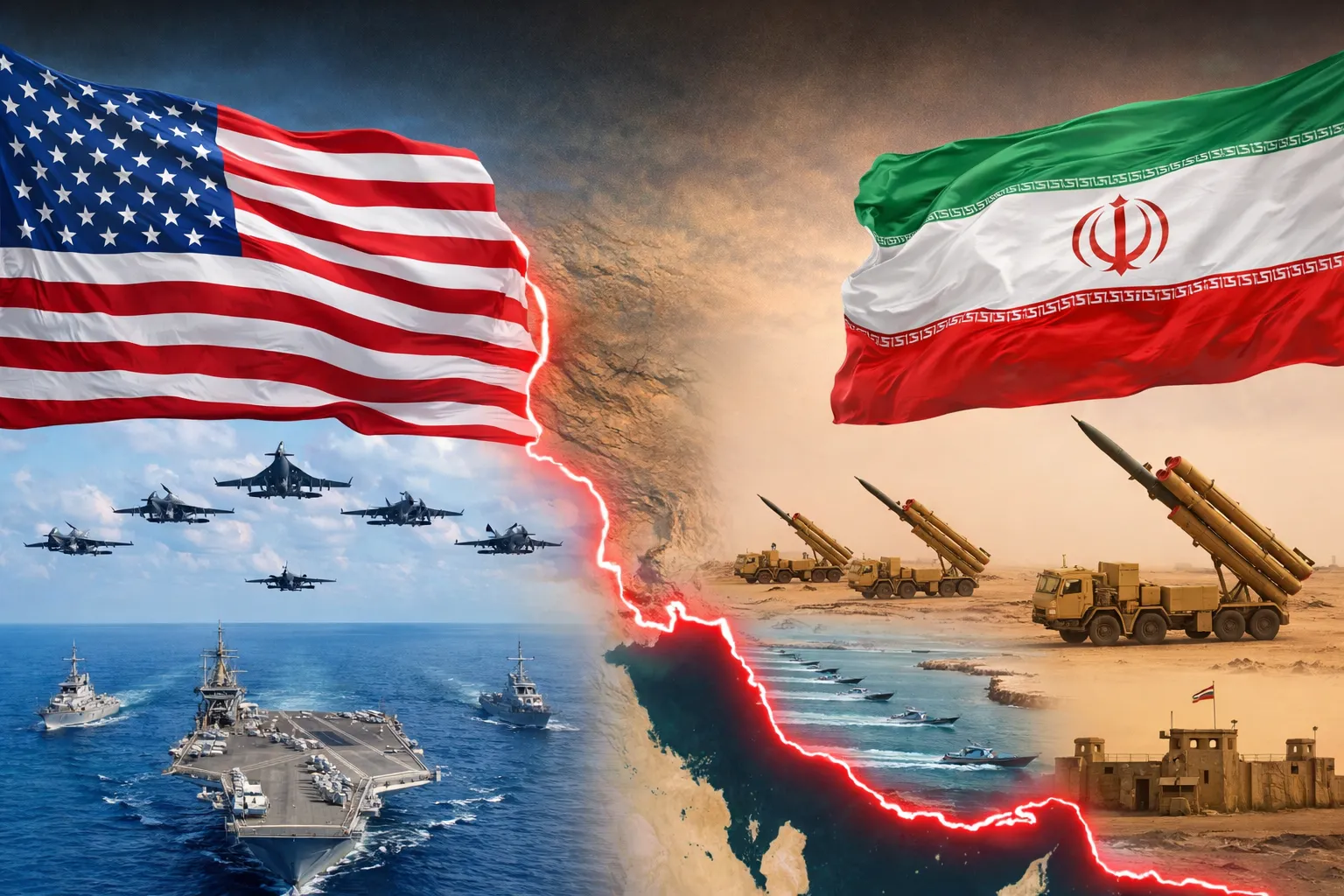
WASHINGTON, D.C., United States — For a month, the ceasefire held. It was fragile, uneasy and punctuated by mutual accusations, but it offered a glimpse of something the Middle East has struggled to find in recent years: a pause.
That pause now appears over.
Eight consecutive nights of American airstrikes inside Iran, retaliatory Iranian attacks across the Gulf, rising military casualties and growing threats to one of the world’s most important energy corridors have pushed the conflict back toward a trajectory many regional leaders had hoped to avoid.
The immediate trigger was deadly.
The United States confirmed that two American service members were killed and another remains missing after an Iranian attack in Jordan. Within hours, Washington launched another round of strikes against Iranian military infrastructure, marking the eighth straight night of operations.
But the significance of the latest escalation extends far beyond the battlefield.
What began as a confrontation between Washington and Tehran is increasingly becoming a regional conflict touching multiple countries, strategic military installations and the global economy itself.
The end of a brief pause
The collapse of the ceasefire has exposed how little trust existed between the two sides.
A month ago, diplomats hoped the temporary agreement might create space for broader negotiations following weeks of fighting triggered by U.S. and Israeli strikes targeting Iran’s nuclear and missile infrastructure.
Instead, the ceasefire appears to have functioned more as a tactical pause than a political breakthrough.
When violence resumed, it did so with greater intensity.
According to U.S. Central Command, the latest American strikes targeted Iranian coastal surveillance systems and air-defence facilities.
“The strikes are designed to further degrade Iran’s ability to threaten commercial shipping in the Strait of Hormuz and swiftly punish Islamic Revolutionary Guard Corps forces who launched attacks against American service members in Jordan last night,” the command said.
Iranian media reported strikes near Sirik in southern Iran and around Shadegan close to the Iraqi border.
Iran responded with drone attacks targeting American military facilities in Kuwait, according to Iranian state television.
The exchange underscored a reality increasingly recognised by military analysts: neither side appears willing to de-escalate without first demonstrating strength.
A conflict no longer confined to Iran
Perhaps the most important development is geographical.
The US-Iran conflict is no longer centred exclusively on Iranian territory.
Military installations and strategic assets across the Gulf region have increasingly found themselves within the conflict’s expanding orbit.
Iranian media reported attacks against U.S. facilities in Kuwait, Bahrain and Jordan.
Saudi Arabia’s missile warning systems were also activated, triggering shelter alerts in areas associated with military and energy infrastructure.
While several claims made by Iranian state media remain independently unverified, the broader pattern is clear.
The US-Iran conflict is spreading across a region that hosts some of the world’s most important military bases, energy facilities and shipping routes.
Security analysts have long warned that any prolonged confrontation between Washington and Tehran would likely involve neighbouring states, many of which host American military personnel while simultaneously seeking to avoid direct involvement in the conflict.
That scenario now appears increasingly difficult to avoid.
Why the Strait of Hormuz matters
At the centre of the confrontation lies a narrow waterway that carries enormous global significance.
The Strait of Hormuz connects the Persian Gulf to international shipping lanes and handles roughly one-fifth of the world’s oil supply.
For decades, the strait has been viewed as one of the most strategically sensitive maritime chokepoints on Earth.
Any disruption there can rapidly affect global energy markets.
American officials argue their military operations are intended to protect freedom of navigation and prevent Iranian interference with commercial shipping.
Iran sees the situation differently.
Iranian Foreign Ministry spokesperson Esmaeil Baghaei accused Washington of seeking greater control over the strait and using military pressure to shape regional shipping dynamics.
The dispute illustrates why the conflict carries implications far beyond the Middle East.
Every escalation in the Strait of Hormuz immediately attracts attention from energy traders, governments and central banks worldwide.
Even temporary disruptions can influence fuel prices, inflation expectations and economic planning across continents.
The human cost continues to rise
Amid the geopolitical calculations, casualty figures continue to climb.
The Pentagon says the latest deaths bring the number of American service members killed since the conflict began to sixteen, with more than 420 wounded.
Iran’s Health Ministry, meanwhile, says at least 50 people have been killed and more than 500 injured during American strikes over the past three weeks.
As in most modern conflicts, independent verification of battlefield casualty claims remains difficult.
Yet regardless of whose figures prove most accurate, the trend points in one direction.
The human cost is rising.
That reality complicates diplomatic efforts because every new casualty creates additional domestic pressure on leaders to respond rather than compromise.
The search for deterrence
Much of the current escalation reflects a classic problem in international security.
Both sides are attempting to deter future attacks while avoiding a full-scale war.
The challenge is that deterrence often requires visible action.
Each military response is designed to convince the other side that further escalation will be costly.
Yet each response can also create incentives for retaliation.
The result is a cycle in which actions intended to prevent wider conflict can unintentionally increase its likelihood.
Statements from both governments suggest neither side currently believes restraint would serve its strategic interests.
U.S. Defence Secretary Pete Hegseth captured Washington’s mood when he wrote on X:
“Their sacrifice only stiffens our resolve.”
Iran’s leadership delivered a similarly defiant message.
In a statement published through official channels, Supreme Leader Ayatollah Mojtaba Khamenei said American actions demonstrated that President Donald Trump’s signature was “utterly worthless and devoid of credibility.”
The statement warned of “even heavier costs and further humiliation” for the United States.
Neither message sounded like an invitation to compromise.
A region holding its breath
The growing concern among regional governments is that the conflict may be entering a phase where events become increasingly difficult to control.
Many Gulf states have spent years attempting to balance security partnerships with the United States against the need to maintain workable relations with Iran.
A prolonged regional conflict threatens that balancing act.
It also threatens economic ambitions that depend on stability, investment and uninterrupted energy exports.
Also Read: US House votes to limit Trump’s military action in Iran
The European Union and Gulf governments have already called for attacks on shipping and maritime navigation to cease immediately.
Whether those appeals influence decision-making in Washington or Tehran remains uncertain.
More than a US-Iran conflict
What is unfolding today is no longer simply a dispute between two adversaries.
It has become a contest over regional influence, military credibility, maritime security and economic stability.
The fighting has already reached multiple countries.
The world’s energy markets are watching the Strait of Hormuz with increasing anxiety.
Military casualties continue to mount.
And the ceasefire that once offered a path away from confrontation now appears increasingly distant.
For now, both sides insist they are responding to aggression rather than seeking war.
History suggests that distinction can become difficult to maintain once conflicts begin expanding beyond their original boundaries.
The greatest danger may no longer be a deliberate decision to widen the war.
It may be the possibility that events widen it on their own.
