


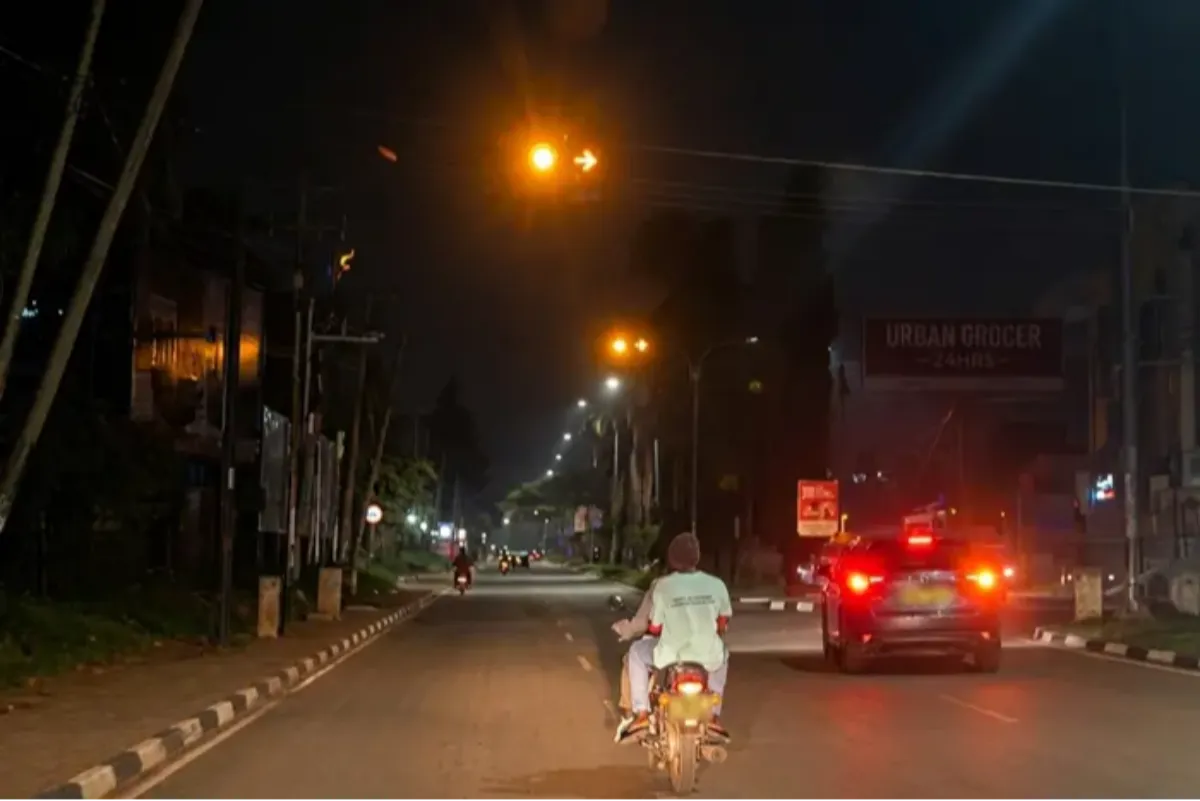
KAMPALA, Uganda — Motorists driving through Kampala late at night may have noticed a significant change at some of the city’s busiest intersections: traffic lights that would ordinarily cycle through red, amber and green are now flashing amber instead.
The Ministry of Works and Transport says the move is a deliberate traffic management and security measure aimed at improving traffic flow during low-volume hours while reducing the risk of robberies and attacks targeting motorists forced to stop at deserted junctions.
The new system has already been rolled out along several major roads, including sections of the Lugogo Bypass and the Kampala Northern Bypass, particularly after 11pm when traffic volumes significantly decline.
Why the change?
According to transport officials, the decision was informed by growing concerns over criminal incidents reported at signal-controlled intersections during late-night hours.
Motorists travelling through Kampala at night have long complained about being forced to stop at red lights even when roads are virtually empty, leaving them vulnerable to criminals who take advantage of isolated locations and reduced police visibility.
Ministry spokesperson Allan Ssempebwa Kyobe said the flashing amber lights are intended to allow cautious movement through junctions without completely removing traffic control measures.
“Flashing amber lights – you will find this along Lugogo Bypass, Kampala Northern Bypass and other major roads, especially beyond 11pm,” Ssempebwa said.
“A flashing amber light does not mean ‘go carelessly’. Motorists should slow down, assess the environment and proceed with caution.”
He explained that the arrangement helps maintain traffic movement during periods when vehicle numbers are low while still requiring drivers to remain alert.
Security concerns behind the decision
The Ministry’s Commissioner for Transport Regulation and Safety, Winstone Katushabe, said the policy emerged following consultations involving the Ministry of Works and Transport, Kampala Capital City Authority (KCCA) and the Uganda Police Force.
Katushabe said authorities recognised that criminals were increasingly targeting motorists who had no option but to stop at red lights during late-night hours.
“As part of traffic management, between around 4pm and 11pm many people are driving home. Criminals tend to target drivers at traffic lights because they stop at red lights even when there is nobody else on the road,” Katushabe said.
“That is when thieves pounce, break into vehicles and rob motorists.”
According to the commissioner, authorities agreed that maintaining normal traffic-light operations throughout the night was creating unnecessary risks in areas with minimal traffic.
“We discussed the matter with KCCA and the police and agreed that some of these lights should switch to flashing mode during low-traffic hours,” he said.
“We cannot leave drivers exposed. The lights will flicker to allow traffic to flow, and then normal operations resume in the early morning.”
What does a flashing amber light mean?
Transport authorities stress that the new arrangement should not be interpreted as permission to speed through intersections.
Under Uganda’s traffic regulations, a flashing amber signal requires motorists to:
- Slow down before entering the junction.
- Carefully assess traffic conditions.
- Give way where necessary.
- Proceed only when it is safe to do so.
- Remain alert for pedestrians, motorcycles and other road users.
Failure to exercise caution could still result in collisions and traffic offences.
Cameras remain operational
Officials have also clarified that the switch to flashing amber lights does not suspend electronic traffic enforcement.
Katushabe noted that surveillance cameras installed at many junctions will continue monitoring motorists and recording violations.
“But the camera system remains operational and will still catch motorists who are overspeeding or violating traffic regulations,” he said.
Also Read: Kampala ranked most polluted major city in the world
This means drivers could still face penalties for dangerous driving despite the altered traffic-light sequence.
Balancing road safety and security
The initiative reflects a broader effort by Ugandan authorities to strike a balance between road safety, efficient traffic management and public security.
While traffic lights are designed to regulate vehicle movement and prevent accidents, officials argue that rigid enforcement of red-light stops during periods of extremely low traffic can inadvertently expose motorists to crime.
The ministry says the flashing amber system will continue to be monitored, with authorities assessing its effectiveness in improving safety and reducing incidents at vulnerable intersections.
For now, motorists travelling through Kampala at night are being advised to remain vigilant, obey the flashing amber signals and remember that caution—not speed—remains the guiding principle of the new system.
