


KAMPALA, Uganda — In May 2006, renowned Ugandan journalist and researcher Timothy Kalyegira posed a question that, even years later, refuses to lose its edge: “What puzzles you most about Africans?”
It was the kind of question that invites discomfort rather than consensus. A Daily Monitor columnist, Asuman Bisiika, offered a response that has since echoed through debates on governance and development across the continent.
“The lack of appreciation of contemporary statehood.”
Fast forward to 2026, Timothy Kalyegira observes: “We still do not have a clear grasp of what a modern state is.”
That statement, stripped of context, can sound sweeping, even unfair. But taken seriously, it opens a deeper and more uncomfortable conversation: not about identity, but about institutions; not about culture, but about the state itself.
The modern state is not a feeling
To understand the weight of Mr Bisiika’s claim, one must first confront what political theory actually means by a “modern state.”
In the Weberian tradition of political science, the state is not symbolic—it is structural. It is defined by institutions that function predictably, enforce rules uniformly, and maintain a monopoly over legitimate authority within a territory.
Or, more simply, a modern state is not built on personality, goodwill, or improvisation. It is built on systems that outlive leaders.
Yet across much of post-colonial Africa, the state is still often experienced differently: not as an impersonal institution, but as a presence that is negotiated, accessed, or avoided depending on circumstance.
The result is a persistent tension between the formal state on paper and the state as lived reality.
When the State becomes personal
One of the most consistent themes in African political sociology is the personalisation of institutions.
Where the modern state is expected to be impersonal, many citizens instead encounter it through individuals—an official who “helps,” a connection who “pushes,” a gatekeeper who “facilitates.”
This is not merely corruption in the narrow sense. It is deeper than that. It reflects what scholars describe as hybrid governance, where formal institutions coexist with informal networks of influence.
In such systems, the state does not disappear. It fragments.
And when institutions fragment, trust does not automatically transfer to the system, it transfers to relationships.
The colonial architecture still casts a long shadow
Any serious analysis must return to history.
Many African states did not evolve gradually through centuries of institutional consolidation. They were largely inherited as administrative structures designed for control, extraction, and order—rather than participation or citizenship.
The post-independence state was therefore tasked with a contradiction: to become democratic systems built on administrative frameworks originally designed for command.
Political historian Mahmood Mamdani has long argued that this produced a “bifurcated state”—one that governs differently in urban administrative centres compared to rural localities, where customary authority still shapes everyday life.
“The post-colonial state was never a blank slate—it was a repurposed machine,” as one governance scholar puts it.
That machine has been modified over time, but not fully rebuilt.
Why the State still feels distant
The criticism that Africans lack appreciation of “contemporary statehood” can be provocative precisely because it shifts responsibility onto citizens. But there is another side to the argument that cannot be ignored.
A state is not only defined by what it claims to be. It is defined by what it consistently delivers.
Where public services are uneven, where institutions are slow or selective, and where enforcement is inconsistent, citizens do not necessarily reject the state, they adapt to it.
They learn how to navigate it rather than rely on it.
In such environments, the question is not whether people understand the state. It is whether the state consistently presents itself as one entity or many competing ones.
Identity, loyalty and the politics of survival
The debate also intersects with identity, often the most sensitive layer of governance discourse.
In many societies, political and economic survival is still mediated through identity-based networks: ethnic affiliation, regional belonging, religious communities, or patronage structures.
These networks are not inherently negative. In fact, they often provide security where formal systems are weak.
But they do create an alternative logic of trust, one that competes with institutional trust.
When citizens trust networks more than systems, the state becomes one option among many—not the default authority.
This is where the idea of “contemporary statehood” becomes contested. Not because it is rejected, but because it is constantly negotiated.
The State that promises more than it delivers
Modern African governments operate under extraordinary pressure: rapid urbanisation, youthful populations, debt constraints, climate vulnerability, and global economic dependency.
They are expected to deliver services at the level of industrialised states while operating within structural limitations that are often far more restrictive.
This creates what development economists describe as a capacity gap, a widening distance between what the state promises and what it can reliably deliver.
In that gap, perception becomes reality.
And perception is shaped not by policy documents, but by daily experience: roads that remain unfinished, hospitals that lack supplies, schools that stretch resources, and bureaucracies that demand patience more than efficiency.
Is the puzzle really about Africans?
There is a risk in framing the question as Mr Kalyegira did: What puzzles you most about Africans?
It can unintentionally suggest that the subject of inquiry is culture or character. But a more rigorous reading shifts the focus elsewhere.
The real puzzle may not be Africans at all.
It may be the uneven evolution of the post-colonial state under global pressure, historical inheritance, and internal contradiction.
The question is less “What is wrong with Africans?” and more “What kind of state is still being formed here?”
That distinction matters.
An unfinished State, not a broken one
What emerges from this debate is not a portrait of dysfunction, but of transition.
The African state is not absent. It is not static. It is not complete.
Also Read: Ugandan opposition, activists would lose foreign funding if rights abuses ended, says Kalyegira
It is still being assembled—through reform, contestation, institutional learning, and political struggle.
And in that sense, Mr Bisiika’s claim can be read less as an indictment and more as an observation of timing: that the idea of the modern state has been adopted faster than it has been fully institutionalised.
The real question going forward
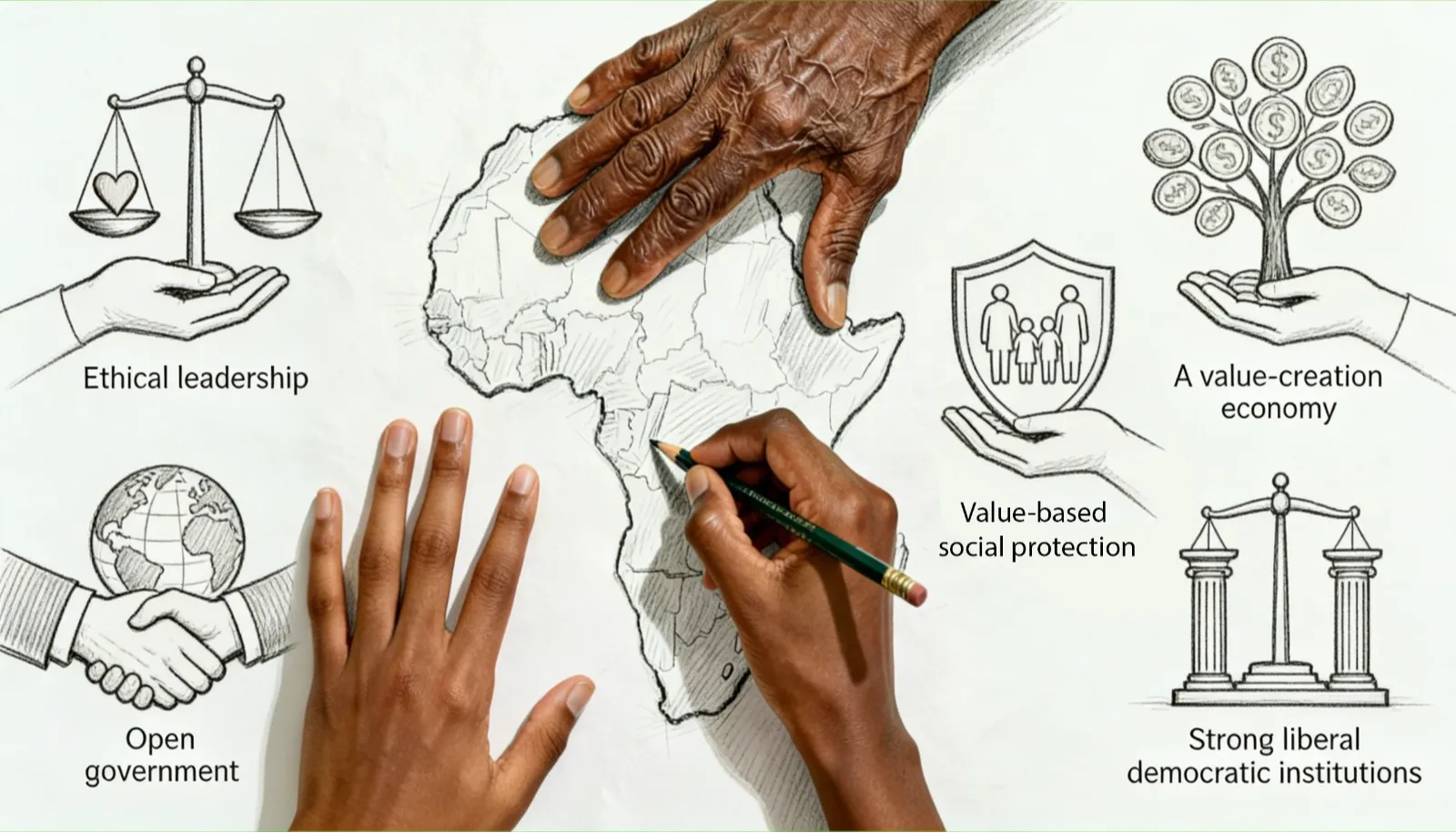
If there is one lesson from this long-running debate, it is that the most important questions are no longer about identity, but about design.
How do states become predictable rather than personal? How do institutions outlast leaders? How does trust shift from networks to systems? And how does governance evolve from management to legitimacy?
Those are not rhetorical questions.
They are the unfinished work of state-building.
And perhaps, that is what still puzzles—not Africans—but the modern state itself.
