


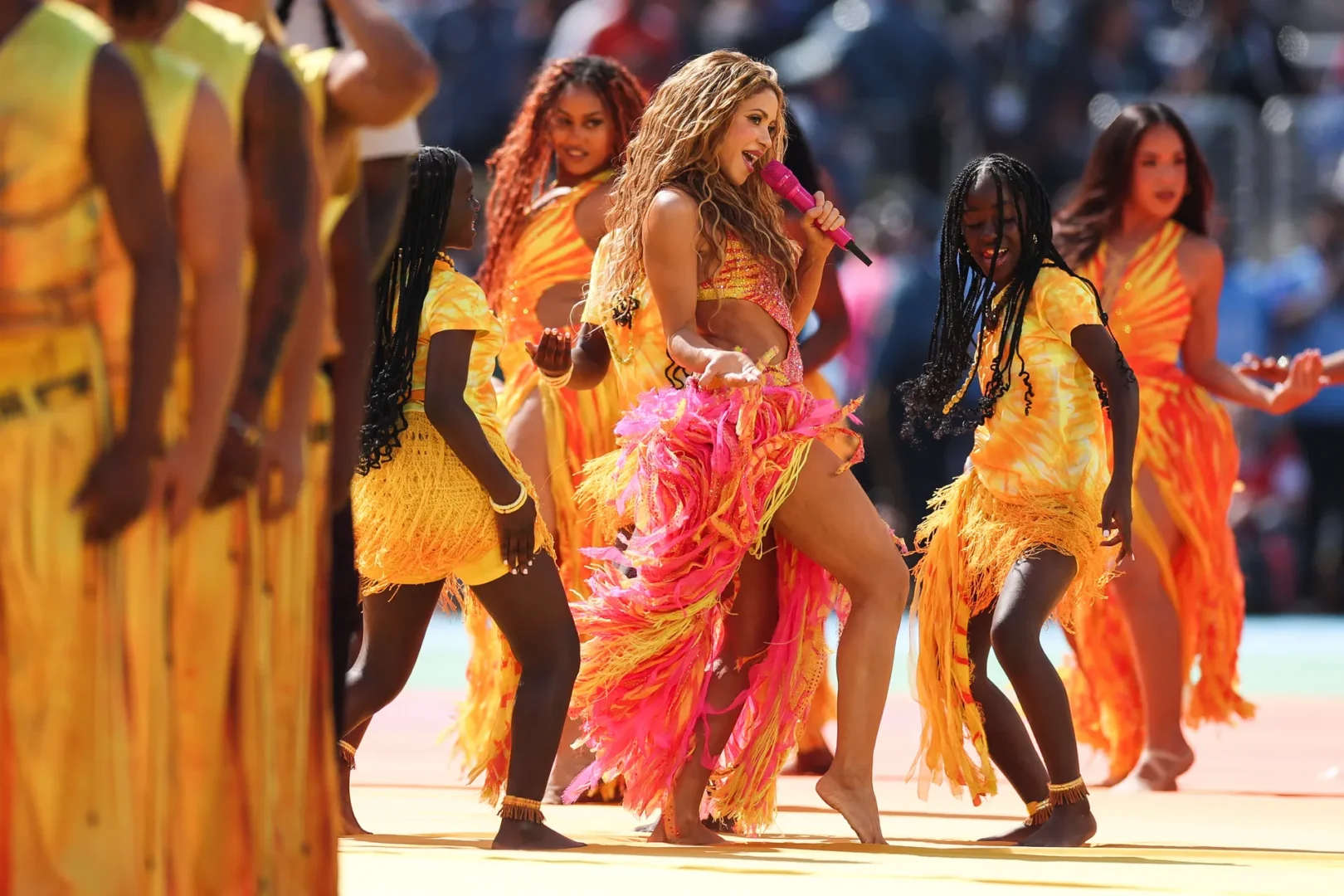
NEW JERSEY, United States — For decades, the World Cup final has been football’s grandest stage. On Sunday night in New Jersey, however, the sport briefly stepped aside as FIFA transformed the biggest match on earth into something else entirely: a global entertainment event designed to rival the Super Bowl and capture audiences far beyond the pitch.
As players disappeared into the dressing rooms with the World Cup final delicately poised, the spotlight shifted from football to pop culture. What followed was a 27-minute and 22-second production that FIFA described as the first full-scale World Cup half-time show of its kind — and the longest interval in the tournament’s history.
The performance was ambitious by any measure.
Madonna emerged as the headline act, appearing to rise from beneath the stadium before launching into her hit Music. Around her, dancers, giant stage structures and elaborate lighting transformed the arena into a temporary concert venue rather than a football stadium.
For FIFA, the show represented more than entertainment.
It was another step in the organisation’s long-term effort to turn football’s biggest tournament into a broader cultural event capable of attracting audiences that may never watch a qualifying match, understand an offside rule or care which nation eventually lifts the trophy.
The World Cup has always been a sporting competition. Increasingly, it is also becoming a global entertainment platform.
A tournament built around spectacle
The scale of Sunday’s production reflected how much the tournament has evolved.
For much of its history, World Cup finals were defined by football and little else. Opening and closing ceremonies existed, but they were secondary to the match itself.
Modern sport operates differently.
Football now competes not only with rival sports but with streaming services, social media platforms, video games and countless other forms of entertainment.
The result is an increasingly blurred line between sport, music and celebrity culture.
Sunday’s programme reflected that shift.
Justin Bieber joined the line-up alongside K-pop superstars BTS and Colombian singer Shakira. Nigerian artist Burna Boy reunited with Shakira to perform Dai Dai, a collaboration that has become one of the defining songs of the tournament after first appearing during the opening ceremony in Mexico City.
The choice of performers appeared carefully designed to mirror the tournament’s global reach.
North America was represented through Bieber and Jennifer Hudson. Latin America had Shakira. Africa had Burna Boy. Asia had BTS. Europe featured Robbie Williams and Italian singer Laura Pausini.
The message was unmistakable.
This was not merely a football final. It was a showcase aimed at every major audience demographic FIFA could reach.
The return of BTS
Among the most closely watched appearances was BTS.
The South Korean group has spent the past three years largely away from the spotlight as members completed mandatory military service.
Their appearance at the World Cup came amid an 85-date world tour and marked another major milestone in their return to international stages.
The reaction inside the stadium suggested football was, at least temporarily, sharing its audience.
While many supporters had arrived to watch Spain and Argentina contest football’s highest honour, thousands were equally eager to see one of the world’s biggest musical acts perform live.
The phenomenon highlights a reality increasingly shaping major sporting events: audiences are no longer attending for a single experience.
Many arrive expecting multiple forms of entertainment packed into one occasion.
From football to fundraising
The show also carried a philanthropic message.
Curated by Coldplay frontman Chris Martin, the production was linked to the FIFA Global Citizen Education Fund, an initiative seeking to raise $100 million (£73 million) for educational programmes benefiting children around the world.
It reflected a growing trend in modern sport, where governing bodies increasingly seek to attach social and charitable causes to marquee events.
Supporters watching from home saw more than performers and fireworks.
They saw football’s governing body attempting to position itself as a global institution with ambitions extending beyond sport.
Whether such efforts are viewed as genuine social engagement or corporate image-building remains a matter of debate.
A star-studded build-up
The entertainment began long before the half-time whistle.
Ahead of kick-off, Jennifer Hudson delivered the United States national anthem accompanied by a live band, while actor Tom Cruise provided one of the evening’s most dramatic introductions.
“From every corner of the globe, we have witnessed greatness, and we have shared in moments of joy,” Cruise told spectators.
“Football is a language spoken without words, a force that unites people.”
Elsewhere, streamer IShowSpeed made an appearance on the field alongside drummers and dancers, while Robbie Williams, Nicole Scherzinger and Laura Pausini performed together.
Post Malone also took to the stage, performing his hit song Wow.
For FIFA, the message was clear: football may have been the centrepiece, but entertainment was now an essential part of the package.
Not everyone was convinced
Yet even as social media lit up with praise for the scale of the production, not everyone embraced football’s latest entertainment experiment.
Critics have long argued that increasingly elaborate ceremonies risk distracting from the sport itself.
Some supporters questioned whether a World Cup final required a half-time concert at all.
Also Read: Spain, Argentina locked at 0-0 after tense World Cup final first half
Former England captain Wayne Rooney offered perhaps the bluntest assessment.
“I like a lot of them artists, but I thought it was crap.”
His criticism reflected a broader divide among football audiences.
For some, Sunday’s show represented a natural evolution of a global event watched by billions.
For others, it symbolised the growing commercialisation of a sport that once relied solely on what happened between the white lines.
The future of the World Cup?
As FIFA looks ahead to future tournaments, Sunday’s production may prove significant for reasons extending beyond music.
The organisation has spent years expanding the World Cup’s reach through larger tournaments, new markets and broader commercial partnerships.
The introduction of a Super Bowl-style half-time show appears to be another chapter in that strategy.
Whether supporters ultimately embrace the concept remains uncertain.
What is clear is that football’s biggest tournament is changing.
For 27 minutes and 22 seconds in New Jersey, the World Cup final became less about tactics, formations and goals — and more about global celebrity, cultural influence and entertainment on a scale few sporting events can match.
The football resumed shortly afterwards.
But for FIFA, the message had already been delivered.
The future World Cup may not be just a football tournament anymore. It may be the world’s biggest show.
