


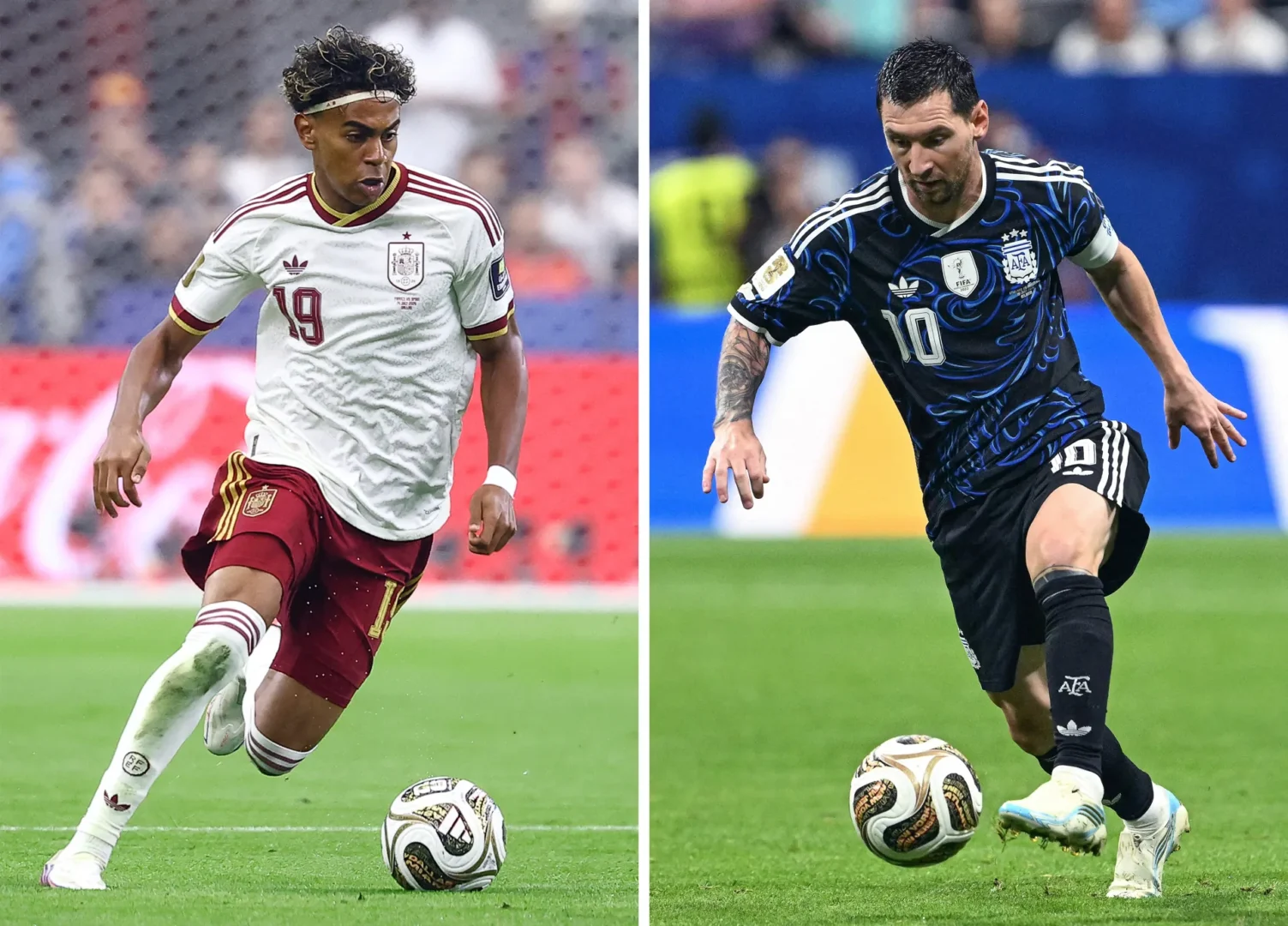
NEW JERSEY, United States — The 2026 FIFA World Cup final remains delicately poised after Spain and Argentina battled to a tense 0-0 draw in a fiercely contested first half at New York New Jersey Stadium on Sunday.
In a final that has so far been defined more by tactical discipline than attacking fireworks, Spain controlled large stretches of possession while defending champions Argentina focused on disrupting their rhythm and limiting clear-cut chances.
The result is a match still searching for its defining moment.
Spain began brightly, pressing aggressively from the opening whistle and attempting to impose the passing style that has carried them to the final. Their best early opportunities fell to teenage sensation Lamine Yamal, whose efforts from the right forced Argentina goalkeeper Emiliano Martinez into action.
Argentina responded with their trademark intensity.
Lionel Scaloni’s side pressed aggressively when required, challenged fiercely in midfield and repeatedly prevented Spain from establishing the fluid combinations that have become their trademark throughout the tournament.
The opening exchanges were played amid a feverish atmosphere inside the stadium, with thousands of supporters creating a backdrop befitting football’s biggest occasion.
“The opening minutes are being played out amid a fever pitch atmosphere in the stands,” BBC Sport’s Neil Johnston reported from the stadium.
“Shirtless fans are twirling their tops in the air as the mid-afternoon sun beats down. There is so much passion on display — both on and off the pitch.”
Spain threatened first when Yamal found space inside the area, but Martinez reacted quickly to deny him. Moments later, the youngster found himself in a similar position only for his effort to be blocked.
Argentina nearly capitalised on a rare defensive lapse when Spain goalkeeper Unai Simon ventured far from his goal to intercept a dangerous ball over the top.
“Unai Simon got so, so lucky because he started to backtrack, and then he was already so far out of his goal that it allowed him to get to the through ball,” former England goalkeeper Paul Robinson said.
England legend Alan Shearer added:
“Unai Simon is 30 yards out of his box. He made his decision very early. He had to get it and he did.”
As the half progressed, the contest became increasingly physical.
Former England defender Micah Richards questioned one of the referee’s early decisions involving Argentina midfielder Alexis Mac Allister.
“We saw in Argentina’s semi-final against England how early refereeing decisions set the tone for the game, and that Alexis Mac Allister challenge should have been a yellow card,” Richards said.
“It sets a dangerous precedent, as Argentina will feel they can get away with roughing up Spain.”
Despite Spain’s territorial advantage, opportunities became increasingly scarce.
Argentina’s compact defensive structure frustrated Spain’s attackers, while Lionel Messi remained largely quiet as the South Americans focused on maintaining their shape.
By the latter stages of the half, Spain’s dominance of possession had not translated into meaningful attempts on goal.
“It has been 30 minutes since Spain last attempted a shot in this game,” BBC commentators noted as the final approached the interval.
Former England striker Alan Shearer praised Argentina’s defensive organisation.
“Spain are not letting Argentina out at all. They just wear you down physically and mentally with how they pass the ball around,” he said.
At the other end, Argentina continued to threaten sporadically through quick transitions, though neither side managed to seriously test the opposing goalkeeper.
“This has become really scrappy to the detriment to the quality of this game,” Robinson observed.
“Much like Argentina’s game against England, this has become very scrappy. And they’ll be very pleased with how it has gone for them so far.”
Why the final remains goalless
The scoreline reflects a clash between two contrasting football philosophies.
Spain have dominated possession, patiently probing for openings and forcing Argentina deep into their own half. Yet for all their control, Luis de la Fuente’s side have struggled to create the kind of chances needed to break down a disciplined defensive block.
Argentina, meanwhile, appear comfortable allowing Spain the ball so long as they can control the space behind it. Scaloni’s side have compressed central areas, challenged aggressively in midfield and turned the final into the sort of attritional contest they often thrive in.
The tactical battle has also limited the influence of the game’s biggest stars.
Yamal has shown flashes of brilliance for Spain but has frequently encountered a wall of Argentine defenders. Messi, meanwhile, has spent much of the first half searching for room between Spain’s lines, unable to dictate proceedings in the way he has throughout much of the tournament.
Also Read: Spain beat France 2-0 to reach 2026 World Cup final
The match also suffered a setback shortly after the interval when Argentina defender Lisandro Martinez was forced off injured, with veteran Nicolas Otamendi replacing him.
For Argentina, losing one of their key defenders in a World Cup final represents a potentially significant challenge heading into the decisive second half.
Everything still to play for
Recent World Cup finals have produced goals, drama and unforgettable moments.
France defeated Croatia 4-2 in 2018, while Argentina and France shared six goals in the epic 2022 final before the South Americans triumphed on penalties.
This final has so far offered a different story — one built on caution, tactical discipline and defensive resilience.
The goals have yet to arrive, but the tension has never disappeared.
Spain have controlled much of the football. Argentina have controlled much of the danger. Neither side has found a breakthrough, leaving the final delicately balanced with 45 minutes separating one nation from football immortality.
Whether the trophy is decided by a moment of Spanish brilliance, an Argentine counterattack or the genius of Lionel Messi, the second half now carries the weight of history.
