


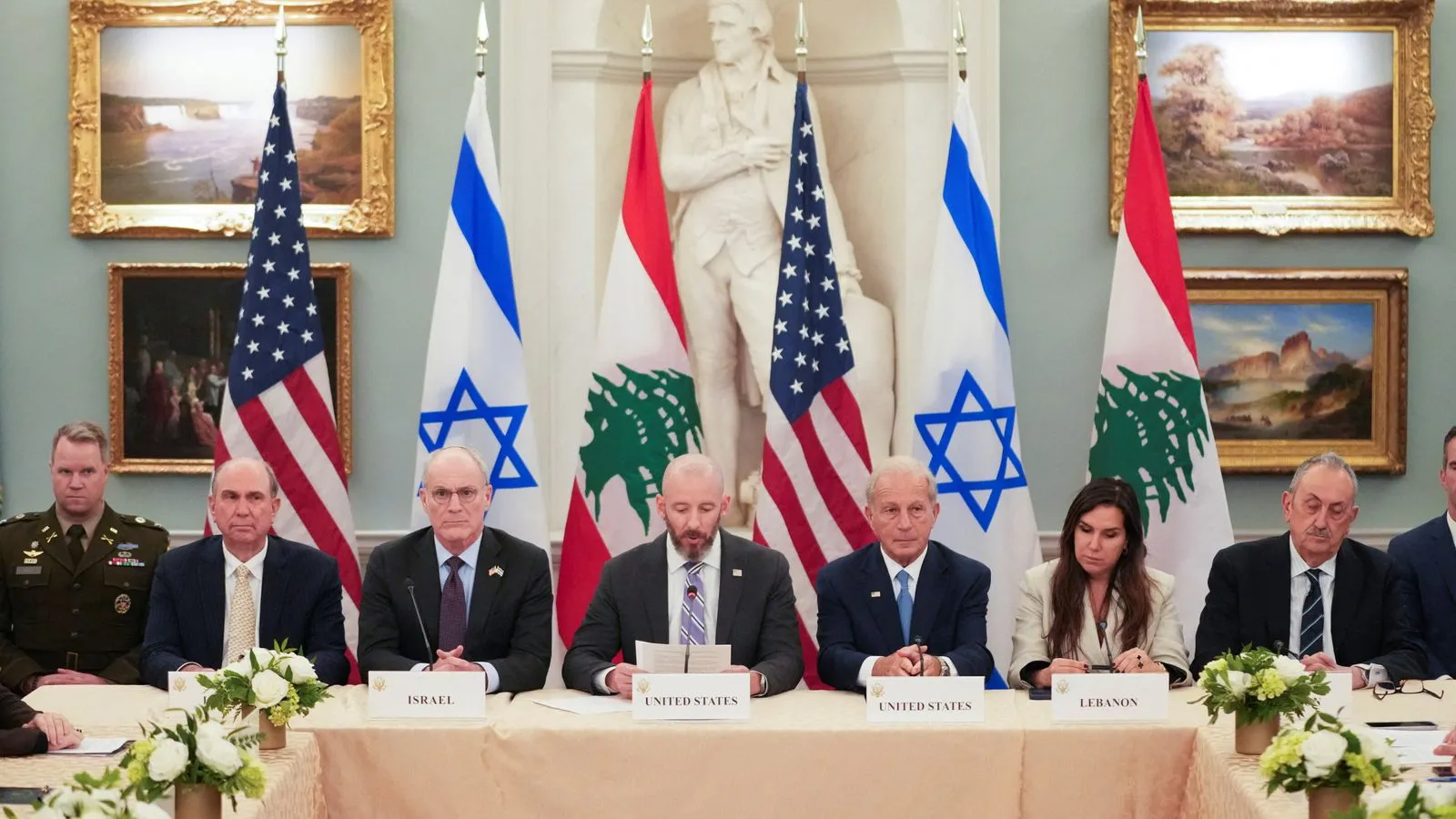
WASHINGTON, D.C., United States — Israel and Lebanon have agreed to renew a fragile ceasefire and establish a series of “pilot” security zones inside Lebanese territory where Hezbollah operatives would be barred, according to a statement from the US State Department.
A joint statement said the arrangement is “contingent on a complete cessation” of attacks by the Iran-backed armed group Hezbollah, alongside other conditions aimed at de-escalating one of the region’s most volatile conflicts.
The three sides also “rejected any attempt, by any state or non-state actor, to hold Lebanon’s future hostage”, in a reference widely seen as aimed at regional proxy influence.
The announcement was made in Washington following a fourth round of US-mediated talks, coming amid renewed cross-border violence that has killed and wounded civilians in both Israel and Lebanon.
The diplomatic breakthrough came as Israeli strikes in southern Lebanon killed at least nine people, while Hezbollah fired rockets into northern Israel in a continued exchange of fire.
Lebanese state media reported further Israeli strikes on Thursday in the south, with at least one attack causing casualties, underscoring the fragility of the proposed truce.
Under the agreement, Hezbollah would be required to withdraw operatives from an area between the Israeli border and the Litani River, approximately 30km north of the frontier, where Israeli ground forces are currently present.
The US is expected to support the establishment of “pilot zones” in which the Lebanese Armed Forces would assume exclusive control, excluding all non-state armed actors, according to the statement.
However, no maps or operational details were provided, raising questions about how the zones would be implemented on the ground.
The deal follows an earlier partial ceasefire announced on Monday, under which Lebanon said Israel would halt strikes on Beirut in exchange for Hezbollah refraining from attacks on Israeli territory.
Further negotiations are scheduled for 22 June, with the aim of reaching a broader and more comprehensive settlement.
Hezbollah has not formally endorsed the latest arrangement. A group spokesperson told the BBC it would issue an official position later.
The proposal has already drawn political backlash in Israel. Far-right National Security Minister Itamar Ben-Gvir described it as a “serious mistake”, arguing it would allow Hezbollah to regroup and strengthen.
Within Lebanon, Hezbollah has rejected aspects of the Washington talks. Senior official Mahmoud Qamati told the BBC the group does not recognise the negotiations or their outcomes, saying: “We think these negotiations do not concern us.”
The conflict has exacted a heavy human cost. Lebanon’s health ministry says 3,516 people have been killed since the war began, though it does not distinguish between civilians and combatants.
The United Nations estimates that more than one million people have been displaced inside Lebanon due to Israeli evacuation orders covering large parts of the country.
On the Israeli side, authorities say 26 soldiers and four civilians have been killed during the conflict.
Recent strikes in southern Lebanon have also killed civilians and emergency workers, including paramedics, according to Lebanese officials, who accuse Israel of violating international humanitarian law. The Israeli military has previously said ambulances may be used for militant activity, without providing evidence.
Despite diplomatic efforts, violence has continued. Israel said it intercepted a “hostile aircraft” and projectiles near its northern border on Wednesday, while Hezbollah said it launched rocket fire in response to Israeli actions.
Israel has also warned it could expand strikes on Hezbollah positions, including areas near Beirut’s southern suburbs, if attacks continue.
Also Read: US-Iran peace hopes fade after Trump cancels key talks
A previous US-brokered ceasefire in April failed to halt hostilities, and Israeli Prime Minister Benjamin Netanyahu has since ordered intensified military operations against Hezbollah targets.
The Lebanon-Israel conflict remains tightly linked to broader regional dynamics involving Iran and the United States. Tehran has warned that any ceasefire arrangement must include Lebanon and has signalled readiness to respond if hostilities escalate further.
US President Donald Trump, who announced the latest partial truce framework, has reportedly urged restraint amid concerns that escalation could derail wider diplomatic efforts aimed at stabilising the region.
As negotiations continue, the proposed ceasefire framework remains uncertain, with key actors still divided over implementation, enforcement and political legitimacy.
