


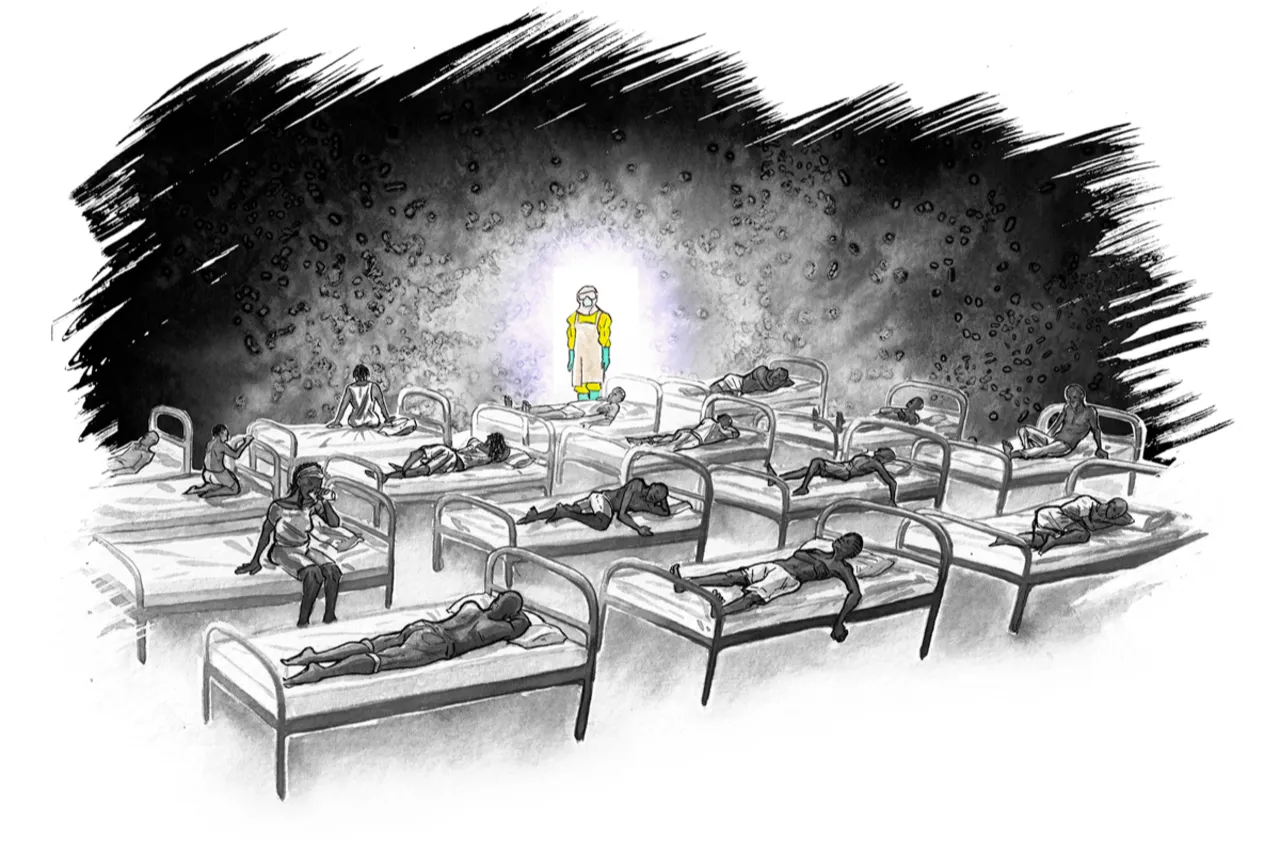
NAIROBI, Kenya — The ongoing debate surrounding the proposed establishment of a United States-linked Ebola quarantine facility at Laikipia Air Base in Kenya has triggered strong public emotions, protests, and political scrutiny. However, beneath the tension lies a broader public health reality that is often overlooked in public discourse: geography, response time, and containment capacity are decisive factors in managing high-fatality infectious diseases such as Ebola.
From a strategic public health perspective, Kenya’s proximity to current Ebola hotspots in the Democratic Republic of Congo (DRC) and Uganda places it in a uniquely critical position in the regional disease containment architecture.
Rather than representing a risk exportation model, the proposed facility can be understood as part of a rapid-response containment corridor designed to reduce mortality and prevent cross-continental spread.
The geography of outbreaks: Why location matters
Ebola Virus Disease (EVD) outbreaks have historically been concentrated in Central and West Africa, with the DR Congo experiencing repeated flare-ups due to dense forest ecosystems, cross-border movement, and limited healthcare infrastructure in remote regions.
Recent outbreaks have demonstrated how quickly transmission can escalate when isolation and treatment are delayed.
In the current Central African outbreak cycle, confirmed cases and fatalities have been reported in both the DR Congo and Uganda, reinforcing the fact that Kenya sits within the same interconnected epidemiological belt.
In such contexts, proximity-based response facilities are not experimental constructs—they are standard global health strategy.
During the West African Ebola epidemic (2014–2016), delayed isolation and weak regional capacity contributed to more than 11,000 deaths, making it one of the most devastating outbreaks in modern history .
The core lesson from that epidemic was not only about treatment, but about time-to-isolation. The faster a suspected case is contained, the lower the reproduction rate of the virus.
Lessons from COVID-19: Speed, isolation, and system overload
The COVID-19 pandemic reinforced a similar principle on a global scale: health systems collapse not only because of disease severity, but because of delayed containment and overwhelmed infrastructure.
Countries with pre-positioned isolation capacity, rapid testing systems, and designated treatment facilities consistently recorded lower mortality rates during peak waves.
Conversely, nations that relied on general hospital systems without dedicated isolation infrastructure experienced rapid transmission within healthcare facilities themselves.
The proposed Ebola quarantine facility in Kenya follows the same logic: it is not intended as a mass treatment centre, but as a controlled buffer zone to prevent uncontrolled hospital exposure and international spread.
Ebola: A disease that demands controlled isolation
Ebola remains one of the most lethal viral haemorrhagic fevers known to medicine, with fatality rates historically ranging between 25% and 90% depending on the outbreak and response speed.
Transmission occurs through direct contact with bodily fluids, making healthcare environments particularly vulnerable if infection control is weak.
This is why global response models consistently prioritise:
- Rapid isolation
- Controlled quarantine environments
- Trained infectious disease units
- Strict movement restrictions for suspected cases
The proposed facility in Kenya aligns with these established containment principles, especially given that patients exposed in DR Congo or Uganda would otherwise require long-distance evacuation to Europe or North America, increasing logistical risk during incubation periods.
Regional disease history: Why Africa faces higher exposure risk
Africa has repeatedly faced outbreaks of zoonotic and viral diseases that expose systemic healthcare vulnerabilities. These include:
1. Ebola virus disease (Multiple outbreaks)
From the Democratic Republic of Congo (DRC) to West Africa, Ebola has caused thousands of deaths and recurrent outbreaks due to forest-based zoonotic spillover and limited rural health infrastructure.
2. Marburg virus disease
Closely related to Ebola, Marburg outbreaks have been recorded in Uganda, Tanzania, and Angola, with fatality rates reaching up to 80–90% in some outbreaks.
Like Ebola, it spreads through bodily fluids and requires strict isolation.
3. COVID-19
While global in scale, COVID-19 exposed disparities in healthcare preparedness, oxygen supply, ICU capacity, and diagnostic infrastructure across African states, including Kenya.
4. Rift valley fever, Yellow fever, and zoonotic spillovers
East Africa remains a hotspot for zoonotic diseases transmitted from animals to humans, driven by livestock movement, climate variability, and ecological interaction.
These repeated outbreaks underline a consistent reality: proximity to ecological and epidemiological hotspots demands stronger—not weaker—preparedness infrastructure.
Why Kenya’s position is operationally strategic
Kenya is not being selected arbitrarily. Its role in regional health security is shaped by:
- Proximity to DRC and Uganda outbreak zones
- Established international airport and military logistics infrastructure
- Existing disease surveillance systems
- Experience in handling regional humanitarian and evacuation operations
- Connectivity to global medical evacuation routes
From an operational standpoint, locating a quarantine and stabilization facility in Kenya reduces:
- Evacuation time
- Airborne transport risks
- Cross-continental exposure uncertainty
- Delays in clinical intervention
In infectious disease management, hours—not days—can determine survival outcomes and containment success.
Addressing public concern: Risk versus perception
Public opposition in Kenya has largely centred on fear of local transmission and distrust in transparency. These concerns are valid in a country that has not recorded Ebola cases in the current outbreak cycle.
However, epidemiologically, a quarantine facility is designed precisely to prevent community exposure. It functions as a sealed containment environment, not a general treatment hospital integrated into civilian healthcare systems.
The misconception arises when quarantine is equated with uncontrolled exposure, when in reality it is the opposite: a controlled barrier between infection risk and the general population.
The broader strategic reality
Global health security is increasingly defined by regional containment networks rather than national isolation strategies. No country can fully insulate itself from cross-border epidemics in a world of high mobility.
The United States proposal, while politically controversial, reflects a broader shift toward decentralised outbreak response hubs placed near epidemic epicentres rather than distant metropolitan centres.
Also Read: Can Africa stop Ebola before it becomes another global crisis?
If properly regulated, transparently governed, and medically isolated from civilian systems, such a facility could serve as:
- A rapid response quarantine unit
- A training and preparedness hub
- A regional containment buffer during outbreaks
Preparedness over panic
The debate over the Ebola quarantine facility in Kenya sits at the intersection of public health, geopolitics, and public perception.
While concerns over safety and sovereignty are legitimate in any democratic society, the historical record of Ebola, Marburg, and COVID-19 demonstrates a consistent lesson: delayed containment costs lives far beyond the point of origin.
Kenya’s geographic positioning near active outbreak zones places it not at the periphery of the crisis, but at the frontline of regional health security.
In that context, preparedness infrastructure—if properly managed—can be a protective measure rather than a risk factor.
The central question is therefore not whether such facilities should exist, but how they are designed, regulated, and integrated into national public health safeguards.
