


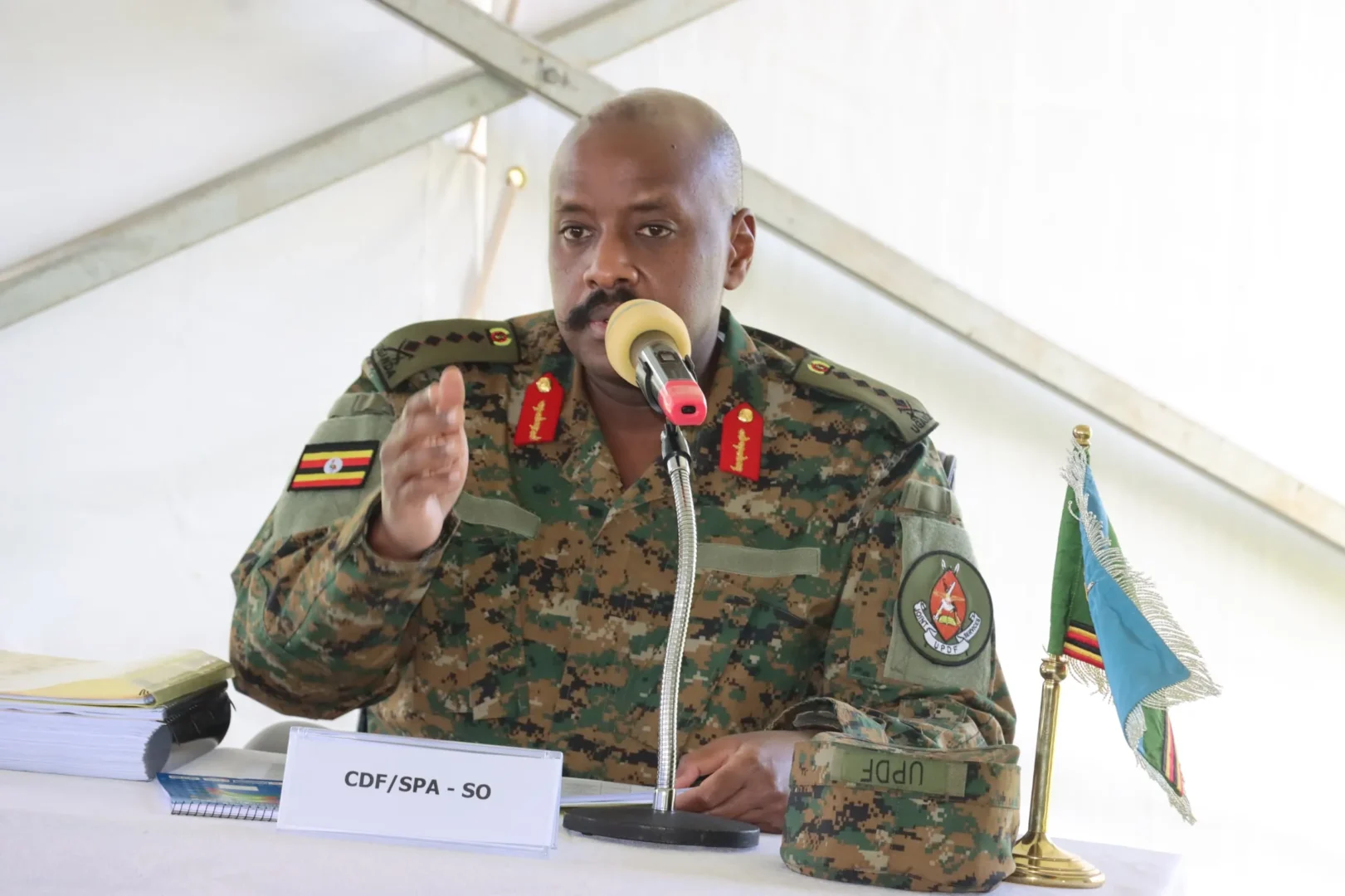
KAMPALA, Uganda — Uganda’s military chief, General Muhoozi Kainerugaba, has reversed an announced plan to withdraw Ugandan troops from Lubero in eastern Democratic Republic of Congo (DR Congo), raising fresh questions about Kampala’s military strategy and its increasingly delicate relationship with Kinshasa.
In a statement published on X on Sunday, November 29, Gen. Muhoozi said the Uganda People’s Defence Forces (UPDF) would remain in the North Kivu town, just two days after the military announced plans to begin withdrawing its troops and transfer security responsibilities to Congolese forces.
Addressing residents of Lubero, the Chief of Defence Forces (CDF) attributed the change of position to guidance from President Yoweri Museveni, who is also Uganda’s Commander-in-Chief.
“Under the guidance of H.E. Yoweri Museveni, Commander-in-Chief of the UPDF, we shall not withdraw from Lubero. You are safe,” Gen. Muhoozi wrote.
The announcement overturned a military statement issued on November 27 by Colonel Chris Magezi, the acting director of defence public information, which said Ugandan troops would begin leaving Lubero within two weeks.
The military had indicated that the withdrawal would involve handing over security responsibilities to the Armed Forces of the Democratic Republic of Congo (FARDC).
Gen. Muhoozi’s intervention has introduced uncertainty into a transition that had appeared to be officially agreed upon, particularly because the army has not publicly explained why the withdrawal was reversed or whether a revised arrangement has been negotiated with Congolese authorities.
The development also comes amid diplomatic tensions between Kampala and Kinshasa following controversial remarks by the Ugandan military chief about the conflict in eastern Congo.
What changed between Friday and Sunday?
The sequence of announcements has become central to the unfolding dispute.
On Friday, November 27, Colonel Magezi announced that the UPDF would withdraw from Lubero within the following two weeks.
Ugandan forces had been deployed in the area in January 2025 to pursue fighters belonging to the Allied Democratic Forces (ADF), who had moved into North Kivu after coming under pressure from joint military operations.
The planned departure was expected to transfer responsibility for security in Lubero to Congolese forces, marking a change in the deployment of Ugandan troops in the area.
However, Gen. Muhoozi’s statement on Sunday effectively halted that plan.
His announcement did not provide a revised withdrawal timetable, explain whether the FARDC had been consulted or clarify whether Uganda had agreed to maintain its existing deployment indefinitely.
It also did not establish whether the decision applies exclusively to Lubero town or signals a wider adjustment to Uganda’s military posture in eastern Congo.
The distinction is important because the November 27 announcement concerned a specific deployment, not the termination of Uganda’s entire military presence in DR Congo.
For now, the clearest position available is that the UPDF’s previously announced withdrawal from Lubero has been reversed by its military chief, who says the decision follows presidential guidance.
Why Uganda has troops in eastern DR Congo
Uganda’s military presence in eastern DR Congo is part of Operation Shujaa, a joint offensive launched by Kampala and Kinshasa in November 2021 to target the Allied Democratic Forces.
The ADF originated in Uganda in the 1990s before establishing bases in eastern Congo, where it has carried out attacks against civilians and security forces.
The group has also developed links with Islamic State, which has claimed responsibility for some attacks attributed to its Central African affiliate.
The insurgency has created a significant security threat for both countries, particularly communities living near the Uganda-DR Congo border.
Operation Shujaa was established to dismantle ADF bases, disrupt its operational networks and reduce its ability to launch attacks across the region.
Ugandan forces subsequently expanded their operations into parts of North Kivu and Ituri, pursuing militants who had moved away from areas targeted by joint offensives.
The deployment to Lubero in January 2025 was part of those efforts.
However, eastern DR Congo is not a single-front conflict involving only the ADF. The region is also affected by fighting involving Congolese government forces, the M23 rebellion and several other armed groups and local militias.
This makes the security environment considerably more complicated than the original counter-insurgency mission.
The decision to maintain Ugandan troops in Lubero therefore raises questions about the precise objectives of the deployment, particularly as the area is affected by broader military and political tensions.
Diplomatic tensions deepen after Muhoozi’s remarks
The troop withdrawal reversal comes against the background of an increasingly sensitive diplomatic dispute between Uganda and DR Congo.
Kinshasa summoned Uganda’s diplomatic representative on November 24 following remarks by Muhoozi about the conflict in eastern Congo.
The controversy followed comments in which the Ugandan military chief expressed support for the proposed capture of Walikale, a strategically important and mineral-rich territory in North Kivu, by the Front for the Liberation of Congo (FRN), an armed movement associated with former Congolese President Joseph Kabila.
Congolese authorities sought clarification from Kampala over the remarks, which raised concerns about Uganda’s position towards armed actors involved in the country’s internal conflict.
The diplomatic protest was significant because Uganda and DR Congo have maintained military cooperation against the ADF despite the wider instability affecting eastern Congo.
The two countries have a shared interest in preventing armed groups from using the border region as a base for attacks, but their cooperation depends on maintaining confidence in each other’s political and security intentions.
Gen. Muhoozi’s public comments have complicated that relationship, particularly because he is not simply a political commentator but Uganda’s serving Chief of Defence Forces (CDF).
His statements can therefore attract attention beyond social media and carry potential diplomatic and security consequences.
Muhoozi’s intervention raises questions about military and diplomatic coordination
The controversy extended beyond the Lubero deployment after Gen. Muhoozi publicly criticised Uganda’s Foreign Affairs Minister, Adonia Ayebare, over a telephone conversation with his Congolese counterpart, Thérèse Kayikwamba Wagner.
In a post on Sunday, Gen. Muhoozi said the foreign minister had not obtained his permission to speak with the Congolese official.
“Our Foreign Minister did not have my permission to call the DRC Foreign Minister to discuss anything. He made a mistake,” he wrote.
The statement attracted attention because diplomatic engagement between foreign ministers is a normal part of managing relations between neighbouring states, particularly during periods of tension.
However, Ayebare subsequently explained that the Congolese foreign minister had initiated the conversation and had made several attempts to reach him.
Gen. Muhoozi later softened his position after receiving the explanation.
“Our Foreign Minister has explained everything to me. It was not him who looked for the DRC Foreign Minister but the other way round. She called him many times asking to speak. He is forgiven. He has no problem,” he wrote.
Ayebare thanked the military chief for giving him an opportunity to explain the circumstances surrounding the call and for supporting his diplomatic work.
The exchange highlighted the difficulties of coordinating military and diplomatic messaging during a sensitive regional security dispute.
It also raised questions about the public handling of Uganda’s foreign policy, particularly when statements by senior military officials intersect with the work of the country’s diplomatic leadership.
The episode does not, by itself, establish that Uganda’s foreign ministry lacks authority to conduct diplomatic engagements.
It does, however, demonstrate how public disagreements between senior officials can complicate the presentation of a consistent national position.
Why Lubero matters to the wider regional security picture
Lubero is located in North Kivu, a province that has experienced prolonged conflict involving armed groups, government forces and competing political interests.
Its strategic importance extends beyond the immediate military operation against the ADF.
The town lies along National Road 2, an important transport corridor connecting commercial centres including Butembo and Beni.
The road network is significant for civilian movement, trade and access to communities affected by insecurity.
The wider North Kivu region has also been destabilised by the conflict involving the M23 rebellion and other armed formations.
Consequently, changes in the deployment of foreign troops can have implications for the security arrangements of communities, the movement of armed groups and the responsibilities of Congolese forces.
Uganda’s original withdrawal announcement suggested that the FARDC would assume responsibility for security in Lubero.
Gen. Muhoozi’s reversal now leaves questions about the extent to which that handover had been prepared and whether Congolese authorities had agreed to the revised arrangement.
Neither the Ugandan announcement nor Gen. Muhoozi’s subsequent statement has provided a detailed explanation of the operational arrangements that will now apply.
There is also no confirmed public breakdown of the number of Ugandan troops stationed in Lubero or the precise military resources involved in the deployment.
Without those details, it remains difficult to establish the full operational significance of the reversal.
Uganda’s military mission faces a broader strategic test
For Kampala, the central challenge is maintaining its security objectives in eastern Congo while avoiding a deterioration in relations with the Congolese government.
Uganda has consistently presented Operation Shujaa as a joint campaign against the ADF, a group that threatens security on both sides of the border.
That cooperation is strategically important because the insurgency cannot easily be contained through operations on one side of the border alone.
However, the wider conflict in eastern Congo presents risks that extend beyond the original counter-terrorism mission.
The presence of multiple armed groups, shifting alliances and competing political interests means that military operations can become entangled in disputes that are not directly related to the ADF.
For Uganda, this creates a difficult balance: it must pursue its security interests without appearing to take sides in DR Congo’s internal political and military struggles.
Also Read: DR Congo summons Uganda envoy over Gen Muhoozi’s threats
The latest controversy makes that balance more complicated.
If Kampala and Kinshasa cannot maintain clear communication over troop deployments and military objectives, misunderstandings could undermine cooperation that has taken years to establish.
The reversal also raises questions about how military decisions are communicated and whether announcements made by the defence establishment are being coordinated with the political and diplomatic leadership.
What happens next?
The immediate question is whether Uganda and DR Congo will issue further clarification on the future of the UPDF deployment in Lubero.
The November 27 announcement indicated that Congolese forces would assume security responsibilities following the Ugandan withdrawal.
Gen. Muhoozi’s subsequent statement, however, suggests that the planned handover will not proceed as previously announced.
The Ugandan government has not publicly provided a detailed explanation of the change, while the available reporting had not established a formal Congolese response to the reversal by Sunday.
It also remains unclear whether the two countries will hold further consultations to agree on the military arrangements.
For civilians in Lubero, the priority remains security and the prevention of further displacement or attacks by armed groups.
For Uganda, the decision will test its ability to maintain a military partnership with DR Congo while managing the diplomatic consequences of public statements by senior officials.
The wider implications will depend on whether the reversal becomes a temporary adjustment to the deployment or a longer-term change in Uganda’s military strategy.
What is already clear is that a planned military withdrawal has turned into a fresh regional diplomatic and security issue, placing Kampala’s relationship with Kinshasa under renewed scrutiny.
