


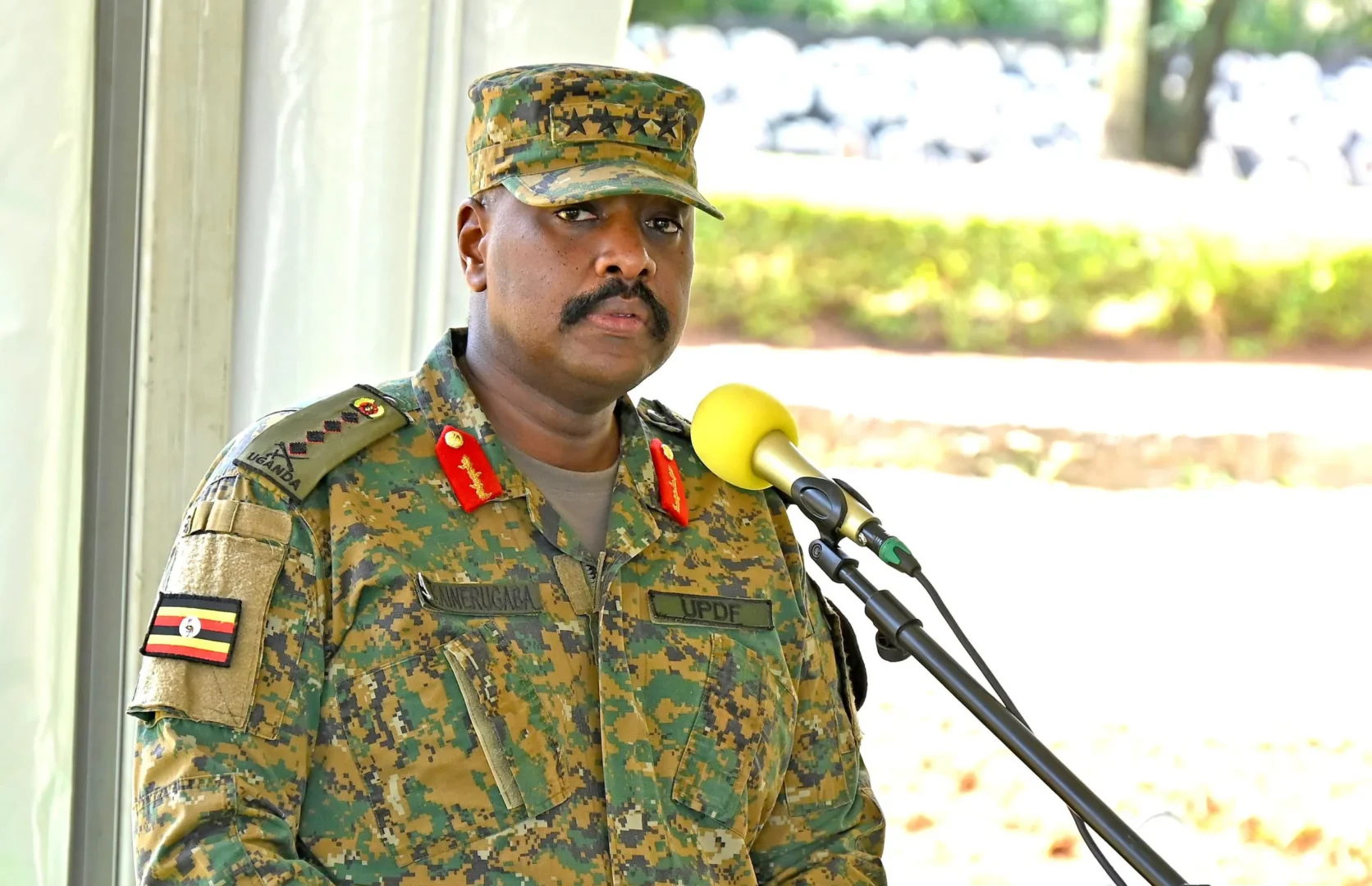
KAMPALA, Uganda — Uganda’s proposed national unity government has suffered another political setback after Chief of Defence Forces (CDF) Gen Muhoozi Kainerugaba declared that the Patriotic League of Uganda (PLU) would not participate in any power-sharing arrangement.
In a statement published on X on Saturday, November 21, Muhoozi rejected the possibility of the political organisation joining a proposed coalition administration, invoking the history of the National Resistance Army (NRA) during the 1981–1986 bush war.
“PLU will ABSOLUTELY not be part of any ‘National Unity Government’. We like NRA/NRM in 1985 refuse to be part of those who want to prevent the righteous victory of the masses,” he wrote.
The declaration adds to growing disagreements over efforts to establish a national dialogue and reconciliation framework intended to address Uganda’s political divisions.
It also raises questions about the prospects of securing broad political participation in a proposed arrangement that seeks to bring government and opposition interests together.
Disagreement over Uganda’s power-sharing proposal
The latest remarks come amid discussions surrounding the proposed Consociational Democracy Agreement (CDA), an initiative associated with Gen Salim Saleh, President Yoweri Museveni’s younger brother.
The proposal seeks to promote political accommodation, power-sharing and national reconciliation through structured engagement between political parties and other stakeholders.
On November 13, representatives associated with the Inter-Party Organisation for Dialogue (IPOD), the National Consultative Forum (NCF) and the CDA initiative met at Kirema Heritage Farm in Nakaseke District.
The meeting agreed to incorporate the proposed agreement into the Uganda National Dialogue Framework, which is chaired by former Prime Minister Ruhakana Rugunda.
Supporters of the initiative argue that a structured political settlement could provide a platform for resolving longstanding disagreements over governance and national cohesion.
However, the proposal has encountered resistance from opposition groups questioning its inclusiveness, credibility and ability to address fundamental political grievances.
Muhoozi’s position deepens divisions over dialogue
Muhoozi had already expressed opposition to including detained opposition leader Dr Kizza Besigye in the proposed national dialogue.
On November 17, he described Besigye as a traitor and rejected negotiations involving him, alleging that the opposition leader had planned to shoot down President Museveni’s helicopter.
“You cannot have ‘National Dialogue’ with a traitor who was planning to shoot down Mzee’s helicopter. We will not accept that,” Muhoozi wrote.
The allegation is a claim by Muhoozi and should not be treated as an established finding. Besigye, who faces treason-related charges, has not been convicted.
His continued detention has become a major point of contention in discussions about national reconciliation, with opposition figures arguing that political dialogue cannot be meaningful without addressing the treatment of detained leaders and wider concerns about civil liberties.
The People’s Front for Freedom (PFF), associated with Besigye, has rejected the proposed power-sharing process in its current form.
PFF leaders argue that negotiations must address political detentions, alleged abductions, human rights concerns, electoral reforms and Uganda’s political transition.
The party has also called for a neutral convener, an agenda jointly developed by participating parties and an independent mechanism to guarantee implementation of any agreement.
The Forum for Democratic Change (FDC) has separately raised concerns about the process, while the National Unity Platform (NUP) has questioned the proposed arrangement.
What rejection means for Museveni’s political transition
Muhoozi’s declaration is particularly significant because he occupies two influential positions: he is Uganda’s military chief and a central figure in the Patriotic League of Uganda, a political organisation.
His comments therefore place the proposed national unity arrangement under further scrutiny, particularly regarding the relationship between the country’s military leadership and political negotiations.
However, his statement should not automatically be interpreted as an official position of the Ugandan government or the National Resistance Movement (NRM).
The disagreement also comes as Uganda faces growing debate over President Museveni’s succession after nearly four decades in power.
Muhoozi has publicly expressed ambitions to succeed his father and has declared his intention to contest the presidency after Museveni.
Also Read: Museveni’s brother Salim Saleh says he found Besigye ‘almost dead’ in prison
Those ambitions have encountered reported resistance within the ruling NRM. An AFP report published on November 11, citing party insiders, said discussions about positioning Muhoozi as Museveni’s successor ended without a decision after objections from members of the party’s executive committee.
The succession question adds another layer to the debate over political accommodation: whether a national unity arrangement would genuinely broaden political participation or primarily serve as a mechanism for managing the transition of power.
A difficult path towards national consensus
The latest developments expose the challenge facing Uganda’s national dialogue initiative.
For supporters, power-sharing could offer a route towards reducing political tensions and establishing a framework for cooperation between competing political groups.
For its critics, however, negotiations risk becoming an exercise in political accommodation without addressing the underlying disputes over elections, accountability, civil liberties and the treatment of opposition leaders.
Muhoozi’s rejection of PLU participation does not, on its own, end the proposed process. But it highlights the difficulty of building a national consensus when influential political actors disagree over who should participate and what issues must be addressed.
The central question now is whether Uganda’s dialogue initiative can develop into an inclusive process with credible guarantees, or whether disagreements over political participation and succession will undermine the effort before a substantive agreement is reached.
