


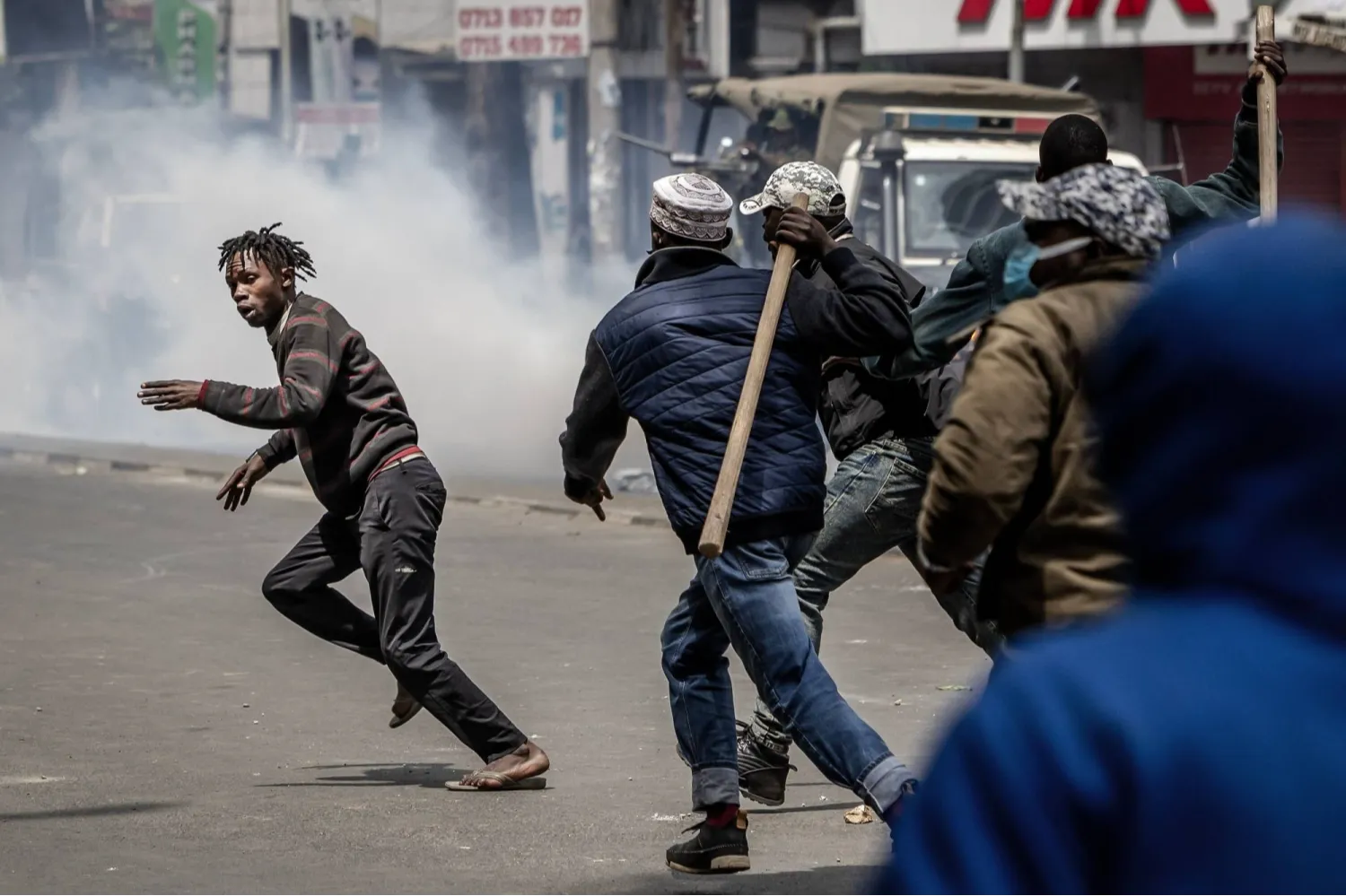
NAIROBI, Kenya — The assault of two Agence France-Presse (AFP) journalists in Homa Bay was supposed to be a story about a political rally.
Instead, it became a story about Kenya itself.
On Sunday 16, August 2026, Fred Ooko and Brian Ongoro travelled from Kisumu to Homa Bay to cover the Linda Mwananchi rally. They arrived to find a town under tension, roads blocked and businesses largely shut.
Before the day was over, both journalists had been beaten, their equipment and identification documents taken, and their attempt to report on political violence had turned them into victims of it.
Ooko said he was dragged along the road and beaten with clubs. Ongoro was also assaulted and lost his phone and camera. The two eventually escaped through different routes and later reunited before making their way back to Kisumu.
Their experience was not isolated. Another Nation Media Group team travelling with the Linda Mwananchi convoy encountered roadblocks, while journalists were reportedly forced to abandon attempts to film confrontations as stones were thrown at vehicles.
Amnesty International Kenya and the Kenya Editors Guild has subsequently called for investigations into the violence, including attacks on journalists, destruction of property and the conduct of security agencies.
The question now is bigger than what happened in Homa Bay.
Is Kenya once again allowing political competition to create an ecosystem in which organised violence becomes a tool of politics?
That question deserves to be asked before the country gets closer to the 2027 General Election.
The disturbing return of the political goon
Kenya has seen this movie before.
The faces change. The political alliances change. The slogans change.
But the method is familiar; Mobilise young men, create disorder around an opponent’s meeting, intimidate those documenting the confrontation, and leave the public debating who actually sent the attackers.
This year, that pattern has appeared in different forms across the country.
Former Deputy President Rigathi Gachagua has repeatedly accused the Ruto administration and allied politicians of financing groups to disrupt his political meetings. In April, he alleged that disruptions targeting his political activities were coordinated and planned.
Edwin Sifuna has made similar allegations.
In May, the Nairobi Senator claimed that organised groups had been planted to disrupt ODM-related meetings in Kilifi and Mombasa. Earlier in the year, his Linda Mwananchi activities in Kitengela were disrupted after police fired tear gas, while Sifuna alleged that unidentified groups had already destroyed the rally’s dais and sound equipment.
In February, opposition leaders accused the government of using police and youth gangs to interfere with their political meetings.
In July, violence disrupted a church service attended by Sifuna and Siaya Governor James Orengo in Kisumu, with witnesses and opposition leaders raising questions about the presence and conduct of armed youths.
Now Homa Bay has produced perhaps the clearest warning yet; When political violence reaches journalists, the danger is no longer confined to politicians and their supporters. It has entered the information space itself.
That should alarm every political camp.
Ruto’s problem is not simply what he says — it is what the State is expected to prevent
President William Ruto has publicly condemned criminality and goonism.
In June, he directed security agencies to act against criminal groups and their sponsors. In July, he said the government would not allow goons to hijack demonstrations and terrorise Kenyans. He has also insisted that peaceful political activity is constitutionally protected while criminal conduct must face the law.
Those statements matter.
But they also create a much higher burden on his administration.
If the President says political violence will not be tolerated, Kenyans are entitled to ask a simple question:
Who is being arrested?
Not who is being blamed.
Not who is being accused on television.
Not which political faction is allegedly behind the violence.
Who is actually being investigated, arrested and prosecuted?
That distinction is crucial.
But the repeated allegations cannot simply be dismissed either.
The responsibility of government is not merely to deny involvement. It is to demonstrate that the State has the capacity and independence to identify whoever is organising violence — whether those people are aligned with the government, opposition or neither.
The Ruto-Uhuru question makes the debate even more complicated
Kenya’s current political argument has another layer.
Ruto’s allies have increasingly accused retired President Uhuru Kenyatta of financing opposition activities and backing the Linda Mwananchi movement as part of efforts to undermine the government ahead of 2027.
Those allegations have been made repeatedly by Kenya Kwanza figures. Some have specifically claimed that Uhuru is funding opposition campaigns.
But those claims have also been challenged.
Saboti MP Caleb Amisi, for example, rejected the allegations and said Uhuru had nothing to do with Linda Mwananchi, claiming responsibility for the movement himself.
This matters because Kenya is increasingly entering an election in which political financing, mobilisation and violence are becoming intertwined in public accusations.
If government allies believe Uhuru is financing opposition operations, the appropriate response is evidence and investigation — not political insinuation.
If the allegations are false, they should be exposed.
If they are true, the evidence should establish what is being financed, by whom and for what purpose.
Either way, the public deserves facts.
And then there is the shadow of 2007–08
This is where Kenya’s history becomes impossible to ignore.
President Ruto’s political biography is inseparable from one of the darkest chapters in Kenya’s electoral history.
Following the disputed 2007 presidential election, violence spread across parts of the country, killing more than 1,000 people and displacing hundreds of thousands.
The International Criminal Court (ICC) later investigated the violence.
In 2011, ICC judges found reasonable grounds to believe that William Ruto, Henry Kosgey and Joshua Arap Sang had prepared and implemented a plan to attack civilians in the Rift Valley.
The ICC also issued summonses in the case involving Uhuru Kenyatta, who was accused by the prosecution of responsibility for attacks carried out in retaliation against ODM supporters.
The allegations were serious, but they must be described accurately.
Ruto and Kenyatta were never convicted by the ICC for the 2007–08 violence.
The ICC proceedings against Ruto and Sang eventually collapsed after the prosecution withdrew the case in 2016, citing witness interference and other difficulties. The Court’s records also make clear that charges and confirmation decisions do not themselves establish guilt.
That distinction is essential.
But the historical record remains relevant because the ICC allegations placed both men at the centre of international scrutiny over the relationship between Kenyan political mobilisation and organised violence.
Today, one of them is President.
The other is a retired President whose political influence is again being debated.
And Kenya is again approaching an election in which accusations of organised gangs and political intimidation are becoming routine.
That is not proof of repetition.
It is a reason to demand that history does not repeat itself.
From the “Ocampo Six” to today’s anonymous goons
The most disturbing lesson from 2007–08 is not simply that violence occurred.
It is how political violence can become organised.
ICC material concerning the Ruto case described allegations of a network that held preparatory meetings, mobilised people and resources, and coordinated attacks in parts of the Rift Valley. The prosecution alleged that perpetrators were organised into groups with specific tasks and transported to designated locations.
The circumstances today are obviously different.
There is no basis to claim that the current groups attacking rallies are the same network or that today’s violence is being directed according to the same structure.
But the political logic of organised disruption deserves scrutiny.
A group of youths does not necessarily become a political militia merely because they appear at a rally.
But when groups repeatedly appear around political meetings, carry weapons, block roads, attack opponents and journalists, and operate in an apparently coordinated manner, investigators should establish who organised them, how they were mobilised and who financed them.
That is not partisan politics.
It is basic law enforcement.
Gachagua has become a target — but allegations need evidence
Gachagua’s political activities have repeatedly been disrupted since his fallout with Ruto.
He has accused Ruto and government-aligned politicians of financing goons to interfere with his meetings. In February, he accused the administration of working with gangs to disrupt opposition gatherings in Kisii.
In April, Gachagua and Kalonzo Musyoka went further, alleging that gangs had been incorporated into security structures and warning that they were compiling evidence over alleged government involvement. They even raised the possibility of an ICC complaint.
Those are extraordinary allegations.
They should not be treated as established facts.
But neither should they be answered with political insults.
If Gachagua possesses evidence, he should present it to investigators and the relevant oversight institutions.
If the government believes opposition politicians are organising gangs, it should arrest and prosecute the organisers.
The public should not be forced to choose between two competing political narratives without an evidential resolution.
Sifuna’s movement is facing the same test
The Linda Mwananchi movement has experienced disruptions in several locations.
Sifuna has alleged that goons were planted to interfere with his meetings, while opposition leaders have repeatedly accused security agencies of either participating in or failing to prevent the violence.
Some of the events have involved police action rather than unidentified gangs, including the Kitengela confrontation in February.
The distinction matters.
A violent incident involving police is not automatically the same thing as an attack by political goons.
But both raise the same constitutional question:
Can Kenyans freely assemble, campaign and express political opinions without intimidation?
Article 37 protects the right to assemble, demonstrate, picket and present petitions peacefully and unarmed.
Article 34 protects media freedom.
Those rights mean little if political gatherings become places where armed youths can determine who is allowed to speak and journalists can be beaten for documenting what happens.
The most dangerous victim may be the truth
The assault on Ooko and Ongoro should therefore be viewed as more than another incident in the catalogue of political violence.
It strikes at the mechanism through which society learns what happened.
A journalist who fears approaching a rally may not attend.
A photographer who has had a camera confiscated may think twice before documenting another confrontation.
A media organisation whose vehicle is attacked may reconsider sending a team into a politically volatile area.
That creates an information vacuum.
And information vacuums are dangerous during elections.
They allow rumours to compete with evidence.
They allow political actors to create their own versions of events.
They make it easier for each side to claim that the other side started the violence.
And they make accountability harder.
That is why the Kenya Editors Guild’s demand for an investigation is not merely a media-sector complaint. It is a democratic demand.
The Guild has called for the attackers to be identified and prosecuted and for the journalists’ equipment and identification documents to be recovered.
Amnesty International Kenya has similarly called for independent investigations and questioned whether security agencies did enough to prevent the violence and protect those affected.
From 2007 to 2027 — the warning signs deserve attention
There is an understandable tendency in Kenya to compare every episode of political violence with 2007–08.
That comparison can be exaggerated.
Kenya today has stronger institutions, a more experienced electorate, a more sophisticated media environment and a constitutional framework that provides significant protections for political participation.
The country is not automatically heading for another 2007.
But history does not repeat itself in identical form.
It repeats through patterns of behaviour that societies fail to stop early enough.
Political intolerance.
Ethnic mobilisation.
Organised youth violence.
The normalisation of threats.
Attacks on journalists.
Weak accountability.
Politicians accusing each other while evidence remains unresolved.
Security agencies being accused of selective enforcement.
And a public becoming accustomed to the sight of armed men deciding who gets to hold a political meeting.
Those are the warning lights.
The question Kenya must answer before 2027
The central question is no longer whether Kenya has political goons.
The evidence of violent groups disrupting political and civic events is already substantial enough to warrant serious concern.
Independent reporting has documented a growing pattern of political disruptions, while analysts have warned about the use of gangs around political activities.
The harder question is:
Who controls them?
Who recruits them?
Who transports them?
Who pays them?
Who gives them information about political movements?
Who provides protection when they attack?
Who orders the police to intervene — or not to intervene?
Also Read: Kenya opposition ‘needs intelligence-led security strategy’
And when a journalist is beaten, a rally is disrupted or a road is blocked, who ensures the perpetrators face the law?
These questions should be answered before, not after, the 2027 election.
Because once an election begins, every unanswered allegation becomes political ammunition.
And every unresolved act of violence becomes a potential trigger for another.
Homa Bay should be a warning, not a footnote
Fred Ooko and Brian Ongoro went to Homa Bay as journalists.
They were carrying cameras because their job was to record events.
They left injured, without some of their equipment and with their press credentials and personal documents taken from them.
Other journalists encountered roadblocks and attacks.
Businesses closed.
Transport was disrupted.
Political leaders accused rival forces.
Security agencies faced questions.
Human rights organisations demanded investigations.
And Kenya moved on to the next political argument.
That is precisely the problem.
The country cannot afford to normalise these incidents.
The 2027 election is still months away. There is therefore an opportunity — perhaps the last relatively calm opportunity — to establish whether Kenya’s political system can compete fiercely without turning young people into weapons, journalists into targets and public roads into battle lines.
Ruto’s administration has a particular responsibility because it controls the instruments of the State and has publicly promised to deal with goonism.
Opposition leaders have a responsibility too: they must condemn violence by their supporters, preserve evidence and cooperate with investigations rather than simply assign blame.
Uhuru Kenyatta, whose name is now repeatedly invoked in claims about opposition financing, should also be judged on evidence rather than political suspicion.
Gachagua, Sifuna, Orengo and every other opposition leader must equally ensure that their supporters do not become perpetrators while political leaders present themselves as victims.
And the police must demonstrate that the law applies equally to everyone.
Kenya does not need another political peace campaign after violence has already begun. It needs accountability before violence becomes an election strategy.
The assault on two journalists in Homa Bay may eventually become another brief headline in the long road to 2027.
Or it could become something more important:
the moment Kenya recognised that the real battle for the next election was not only over votes, but over whether politics would once again be allowed to weaponise violence.
