


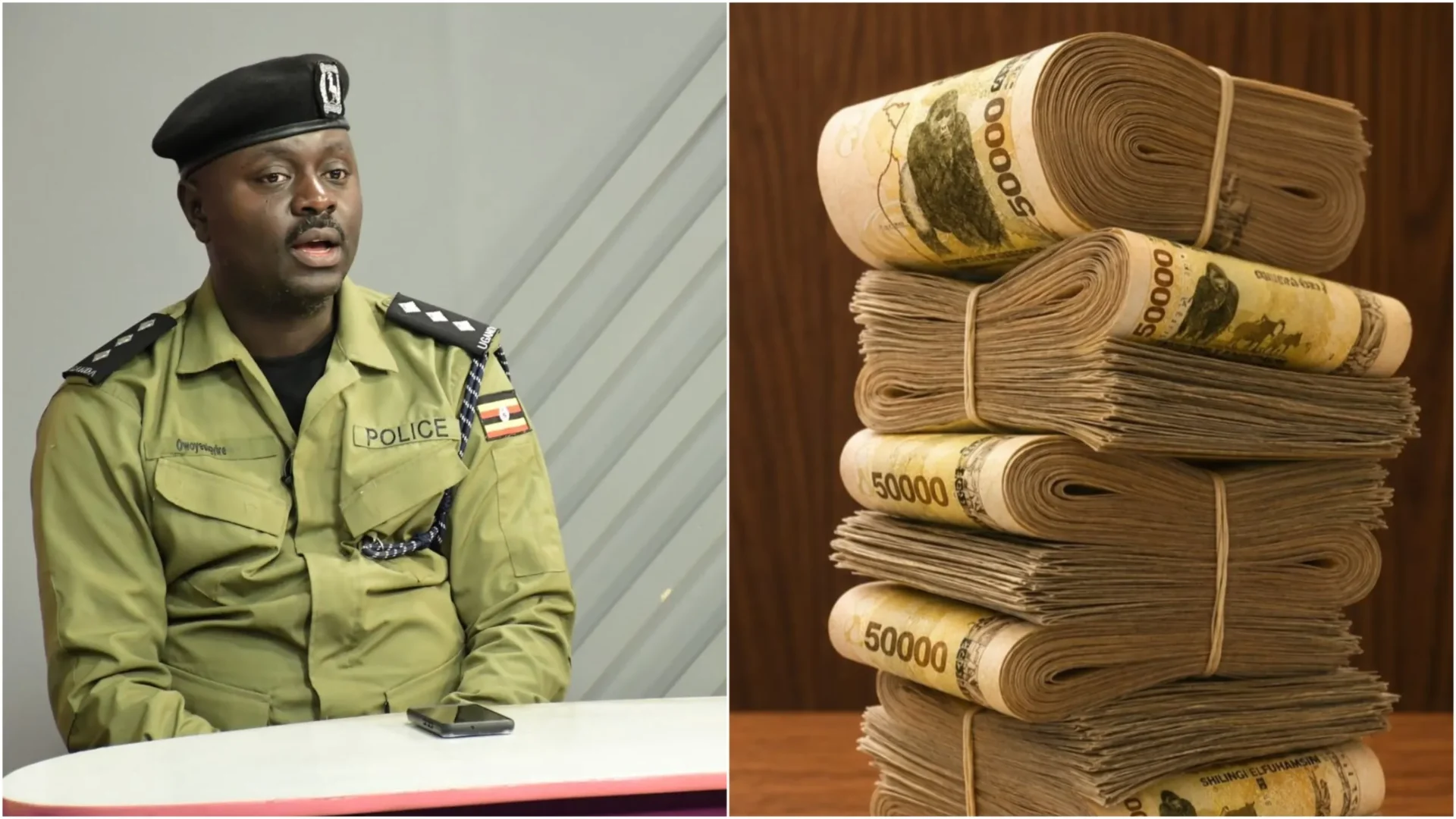
WAKISO, Uganda — Police in Nansana have arrested four suspects and recovered more than Shs54 million in cash following an investigation into the alleged theft of Shs200 million from a residence in Lugazi, a case that has since led detectives from a guest house in Wakiso District to the doorstep of a traditional healer accused of helping “cleanse” the stolen money.
The arrests followed intelligence received in the early hours of July 16 indicating that two men were moving around Nansana Heights Building in Ochieng One Zone carrying a bag suspected to contain a large amount of cash. Officers from Yesu Amala Police Station responded and arrested the pair, allegedly recovering Shs35.6 million.
According to investigators, the suspects told police the money had been handed to them for safekeeping by an associate, Kafeero Ramathan. That revelation set in motion a chain of events that would uncover additional cash, newly purchased electronics and household items, and claims that part of the missing fortune had been delivered to a traditional healer for a ritual intended to “cleanse” its origins.
What initially appeared to be a routine intelligence-led arrest soon evolved into one of the more unusual criminal investigations reported in the Kampala metropolitan area this year.
At its centre lies a story that combines allegations of family betrayal, sudden wealth, conspicuous spending and enduring beliefs about the spiritual consequences of ill-gotten money.
Police say the investigation took a significant turn when the two suspects led officers to Standard Rose Site Guest House, where Kafeero Ramathan was arrested.
Preliminary investigations indicate that Kafeero allegedly stole Shs200 million from his grandmother, a resident of Lugazi. Detectives later contacted the complainant and confirmed that a theft case had already been registered at Lugazi Police Station.
For investigators, the discovery transformed what had begun as a suspicious-cash case into a major theft inquiry involving one of the largest sums reported stolen from a private residence in recent months.
Yet the money recovered in Nansana represented only a fraction of the amount police were trying to trace.
A search conducted at the guest house yielded another Shs18.9 million in cash. Officers also recovered four new smartphones, a laptop and several household items believed to have been purchased using the suspected proceeds of the theft.
Taken together, the recoveries brought the total amount of cash recovered to more than Shs54 million.
The findings also revealed a familiar pattern often encountered in financial crime investigations.
Criminal justice experts have long observed that one of the greatest challenges for people who suddenly gain access to large sums of money—whether legally or illegally—is resisting the temptation to spend it quickly.
In many cases, stolen cash does not remain hidden for long because it is converted into visible assets. New electronics, household goods, vehicles and expensive lifestyle purchases frequently become some of the first clues that investigators follow.
The alleged purchases uncovered in this case appear to fit that pattern.
But the investigation was about to take an even more unexpected turn.
According to police, during further interrogation Kafeero claimed he had handed Shs100 million to a traditional healer identified as Salongo Kato Nsobya of Kavumba in Wakiso District.
The purpose was unusual.
Police say Kafeero told investigators the money had been given to the healer for what he described as the “cleansing” of the stolen funds.
The allegation immediately expanded the scope of the investigation beyond conventional theft and into territory where criminal investigations occasionally intersect with long-held cultural and spiritual beliefs.
Acting on the information, officers arrested the traditional healer and conducted a search at his residence.
Investigators did not recover any large sums of cash during the operation.
However, police say they found Shs120,000 and a goat allegedly purchased for use in the purported cleansing ritual.
The claim has attracted public attention because it reflects a phenomenon that periodically surfaces during criminal investigations across East Africa.
Anthropologists and cultural researchers have documented beliefs in some communities that wealth obtained through theft, fraud or other questionable means may carry spiritual consequences. Such beliefs have, at times, created demand for rituals intended to remove misfortune, conceal wrongdoing or “protect” newly acquired wealth.
While law enforcement agencies generally focus on the financial and criminal dimensions of such cases, the persistence of these beliefs illustrates how traditional practices and modern criminal investigations can occasionally collide in unexpected ways.
In this case, police have not publicly presented evidence that any ritual was actually performed, and investigators continue to establish what happened to the money that was allegedly handed over.
What remains clear is that a substantial portion of the missing Shs200 million has yet to be accounted for.
That unanswered question now sits at the heart of the investigation.
Police must determine whether the remaining funds were spent, transferred to other individuals, hidden elsewhere or moved through channels that investigators have not yet uncovered.
The case also highlights another challenge frequently faced by investigators handling large thefts involving cash.
Unlike money transferred through banks or digital platforms, physical cash can be difficult to trace once it changes hands. Recovering stolen funds often depends on witness testimony, intelligence gathering, confessions, financial behaviour and the ability of investigators to follow spending patterns before the money disappears into multiple transactions.
That is partly why intelligence-led operations such as the one that began in Nansana can prove crucial.
Had officers not acted on information about two men carrying a suspicious bag, investigators may never have discovered the alleged link to the Lugazi theft until much later.
For the complainant, however, the case is about more than investigative procedures or criminal justice statistics.
At the centre of the allegations is a family dispute involving a grandmother and her grandson—an element that adds another layer of complexity to a case already filled with unusual twists.
Criminologists note that crimes involving relatives often generate deeper emotional consequences than offences committed by strangers because they involve a breach of trust as much as a financial loss.
Also Read: Security guard arrested over theft of Shs29m, 900 grams of gold in Kampala
Whether prosecutors ultimately establish the allegations in court remains to be seen.
For now, all four suspects remain in police custody as investigations continue.
The recovered cash and exhibits have been secured and are being transferred to Lugazi Police Station to support the ongoing inquiry.
As detectives work to reconstruct the movement of the missing funds, the case leaves behind a broader lesson about the challenges of sudden wealth.
Large thefts often begin with opportunity, but they frequently unravel because money is difficult to hide once it begins changing hands. Whether through hurried spending, misplaced trust, attempts to share the proceeds or efforts to seek protection through spiritual means, the trail often becomes visible long before investigators reach the final destination.
In this case, police say a suspicious bag carried through a building in Nansana may have been enough to expose what they believe was a Shs200 million theft, trigger a multi-district investigation and uncover a story that stretched from a family home in Lugazi to a traditional healer’s compound in Wakiso.
The investigation is continuing.
One question, however, remains unanswered: where is the rest of the money?
