


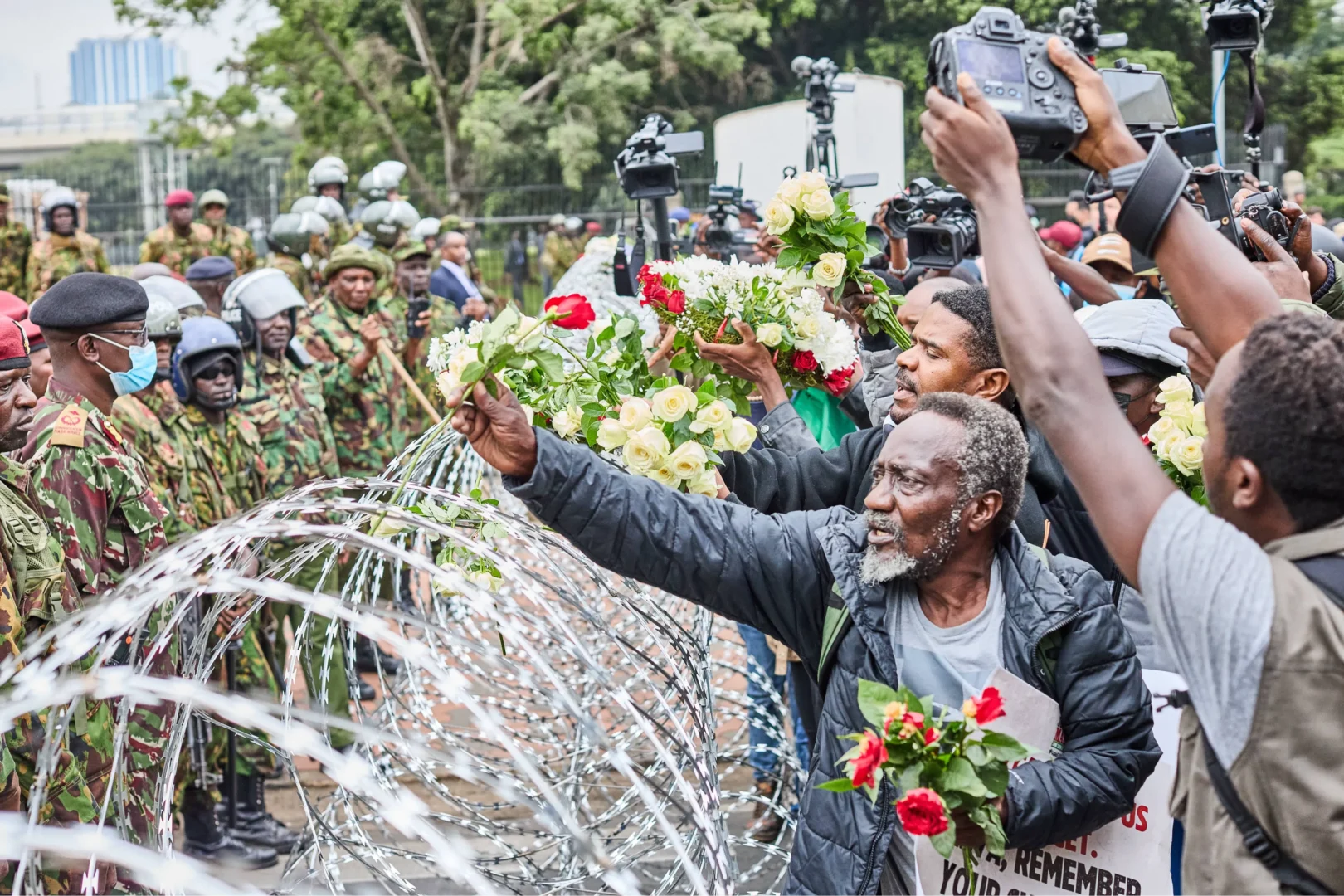
NAIROBI, Kenya — Families of Kenyans killed during the June 25, 2024 anti-government protests laid flowers on barbed wire barricades outside Parliament on Thursday, turning a heavily secured section of Nairobi into a poignant symbol of grief, remembrance and unresolved demands for justice.
The commemorations marked two years since the youth-led demonstrations that shook the country, culminating in the storming of Parliament and a deadly security crackdown that left dozens dead and many others injured.
With Parliament sealed off by police and surrounded by rolls of razor wire, grieving families were prevented from reaching the site where many had hoped to lay wreaths in memory of their loved ones.
Instead, they placed flowers on the barricades outside the parliamentary precincts as they renewed calls for accountability for those killed during the demonstrations.
Among those present was Jacinta Anyango, whose 12-year-old son, Kennedy, was killed during the 2024 unrest on the outskirts of Nairobi.
Fighting back emotion, she said her family continues to wait for answers and justice.
“All I want is for the government to bring the officers responsible for killing our children before us and let them apologise,” Anyango said.
She questioned whether the country had done enough to address the pain endured by families who lost relatives during the protests.
“Who does the president expect to vote for him next year if he continues killing us like this?” she asked.
Caroline Mutisya, whose son Erickson was among those killed near Parliament during the demonstrations, also attended the memorial gathering.
She said the heavy security presence around Parliament made it difficult for grieving families to freely express themselves.
“I came here today to remember my son who was killed just 50 metres from Parliament Buildings,” she said.
“But I do not feel safe enough to express myself.”
A small group of activists, civil society representatives and opposition leaders marched toward Parliament to honour those who died during the protests.
Among the leaders present were Wiper Party leader Kalonzo Musyoka, People’s Liberation Party leader Martha Karua and Democratic Action Party-Kenya leader Eugene Wamalwa.
The leaders joined families in laying flowers and observing moments of silence for the victims.
Their participation underscored the continuing political significance of the June 25 protests, which many observers describe as one of the most consequential youth-led movements in Kenya’s modern history.
The commemorations unfolded under tight security, with police blocking major roads leading into Nairobi’s Central Business District and restricting access to Parliament and other key government installations.
The road closures left parts of the city unusually quiet, with many businesses, schools and offices remaining closed throughout the day.
Public transport was disrupted in several areas as commuters struggled to access the city centre.
Security agencies defended the measures, saying they were necessary to maintain order and prevent criminal elements from infiltrating peaceful demonstrations.
Deputy Inspector General of Police Gilbert Masengeli said the roadblocks were intended to ensure weapons and individuals seeking to cause chaos did not enter the capital.
He maintained that the country remained largely calm despite the heightened tensions.
While turnout in Nairobi was lower than during the 2024 protests and last year’s anniversary commemorations, demonstrations were reported in several parts of the country.
In Mombasa, hundreds of young people marched through the streets dressed in black and draped in Kenyan flags.
Many carried banners demanding justice for victims of police violence and calling for an end to extrajudicial killings.
The march proceeded under police escort and remained largely peaceful.
Smaller gatherings were also reported in other regions as Kenyans marked the anniversary in different ways.
However, isolated clashes occurred in parts of Nairobi, where police used tear gas to disperse groups of protesters while demonstrators responded by throwing stones.
Footage circulating online showed smoke rising from sections of Githurai after protesters lit fires during confrontations with security officers.
Mounted police units were also deployed to disperse crowds in some areas.
The June 2024 demonstrations began as protests against controversial tax measures contained in the Finance Bill but quickly evolved into a broader movement driven largely by Generation Z activists demanding accountability, economic justice and improved governance.
The protests reached their peak when demonstrators breached Parliament grounds, prompting a forceful security response.
Human rights organisations estimate that more than 80 people were killed during the demonstrations and their aftermath, while dozens were injured or reported missing.
A subsequent investigation by the BBC alleged that some police officers deliberately targeted protesters during the unrest.
In the months that followed, reports of abductions, enforced disappearances and unexplained deaths further intensified scrutiny of the government’s response.
The anniversary comes amid continuing debate over accountability and reparations for victims.
Last week, President William Ruto announced a compensation fund worth nearly KSh2 billion (approximately $15 million) for almost 2,000 victims of protest-related human rights violations recorded between 2017 and 2025.
The President said the initiative was intended to support affected families and individuals but stressed that it should not be viewed as placing a monetary value on human life.
“This is not a price for life, pain or loss,” Ruto said.
Also Read: 355 arrested as Kenya marks second anniversary of June 25 Gen Z protests
However, several human rights organisations criticised the programme, arguing that it excludes some victims and lacks transparency regarding eligibility and payment criteria.
Rights groups continue to push for independent investigations and prosecution of those responsible for deaths and abuses linked to the demonstrations.
The June 25 anniversary also arrives at a politically sensitive moment as President Ruto’s administration faces growing public scrutiny ahead of the 2027 General Election.
Critics accuse the government of failing to deliver on key economic promises and of responding harshly to dissent.
The President has rejected those claims, maintaining that his administration has implemented the majority of its commitments and remains focused on economic transformation and service delivery.
For families gathered outside Parliament, however, the anniversary was less about politics and more about remembrance.
As flowers accumulated along the razor-wire barricades, the memorial served as a stark reminder that, two years later, many families are still searching for answers—and justice—for those they lost.
