


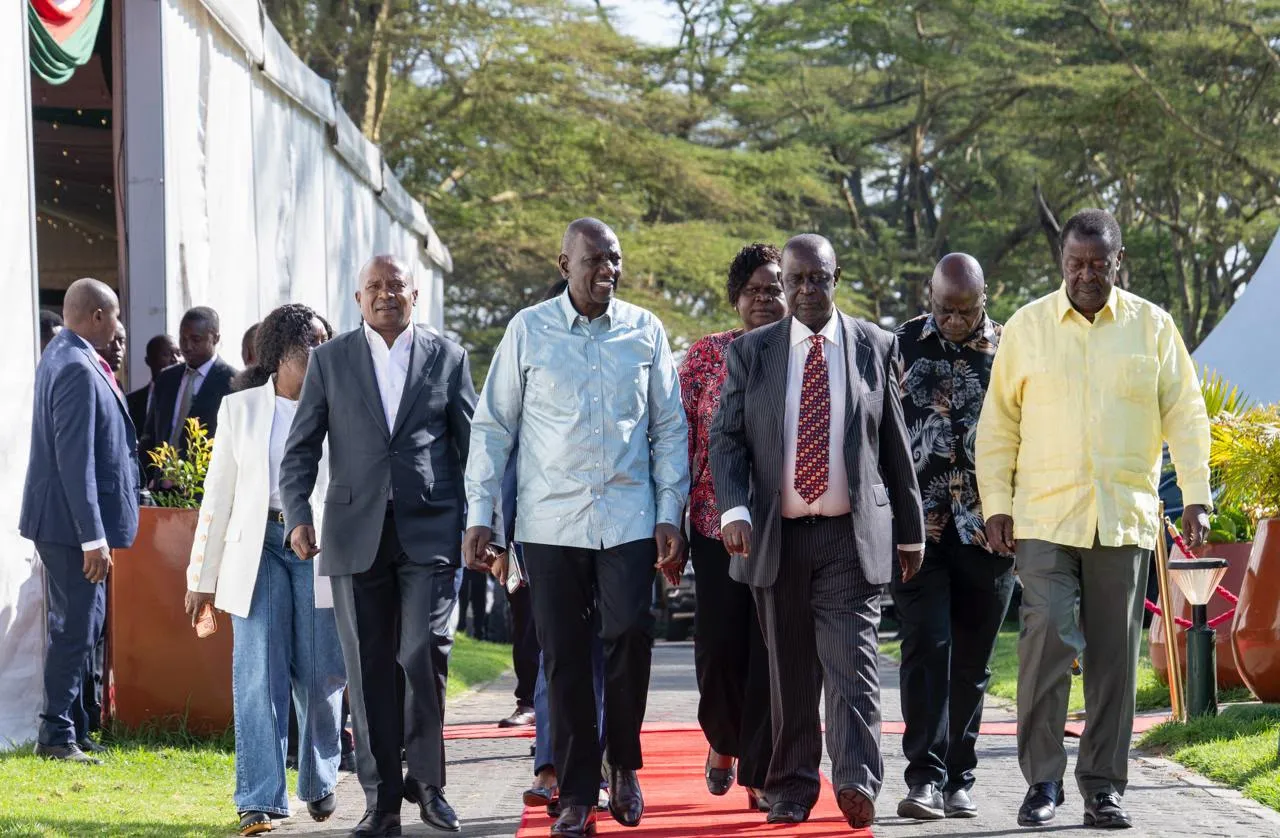
NAIVASHA, Kenya — President William Ruto has described Kenya’s broad-based government as the country’s largest political formation since the grand coalition government established after the disputed 2007 General Election.
Speaking on Monday, August 10, 2026, during the opening of a three-day broad-based parliamentary retreat in Naivasha, Ruto said the arrangement had brought together more than 250 members of the National Assembly, giving its leaders significant influence over the country’s political direction.
“This broad-based family is only second to the grand coalition government. Therefore, where you are seated today, understand the consequence of your being here,” Ruto said.
The President urged lawmakers and other leaders attending the retreat to appreciate the responsibility attached to the political arrangement, saying decisions made during the meeting could shape Kenya’s future.
“Our nation, Kenya, today depends to a very large extent on this team that is seated here. It is not easy to put together 250-plus members of the National Assembly,” he said.
Ruto said the leaders should approach the discussions with an understanding of the consequences their decisions could have on the country.
“The future of our nation is dependent on the decisions that we make in this meeting, and therefore, all of us seated here must understand the weight of the decisions we make because they will influence how Kenya moves into the future,” he added.
UDA-ODM talks take centre stage
The Naivasha retreat comes as the United Democratic Alliance (UDA) and the Orange Democratic Movement (ODM) deepen discussions on their political cooperation ahead of the 2027 General Election.
The meeting is expected to assess the performance of the broad-based government, examine progress on the 10-point agenda agreed when the two political sides began working together, and identify areas requiring greater coordination.
The talks are also expected to lay the groundwork for negotiations over a possible political arrangement for the 2027 presidential election.
A key proposal expected to emerge from the retreat is the formation of a 10-member negotiating team, with five representatives from each side, to steer discussions on a possible pre-election coalition.
The proposed arrangement could determine how UDA and ODM share political responsibilities and positions should they agree to support Ruto’s re-election bid.
ODM demands Deputy President position
The negotiations are, however, likely to be difficult, with ODM already signalling that it expects significant concessions in return for backing Ruto in 2027.
ODM leader Oburu Odinga has said the party would not field its own presidential candidate if it agrees to support Ruto, but that other positions would remain subject to negotiation.
“Wakati huu sisi ODM hatutakuwa na candidate, candidate wetu ni President William Ruto. But all the other positions are negotiable. Particularly number two,” Oburu said.
Also Read: Oburu Odinga urges ODM members to take clear stand on Ruto government
The deputy presidency is therefore expected to be one of the most contentious issues in the talks, potentially placing the position held by Kithure Kindiki at the centre of negotiations.
ODM has also pushed for a larger role in government, with party leaders calling for an equal share of government positions and resources as part of any agreement to support Ruto’s second-term bid.
Broad-based government enters election phase
The Naivasha meeting marks a significant shift from the original rationale of the broad-based government, which was presented primarily as an effort to promote national dialogue, political stability and cooperation following the 2024 anti-government protests.
With the 2027 election approaching, the arrangement is increasingly becoming the centre of political negotiations between Ruto’s UDA and ODM.
The outcome of the Naivasha discussions could therefore have implications beyond the current administration, particularly on the shape of the coalition that could contest the 2027 presidential election.
For now, both sides are seeking to preserve the political partnership while negotiating the terms under which it could translate into an electoral alliance.
