


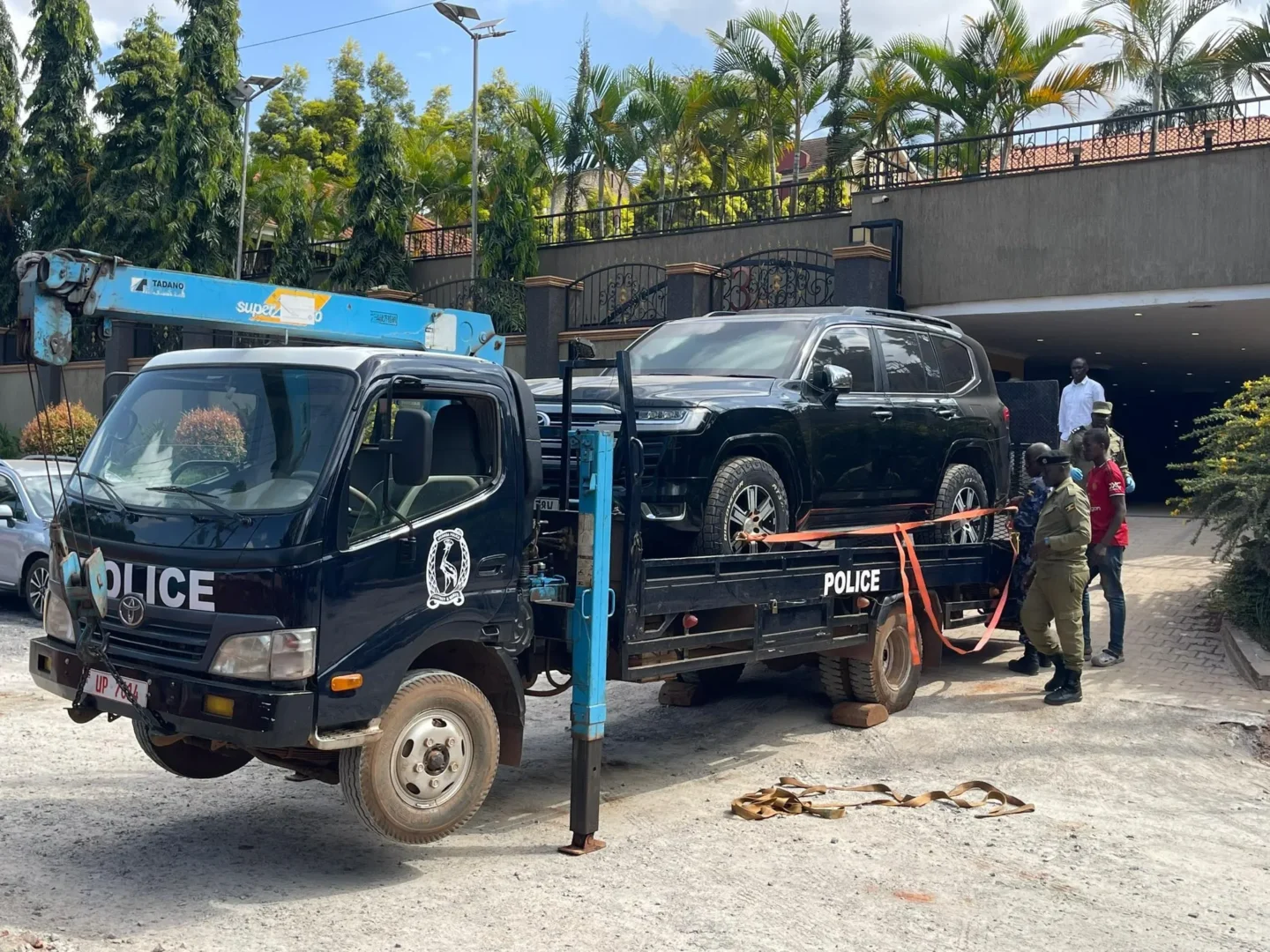
KAMPALA, Uganda — Uganda’s widening anti-corruption crackdown on outgoing Speaker Anita Annet Among has escalated into a full-scale asset seizure operation, with security agencies now impounding at least six luxury vehicles, large quantities of cash and a cache of firearms as part of an expanding probe into alleged illicit wealth.
The latest developments mark a dramatic intensification of investigations led by the Criminal Investigations Directorate (CID), working in coordination with military intelligence units, in what analysts describe as one of the most consequential accountability actions against a sitting or former senior official in Uganda’s recent political history.
The operation follows Among’s abrupt withdrawal from the Speakership race after mounting political pressure and a high-level intervention linked to Yoweri Kaguta Museveni, signaling a decisive shift from political contestation to legal and institutional scrutiny.
A coordinated asset seizure operation
What began as targeted searches at Among’s properties has now evolved into a structured asset recovery campaign spanning multiple high-value residences, including Kigo and Nakasero.

Security operatives deployed heavy-duty carriers to transport a fleet of luxury vehicles to the Police Forensics Headquarters in Naguru, where investigators have begun detailed auditing and forensic analysis.

According to sources familiar with the operation, the impounded fleet includes:
- A Rolls-Royce Cullinan valued at over Shs3.4 billion
- A Range Rover with personalised “AAA” registration
- A Mercedes-Maybach (AAA 1) recovered from a secondary location
- A Lexus SUV (UBP 704Y)
- Two armoured Toyota Land Cruisers linked to official convoys
The scale and coordination of the seizures suggest a transition from preliminary investigations to evidence consolidation, with authorities now focusing on tracing asset ownership, procurement channels and financial flows.
Cash recoveries and security concerns
The investigation has also taken a more serious turn following the reported recovery of large amounts of physical cash during coordinated searches.
Security sources say multiple suitcases containing significant sums of money were seized and transferred under guard, with prosecutors expected to rely on the findings as part of a broader illicit enrichment and money laundering case.
More significantly, investigators reportedly recovered a cache of firearms during the searches, some of which are said to have no record in Uganda’s national firearms registry.
Preliminary checks indicate the weapons were manufactured in Israel, raising potential national security concerns over unregistered arms and their acquisition channels.
While officials have yet to release a formal inventory, the discovery has added a new dimension to the probe, shifting part of the investigation toward security compliance and arms control violations.
Internal political rupture
The timing and scale of the crackdown reflect deeper shifts within Uganda’s political establishment.
Among’s fall has coincided with the withdrawal of support from factions linked to Gen Muhoozi Kainerugaba and the Patriotic League of Uganda (PLU), which played a decisive role in reshaping the Speakership race.
Her eventual withdrawal marked a political turning point—but the ongoing seizures indicate that the consequences extend far beyond parliamentary leadership contests.
“This has clearly moved into a different phase,” a Kampala-based political analyst said. “What we are seeing now is not just political isolation, but institutional exposure.”
Digital forensics and financial mapping
Investigators are now focusing on digital evidence recovered during earlier raids, including mobile devices and electronic records.
Forensic teams in Naguru are analysing communications, financial transactions and data trails to reconstruct networks potentially linked to asset accumulation.
Experts are also examining onboard systems from seized vehicles, including tracking and navigation data, to establish usage patterns, acquisition timelines and possible links to procurement processes.
Such methods reflect a more sophisticated investigative approach, increasingly reliant on digital intelligence to support complex financial cases.
This latest escalation builds on Vivid Voice News’ earlier reporting, including:
- Seizure of luxury vehicles from Among’s Kigo residence, which first exposed the scale of the investigation
- Her withdrawal from the Speakership race amid mounting political pressure
- Recovery of digital devices and forensic analysis linked to the probe

Together, these developments trace the rapid transformation of a political dispute into a multi-agency enforcement operation.
Symbolism and public perception
The public removal of luxury assets, particularly high-end vehicles, has amplified the political resonance of the case.
In a country facing economic pressures, such displays have intensified scrutiny of wealth accumulation among senior officials, reinforcing broader debates about governance, accountability and inequality.
Also Read: The rise and fall of Anita Among: A story of power, wealth and political reckoning
At the same time, questions persist over whether such enforcement actions reflect a systemic shift or remain tied to internal political dynamics.
A defining test for accountability
For Uganda’s institutions, the case represents a critical test.
If pursued consistently and transparently, it could signal a strengthening of accountability mechanisms.
If perceived as selective, it risks reinforcing long-standing concerns about the politicisation of anti-corruption efforts.
For Anita Among, the developments represent a profound reversal, from one of the most powerful figures in government to the central subject of an expanding legal and political storm.
With forensic analysis underway and prosecutors preparing potential charges, the investigation appears to be entering a decisive phase.
The scale of asset seizures, combined with emerging financial and security dimensions, suggests that the case could extend beyond a single individual to examine broader networks within Uganda’s political and administrative system.
For now, the message is unmistakable: what began as a political contest has evolved into one of the most significant accountability moments in Uganda’s recent history.
