


NAIROBI, Kenya — As a deadly and little-known Ebola strain with no approved vaccine spreads across the Democratic Republic of the Congo (DRC) and Uganda, United States health authorities have begun evacuating American nationals exposed to the virus, highlighting growing international concern over the scale and complexity of the outbreak.
The Centers for Disease Control and Prevention (CDC) confirmed on May 17, 2026, that “a small number of Americans” were being transferred out of Congo, including individuals classified as high-risk exposures. Among them is an American doctor who has since been evacuated to Germany for treatment and monitoring.
A day later, U.S. authorities announced new entry restrictions targeting travellers who had recently visited Ebola-affected countries, as part of broader containment measures.
The World Health Organization (WHO) declared the outbreak a “public health emergency of international concern” on May 17, citing concerns over cross-border spread and delayed detection.
Despite the escalation, the CDC maintains that the immediate risk to the United States remains low, a position broadly supported by infectious disease experts.
However, scientists warn that one critical factor sets this outbreak apart: it is caused by a strain of Ebola for which there is no approved vaccine.
Ebola is not a single virus but a group of related pathogens known as orthoebolaviruses. While several species exist, most major outbreaks have historically been driven by the Zaire strain, the only one for which a licensed vaccine, Ervebo, and targeted treatments are available.
The current outbreak, however, is linked to the Bundibugyo strain, first identified in Uganda in 2007. It remains one of the rarest Ebola variants and has been responsible for only a handful of outbreaks.
Crucially, there are no approved vaccines or specific therapeutics for this strain. Scientists say its genetic differences mean that immunity from existing vaccines is unlikely to provide protection.
Perhaps the most concerning aspect of the current crisis is how long it may have spread before being identified.
Initial field tests—designed primarily to detect the Zaire strain, failed to identify the virus. It was only after genomic sequencing in Kinshasa that the Bundibugyo strain was confirmed.
By then, the outbreak had already expanded significantly, with hundreds of suspected cases reported in Ituri Province.
Experts warn that such delays make containment far more difficult, as contact tracing efforts are forced to play catch-up.
The outbreak is unfolding in a region already destabilised by conflict, displacement and weak healthcare systems.
Ituri Province borders both Uganda and South Sudan and is characterised by high population mobility, including movement linked to artisanal mining and cross-border trade.
Cases have already reached major urban centres, including Kampala—Uganda’s capital—raising fears that the virus could spread through regional and international transport networks.
Health officials warn that once Ebola reaches densely populated and highly connected cities, containment becomes significantly more complex.
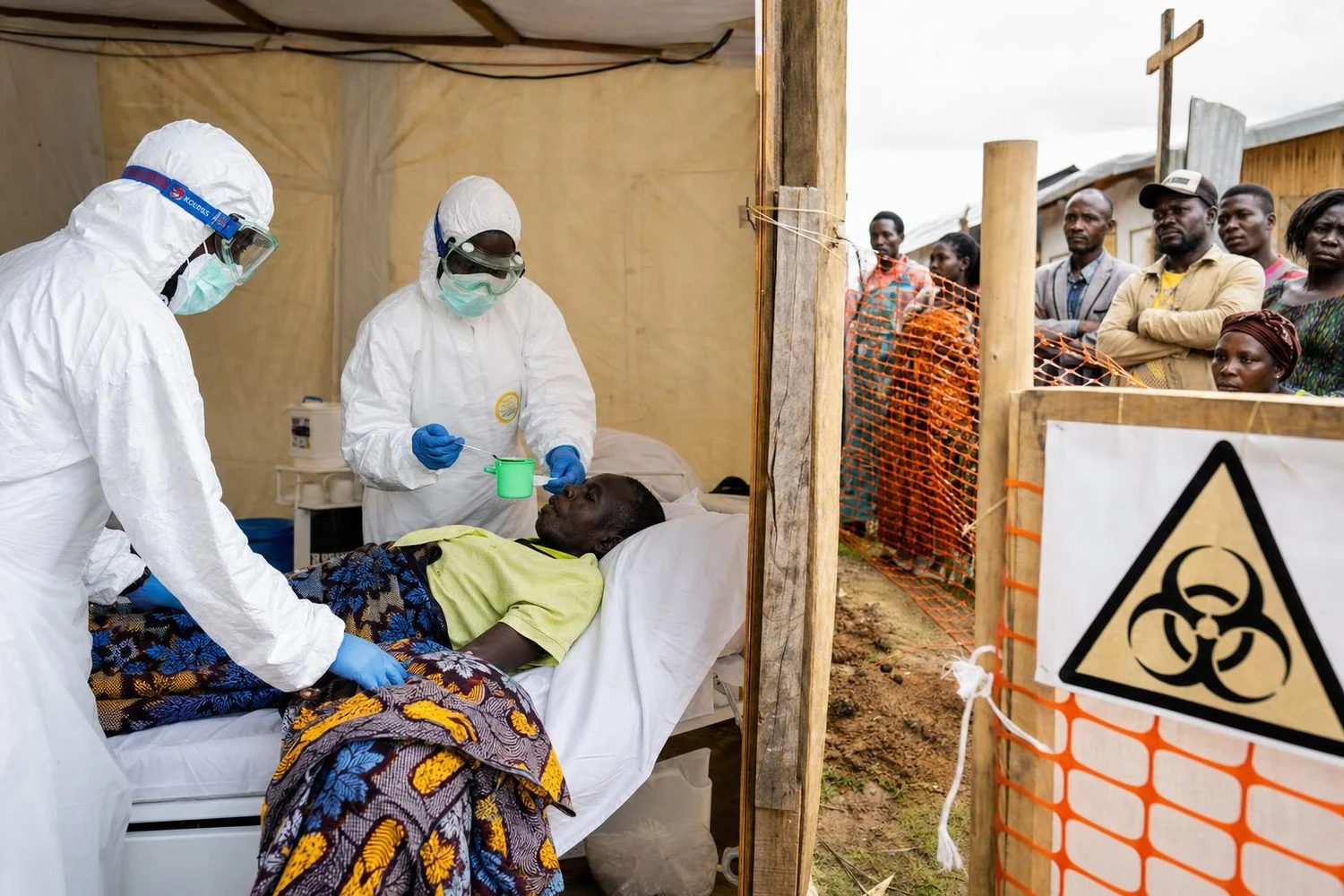
Ebola spreads through direct contact with infected bodily fluids, including blood, vomit and other secretions. Health workers are particularly vulnerable, especially in settings where protective equipment is limited.
In the current outbreak, several of the earliest identified victims were healthcare workers—an indicator of transmission within medical facilities.
There are also concerns about less visible transmission pathways. Studies from previous outbreaks show the virus can persist in certain parts of the body, including reproductive tissues, even after recovery. This has led to documented cases of sexual transmission months after initial infection.
Whether similar patterns apply to the Bundibugyo strain remains under investigation.
Without a targeted vaccine or antiviral treatment, the response depends heavily on traditional containment strategies: early detection, isolation of cases, contact tracing, safe burials and community engagement.
These measures have proven effective in past outbreaks but are resource-intensive and difficult to sustain in conflict zones.
Health experts say early supportive care, such as hydration, oxygen and blood pressure management, can improve survival rates, even in the absence of specific drugs.
Also Read: Latest Ebola outbreak in DR Congo may be larger than reported, WHO warns
Experimental vaccines targeting the Bundibugyo strain have shown promise in laboratory settings but are not yet approved for human use.
The current outbreak has also reignited debate over global health preparedness. Some epidemiologists have questioned whether gaps in surveillance funding may have contributed to delayed detection.
More broadly, the crisis highlights a structural vulnerability: global preparedness efforts have largely focused on the most common Ebola strain, leaving gaps in response capabilities for rarer variants.
For now, health authorities stress that containment remains possible, but increasingly urgent.
The evacuation of exposed individuals and tightening of international travel measures reflect a growing recognition that in an interconnected world, outbreaks are rarely confined by geography.
As the situation evolves, experts warn that the greatest risk lies not only in the virus itself, but in the speed at which it moves, and the systems tasked with stopping it.
