


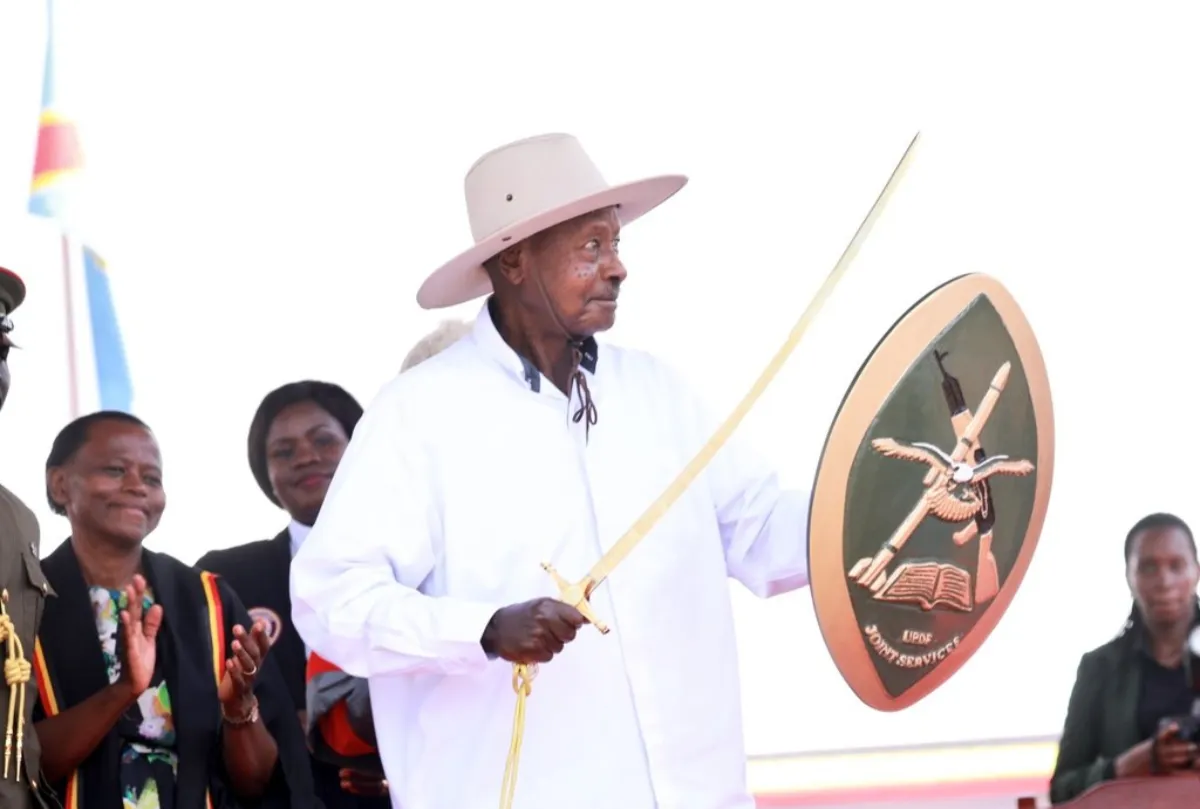
KAMPALA, Uganda — President Yoweri Kaguta Museveni has used his swearing-in ceremony in Kampala to defend the National Resistance Movement’s (NRM) nearly four decades in power, presenting what he described as a structured “seven-brick” development framework that has guided Uganda’s transformation since 1986.
Speaking at Kololo Ceremonial Grounds before regional heads of state, diplomats and international guests, Museveni framed his administration’s record as a phased model of national development built on stability, infrastructure expansion and economic integration.
He said the framework reflects Uganda’s long-term governance strategy, with each “brick” representing a pillar of national transformation.
The ceremony marked the beginning of another five-year term for the 81-year-old leader, who remains one of Africa’s longest-serving heads of state.
Peace as the foundation
Mr Museveni said the first pillar of his model is peace, which he attributed to the NRM’s rejection of sectarian politics based on ethnicity and religion.
He argued that political stability laid the foundation for Uganda’s recovery from decades of conflict.
“When we rejected the politics of sectarianism… that is how we were able to unite the people,” Museveni said.
Infrastructure expansion
The second “brick” is infrastructure development, which he said includes roads, electricity, water systems, railways, airports and telecommunications.
Museveni also pointed to schools and health facilities as part of what he described as the country’s social infrastructure backbone.
Economic transformation and wealth creation
The third pillar focuses on economic transformation, shifting Uganda from subsistence production to commercial agriculture, manufacturing, services and technology-driven growth.
He drew a distinction between national development indicators and individual prosperity.
“Development is one thing, but wealth is another,” he said.
Jobs, services and markets
Mr Museveni said the fourth brick is job creation, which he linked to expanding production and private sector growth.
The fifth is service delivery, covering key public functions such as security, education, healthcare and justice.
The sixth focuses on market integration, with Museveni highlighting regional and continental trade frameworks including the East African Community (EAC) and the African Continental Free Trade Area (AfCFTA) as critical to expanding demand for Ugandan goods.
Regional integration as the final pillar
The seventh brick is political and economic integration within East Africa, which he said is necessary for long-term stability, competitiveness and industrial growth.
He compared Africa’s fragmented markets with larger global economic blocs, arguing that integration remains essential for scaling production and trade.
Poverty, inequality and economic reality
Museveni said Uganda’s development has not been evenly distributed, acknowledging that while many households have benefited from government programmes, pockets of poverty remain.
Also Read: Museveni sworn in again as Uganda faces succession and economic questions
He urged citizens to actively participate in wealth creation, stressing that government support alone is insufficient to drive transformation.
“You must be part of wealth creation,” he said.
Broader economic context
His remarks come as Uganda continues to pursue industrialisation and deeper regional trade integration, while grappling with persistent challenges including youth unemployment, income inequality and uneven service delivery.
Analysts have long debated the gap between Uganda’s macroeconomic growth and household-level welfare, a tension that remains central to the country’s policy direction.
Museveni’s “seven-brick” doctrine reinforces a long-standing governance philosophy centred on peace, infrastructure-led growth, production, and regional integration as the pillars of national development.
As Uganda enters another term under his leadership, the framework is likely to remain central to government messaging amid growing scrutiny over economic inclusion and political continuity.
