


NYAMIRA, Kenya — President William Ruto has dismissed the United Opposition’s efforts to rally behind a single presidential candidate in the 2027 General Election, challenging its leaders to explain how their political arrangements would improve the lives of Kenyans.
Ruto questioned the significance of the opposition’s unity campaign, arguing that voters were more concerned about their economic well-being, access to healthcare, education and infrastructure than the number of candidates opposition leaders intended to field.
Speaking on Monday, November 9, during the launch of the Riamoni-Nyangori Road and Last Mile Connectivity project in Kitutu Masaba, Nyamira County, the President challenged opposition leaders to shift their attention from political negotiations to addressing the country’s development challenges.
“Who cares whether you are united or have one candidate?” Ruto asked.
He questioned what the opposition’s proposed political alliance would offer ordinary Kenyans, insisting that leaders should explain how their policies would improve household incomes and access to essential services.
“How will you put money in their pockets? How will their children go to school? How will their roads be built? How will they access healthcare? Those are the things Kenyans want to know,” he said.
The President urged opposition leaders to keep their political negotiations to themselves, arguing that Kenyans were more interested in solutions to their everyday challenges than discussions about coalition arrangements.
“That is your business. Do not keep telling Kenyans about your business. Kenyans want to know their own concerns, not yours,” he added.
Ruto questions opposition claims of controlling millions of votes
Beyond dismissing the opposition’s unity campaign, Ruto took aim at leaders claiming to command millions of votes, arguing that politicians could not treat voters as personal political possessions.
He questioned the suggestion that individual opposition figures could negotiate political positions based on the number of supporters they claimed to control.
Ruto likened the claims to politicians carrying voters around in bags, insisting that Kenyans had the independence and intelligence to determine their preferred leaders.
“I hear three people called a meeting and talked about, ‘I have a bag of 10 million votes,’ and another said, ‘I have a bag of 3 million votes.’ Do you think Kenyans are so gullible that you can walk around claiming to carry their votes?” he asked.
He challenged the opposition to respect the electorate rather than assume that political support could be transferred between leaders through coalition negotiations.
“These citizens are intelligent. They are the ones who will decide who to elect and who not to elect,” Ruto said.
The President’s remarks appeared directed at the United Opposition’s claims that its combined political support could deliver at least 10 million votes in the 2027 election, with additional backing expected from parts of Eastern and Kisii regions.
Gachagua, Kalonzo and Matiang’i reaffirm opposition unity
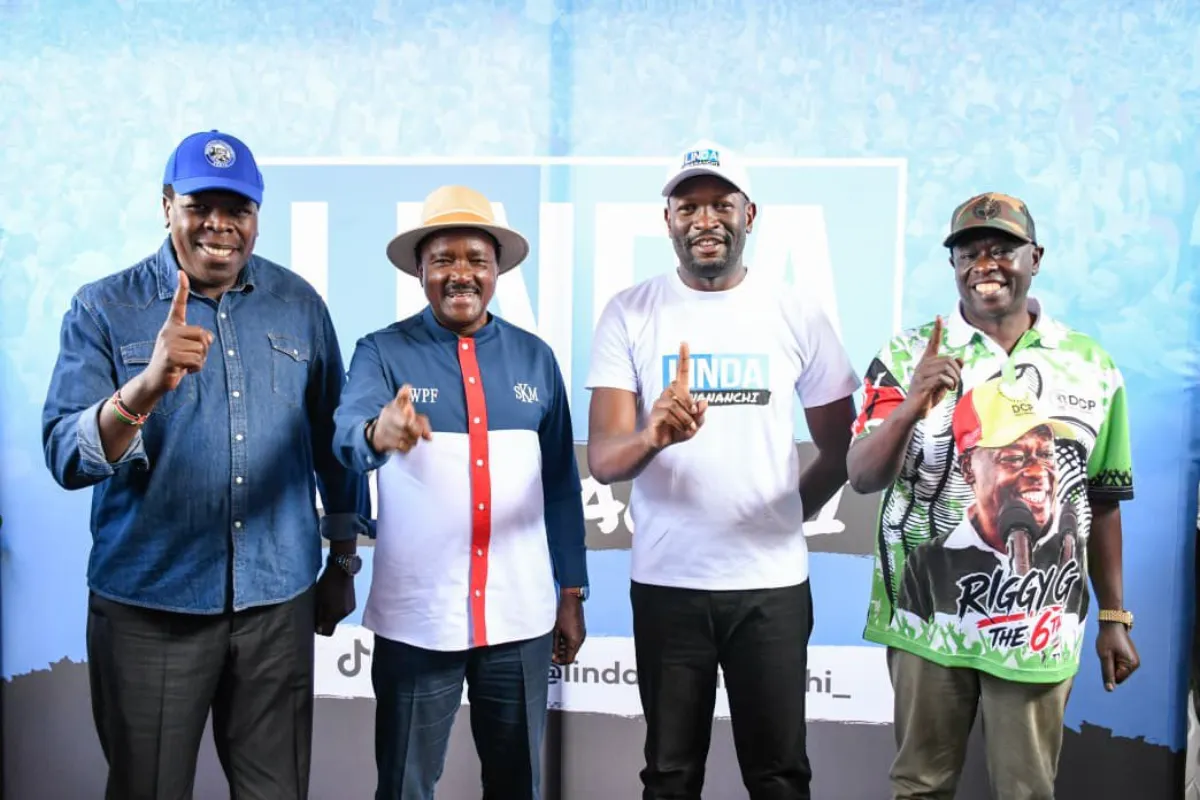
Ruto’s latest remarks come amid renewed efforts by opposition leaders to resolve internal disagreements and establish a united political front ahead of the 2027 presidential election.
On Saturday, November 7, Wiper Party leader Kalonzo Musyoka, Democracy for the Citizens Party (DCP) leader Rigathi Gachagua and Jubilee Party leader Fred Matiang’i held a strategic meeting aimed at addressing tensions within the opposition.
The meeting followed weeks of public disagreements, with Gachagua appearing to question whether some leaders expected to secure the opposition’s presidential ticket without making sufficient efforts to mobilise political support.
Kalonzo was understood to have convened the talks amid concerns that continued divisions could push Matiang’i towards alternative political arrangements.
However, the meeting appeared to ease tensions, with Matiang’i subsequently signalling that the leaders had resolved their differences.
In a post on his X account, he shared photographs from the meeting accompanied by the caption: “Brothers will always put Kenya first.”
Speaking during a church service in Naro Moru, Nyeri County, on Sunday, November 8, Matiang’i reiterated his commitment to opposition unity, saying individual political differences should not derail their shared objective of challenging Ruto.
He described unity as one of the foundations upon which Kenya was built, adding that opposition leaders were prepared to make sacrifices to achieve their political ambitions.
“As the opposition, we may have our differences, just like any household. But we know Kenyans want us united, and I assure you, we will build an unbeatable team, united in purpose and ready to deliver victory with military precision,” Matiang’i said.
Gachagua has similarly maintained that the opposition will eventually agree on a single presidential candidate, drawing comparisons with the 2002 elections when opposition parties united under the National Rainbow Coalition (NARC) to end KANU’s 24-year rule.
On November 3, the former Deputy President said opposition leaders had agreed to field one candidate, insisting that their differences would not derail the arrangement.
However, the opposition has yet to publicly identify its preferred presidential candidate for 2027.
Ruto revisits political fallout with Gachagua
The President also used the Nyamira rally to revisit his political fallout with Gachagua, dismissing the former Deputy President’s repeated assertions that he played a decisive role in securing victory in the 2022 General Election.
Ruto pointed to their respective electoral records, claiming he had won seven elective contests while Gachagua had been elected only once.
“I have been elected seven times; you were elected once,” he said.
Also Read: Ruto accuses Gachagua of extorting DCP aspirants, calls him ‘chief extortionist’
He also revisited the circumstances surrounding Gachagua’s selection as his running mate in the 2022 election, claiming that the former Deputy President received only four votes in a selection process involving 30 people.
“We went through a vote involving 30 people, and he got four votes. I felt sorry for him and decided to give him the position because he was more senior. But even what I gave him, he could not keep,” Ruto said.
The remarks add to the increasingly personal confrontation between the two leaders, who have become political rivals following Gachagua’s removal from office in October 2024.
With the 2027 presidential contest approaching, the opposition faces the challenge of reconciling competing political interests, agreeing on a joint flagbearer and translating its claimed support into a coherent electoral strategy.
For Ruto, the opposition’s unity efforts present an opportunity to question whether its leaders can offer a credible alternative to his administration.
Ultimately, the contest will depend not only on whether opposition leaders can agree on one presidential candidate but also on their ability to convince voters that their proposed leadership and policies offer a better alternative.
