


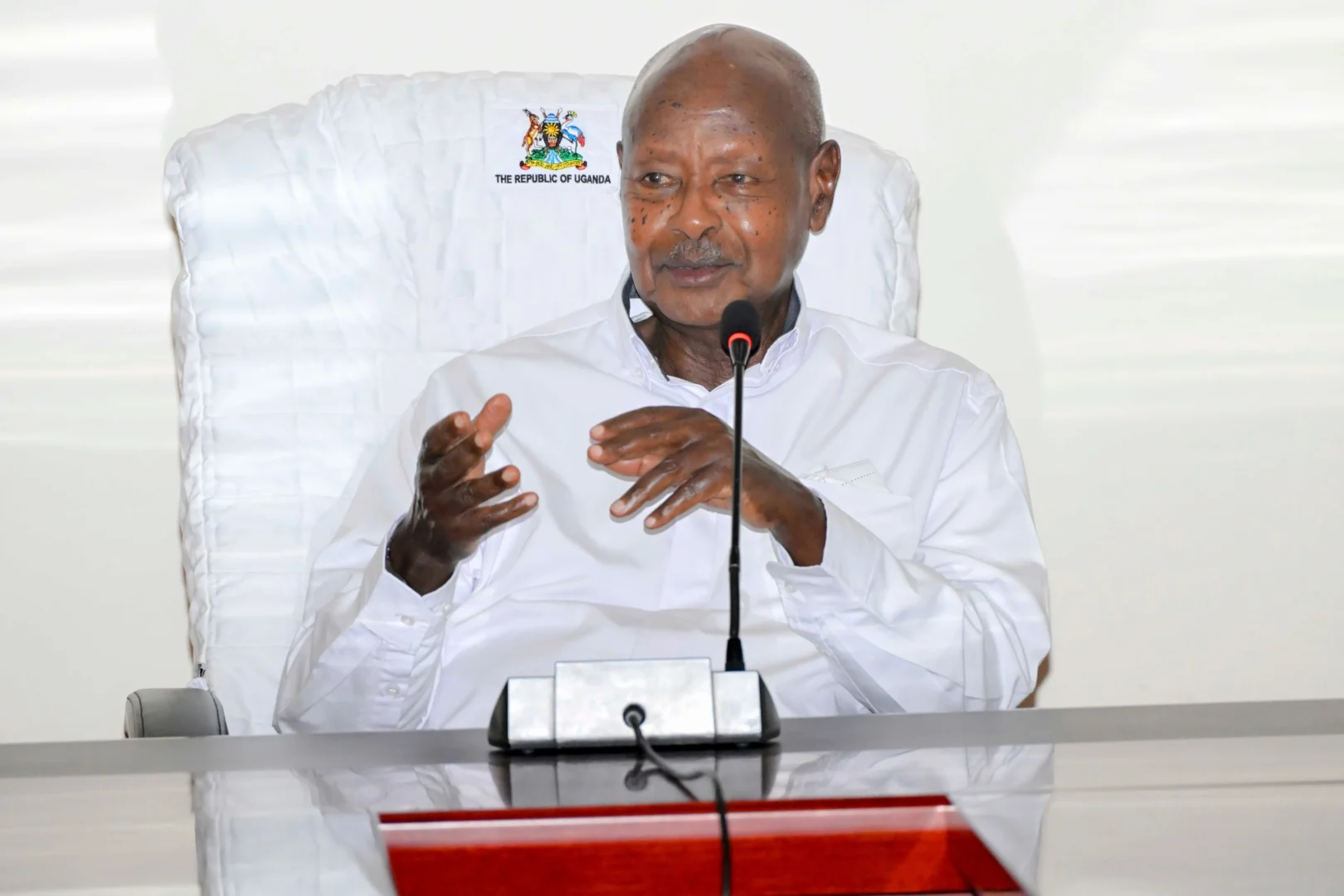
ENTEBBE, Uganda — President Yoweri Museveni has rejected calls to use Uganda’s foreign exchange reserves to slow the depreciation of the shilling, arguing that the country should preserve its dollar holdings and reduce dependence on imports as global conflicts drive up fuel costs.
Speaking during Uganda’s 64th Independence Day celebrations at State House Entebbe on Friday, October 9, 2026, Museveni attributed the economic pressures to geopolitical tensions, rising international energy costs and other external shocks.
He said the government would not continue injecting dollars into the market simply to defend the shilling against the US currency.
“I am totally against the Governor Bank of Uganda’s proposal to squander our reserves and deploy more dollars in the market to counter the falling shilling,” Museveni said.
Instead, the President urged Ugandans to minimise imports and purchase domestically manufactured products, arguing that stronger local production would make the economy less vulnerable to international price fluctuations.
The position puts the government’s emphasis on domestic production and exchange-rate flexibility rather than attempting to maintain the shilling at a particular level through foreign currency sales.
Shilling loses more than 11% against the dollar
Museveni’s remarks came as the Ugandan shilling faced renewed pressure in the foreign exchange market.
A Reuters report published on October 8 said the currency had weakened by more than 11 per cent against the US dollar since the beginning of 2026, with commercial banks quoting the dollar at approximately Shs4,090 to Shs4,100.
The report attributed the pressure partly to strong demand for foreign currency from merchandise importers, energy companies and telecommunications businesses. Some firms were also seeking to build up dollar holdings ahead of the fourth-quarter holiday period.
The weakening currency has significant implications for businesses and households because Uganda relies on imports for petroleum products, machinery, industrial raw materials and other goods.
When the shilling loses value against the dollar, importers need more local currency to pay overseas suppliers. Those additional costs can be passed on to consumers through higher prices for fuel, transport and other goods and services.
Museveni argued, however, that depreciation also benefits exporters, who receive more shillings when they convert dollar earnings into local currency.
“The depreciating shilling is good for exporters because they will earn more shillings,” he said, while acknowledging that importers face the opposite effect.
The benefits are not uniform across the economy: exporters may gain from improved local-currency earnings, while businesses that depend heavily on imported inputs face higher operating costs.
Museveni says Vitol deal temporarily cushioned fuel prices
The President also explained how the government had attempted to shield Ugandans from rising fuel prices through a temporary supply arrangement with international commodities trader Vitol.
Museveni said he had negotiated for the company to supply petroleum products at discounted prices, hoping that conflicts affecting international energy markets would end before the arrangement expired.
“When the Iran-America war started biting, I negotiated with Vitol to supply us fuel at subsidized prices which they did for months,” he said, adding that the conflict had persisted and international fuel prices had risen.
The arrangement, he said, had provided temporary relief but could not be maintained indefinitely while global prices remained elevated.
Uganda has changed its petroleum procurement approach in recent years, moving towards direct purchases from international suppliers through the Uganda National Oil Company (UNOC), rather than relying solely on the previous supply arrangement through Kenya.
The strategy is intended to strengthen Uganda’s control over fuel procurement and help cushion the country against supply disruptions. However, direct procurement cannot fully insulate consumers from movements in international oil prices or exchange-rate changes.
Fuel prices remain high as Parliament demands answers
The fuel-price debate has also intensified in Parliament, where legislators are seeking a clearer explanation of how international costs, taxes and domestic supply arrangements are reflected in pump prices.
According to Uganda’s Ministry of Finance, Planning and Economic Development, petrol averaged Shs6,529 per litre and diesel Shs6,647 per litre in August 2026.
The ministry attributed the elevated prices to geopolitical tensions affecting global supply chains and delays in passing lower international prices on to consumers because some suppliers still held stocks purchased at higher prices.
On October 7, Energy and Mineral Development Minister Monica Musenero told Parliament that several factors were contributing to the increases, including shilling depreciation, international supply pressures and a Shs200-per-litre excise duty increase introduced in the 2026/2027 financial year.
Parliament subsequently demanded a detailed breakdown of the prices at which UNOC supplies petroleum products to oil marketing companies. Deputy Speaker Thomas Tayebwa said lawmakers needed to establish how much was added to the price before fuel reached consumers.
Musenero said she had not yet received the detailed figures but promised to provide the information. The debate was adjourned pending a more comprehensive government statement.
The parliamentary scrutiny highlights a domestic dimension to the fuel-price problem. Although international oil prices and exchange-rate movements are important, taxes and the pricing decisions of suppliers and oil marketing companies also influence what motorists ultimately pay.
Bank of Uganda’s approach to currency pressure
Museveni’s rejection of reserve sales comes amid broader debate about how Uganda should respond to the shilling’s depreciation.
Reuters reported that the Bank of Uganda does not intend to defend a specific exchange-rate level, although it has tools to manage excessive volatility and maintain an orderly foreign exchange market.
The President’s remarks indicate that he does not support using the country’s dollar reserves to force the exchange rate lower simply to reduce the cost of imports.
Foreign exchange reserves provide a buffer against external shocks and help meet international payment obligations. Using them to influence the exchange rate can provide temporary relief, but the effectiveness of such intervention depends on the scale and persistence of demand for dollars.
The challenge for policymakers is to balance the need to preserve reserves with the risk that a persistently weaker currency could increase inflationary pressure and raise costs for businesses and consumers.
IMF warns of risks from energy prices and regional instability
Uganda’s economic outlook also faces risks from the Middle East conflict and other disruptions.
In its July 2026 assessment, the International Monetary Fund said Uganda’s economy had maintained strong growth momentum, supported by domestic demand, low inflation and increased private-sector credit.
However, it warned that a prolonged or intensified Middle East conflict could disrupt trade and capital flows, raise energy and transport costs and weaken the economic outlook. The Fund also identified the Ebola outbreak as a near-term downside risk.
The IMF said exchange-rate depreciation, elevated energy prices and higher transport costs could push headline inflation above 5 per cent in the 2026/2027 financial year. It also stressed the importance of exchange-rate flexibility and rebuilding economic buffers.
The government therefore faces a difficult balancing act: protecting households from rising living costs while preserving foreign currency reserves and maintaining the stability of the wider economy.
Local production at the centre of Museveni’s response
Museveni urged Ugandans to respond to the pressure by buying more locally produced goods and reducing their reliance on imported products.
His argument is that a stronger domestic manufacturing base would reduce demand for foreign currency, retain more spending within the economy and make Uganda less exposed to international supply shocks.
However, shifting consumption towards locally manufactured goods depends on whether domestic producers can supply sufficient quantities at competitive prices. Many manufacturers themselves rely on imported machinery, fuel, packaging and raw materials, meaning currency depreciation can raise their production costs as well.
Also Read: Uganda shilling approaches Shs4,000 per dollar as forex demand rises
The President also cited the Ebola outbreak and movements in international investment as additional pressures affecting economic activity, including travel and tourism.
His message on Independence Day was that Uganda should strengthen its ability to withstand disruptions beyond its borders rather than rely on foreign exchange intervention to shield the economy from every external shock.
For households and businesses, the immediate concern remains the effect of the weaker shilling and elevated fuel prices on transport, production and the cost of living.
Whether greater reliance on local production can reduce that vulnerability will depend on the pace of investment, the competitiveness of domestic industries and the government’s ability to address the factors driving import demand and rising prices.
For now, Museveni has made clear that his government will prioritise preserving foreign exchange reserves and encouraging local production over using public dollar holdings to defend the shilling at a particular rate.
