

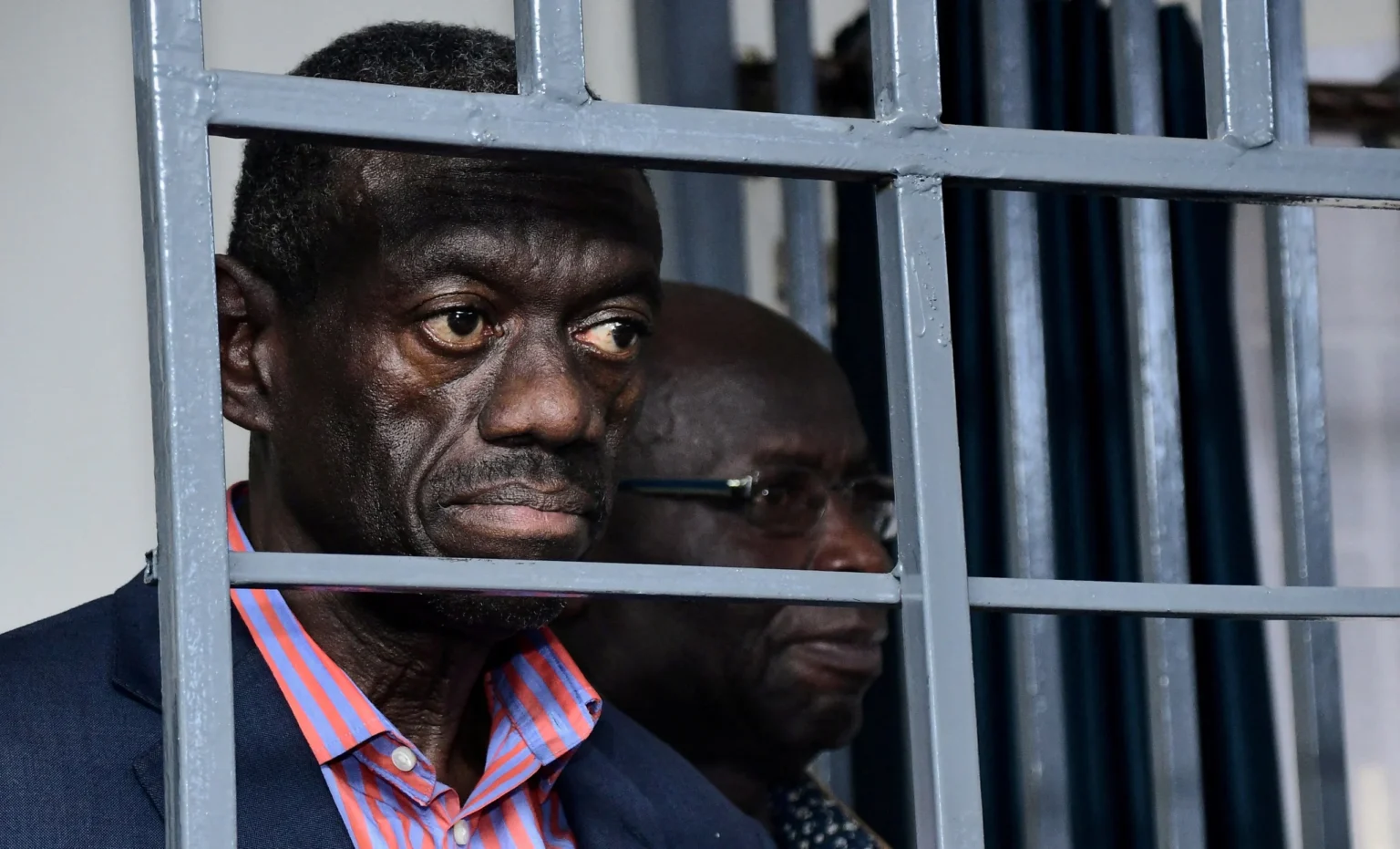
KAMPALA, Uganda — In most criminal trials, the fight revolves around guilt, innocence, evidence and witnesses.
But in the case of veteran opposition leader Dr Kizza Besigye, one of the fiercest battles unfolding before the High Court is not yet about the allegations against him. It is about something more fundamental: who has the right to stand beside an accused person in court.
That question has now ignited a fresh confrontation between the State, the judiciary and members of Uganda’s legal fraternity after lawyer Eron Kiiza publicly challenged the appointment of advocates selected by the High Court to represent Dr Besigye and his co-accused, Hajj Obeid Lutale.
At the centre of the dispute lies a constitutional principle that lawyers often regard as sacred — the right of an accused person to choose his or her own legal representation.
For Kiiza, the issue is not merely procedural. It goes to the heart of whether justice can remain legitimate when legal representation is imposed on defendants who have openly rejected it.
His four-page letter to three advocates appointed by the court transforms what might have appeared to be a routine judicial decision into a broader debate about constitutional rights, professional ethics and the limits of state power in politically sensitive prosecutions.
The controversy traces its roots to a ruling delivered by High Court Judge Emmanuel Baguma earlier this week.
Faced with repeated concerns from prosecutors that Dr Besigye and Lutale were appearing before court without legal representation, the judge directed the Registrar of the Criminal Division to provide the accused with a list of advocates available on state brief.
The court further ruled that if the accused declined to choose lawyers from that list, counsel could be appointed for them under Article 28(3)(d) of Uganda’s Constitution.
To supporters of the ruling, the decision was presented as a practical measure designed to prevent further delays in a high-profile treason case.
To Dr Besigye and his legal team, however, the ruling immediately raised a different concern.
The opposition leader rejected the arrangement, arguing that he already had lawyers of his choice and that assigning new counsel shortly before trial would deny them adequate time to prepare.
It is within that context that Kiiza’s letter landed with unusual force.
Addressing the three lawyers named by the court — Sylvia Namawejje, Sarah Awero and Julius Sserwambala — Kiiza framed the issue not as a professional opportunity but as a constitutional dilemma.
“I write to you as one of the advocates chosen — freely, and only by Col. (Rtd.) Dr Kizza Besigye and Hajji Obied Lutale to defend them,” Kiiza wrote.
“You have been hand-picked at the instance of Mr Baguma Emmanuel… for men who have not asked for you, who do not want you, and who have asserted their counsel of their own choosing firmly on the record.”
His message was not simply legal argument. It was a direct appeal to professional conscience.
“It is not a brief. It is a role in a script whose closing scene dishonours every advocate who has stood before the Courts of Judicature of Uganda.”
The language reflects how deeply the dispute has evolved beyond questions of courtroom administration.
Legal analysts note that the right to legal representation contains two distinct but often overlapping principles.
One is the right to legal assistance. The other is the right to counsel of one’s own choosing.
In ordinary criminal cases, those principles generally coexist without conflict. Courts appoint lawyers when defendants cannot afford representation. Defendants retain lawyers when they can.
The Dr Besigye case presents a more complicated scenario because the accused are not claiming a lack of legal representation. Instead, they argue that their preferred legal team has been prevented from effectively representing them.
Kiiza’s argument hinges on that distinction.
“The right to counsel of choice belongs to the accused. It is not the gift of the State,” he wrote.
“The right belongs to the accused alone. No court, no prosecutor, and no judge can supply the one thing the accused alone can give: his consent.”
The letter repeatedly returns to the concept of consent, portraying it as the foundation upon which the entire advocate-client relationship rests.
“The advocate-client relationship is not a duty the court may foist upon an unwilling recipient like a prison uniform. It is a consensual, fiduciary bond, founded upon trust and upon instructions freely given and freely received.”
“Without instructions, there is no advocate.”
Such arguments touch on a long-established principle in legal practice: lawyers derive authority from their clients.
Without that authority, legal representation risks becoming symbolic rather than substantive.
Yet the dispute is also unfolding against a highly charged political backdrop.
Dr Kizza Besigye’s legal team has repeatedly argued that the environment surrounding the case has made it difficult for his chosen lawyers to operate freely.
Kiiza’s letter references what he describes as actions taken against members of the defence team, including the deportation of Kenyan Senior Counsel Martha Karua and the prosecution of Kampala Lord Mayor Erias Lukwago.
“The chairs you are asked to occupy are not empty by accident, nor by the client’s choice,” he wrote.
“They are empty because they were violently emptied.”
Whether those claims ultimately withstand legal scrutiny remains a matter for the courts.
What is clear, however, is that the dispute has become about more than the fate of a single criminal case.
It has evolved into a contest over how constitutional guarantees should function when the State’s interests and an accused person’s rights appear to collide.
The implications extend beyond Dr Besigye himself.
If courts can appoint lawyers over the objections of defendants who insist they already have preferred counsel, legal scholars argue that difficult questions emerge about the limits of judicial intervention.
Conversely, if accused persons can indefinitely reject representation, courts face the challenge of ensuring that proceedings do not become paralysed.
That tension explains why the latest developments are attracting attention far beyond the courtroom.
The case now sits at the intersection of constitutional law, judicial administration and Uganda’s often turbulent political landscape.
For Kiiza, the stakes could not be higher.
Appealing directly to the three lawyers, he warned that accepting the appointments would amount to legitimising a process he believes is fundamentally flawed.
“You would be the seal the State presses upon its own illegality, the signature that makes the forgery appear genuine.”
Also Read: Museveni challenges Besigye to face treason trial instead of ‘court drama’
“You would be the instrument, not the author — but the instrument is not innocent.”
The three advocates have not publicly responded to the letter, and the High Court has yet to determine how it will address the objections raised by Besigye and his legal team.
As the treason case moves toward trial, the immediate legal question remains unresolved.
But the larger issue now confronting the courts is whether the constitutional right to legal representation can be fully realised without the constitutional right to choose who provides it.
The answer may ultimately shape not only the future of Besigye’s trial, but also how Uganda’s justice system balances efficiency, fairness and individual liberty in some of its most politically consequential cases.