


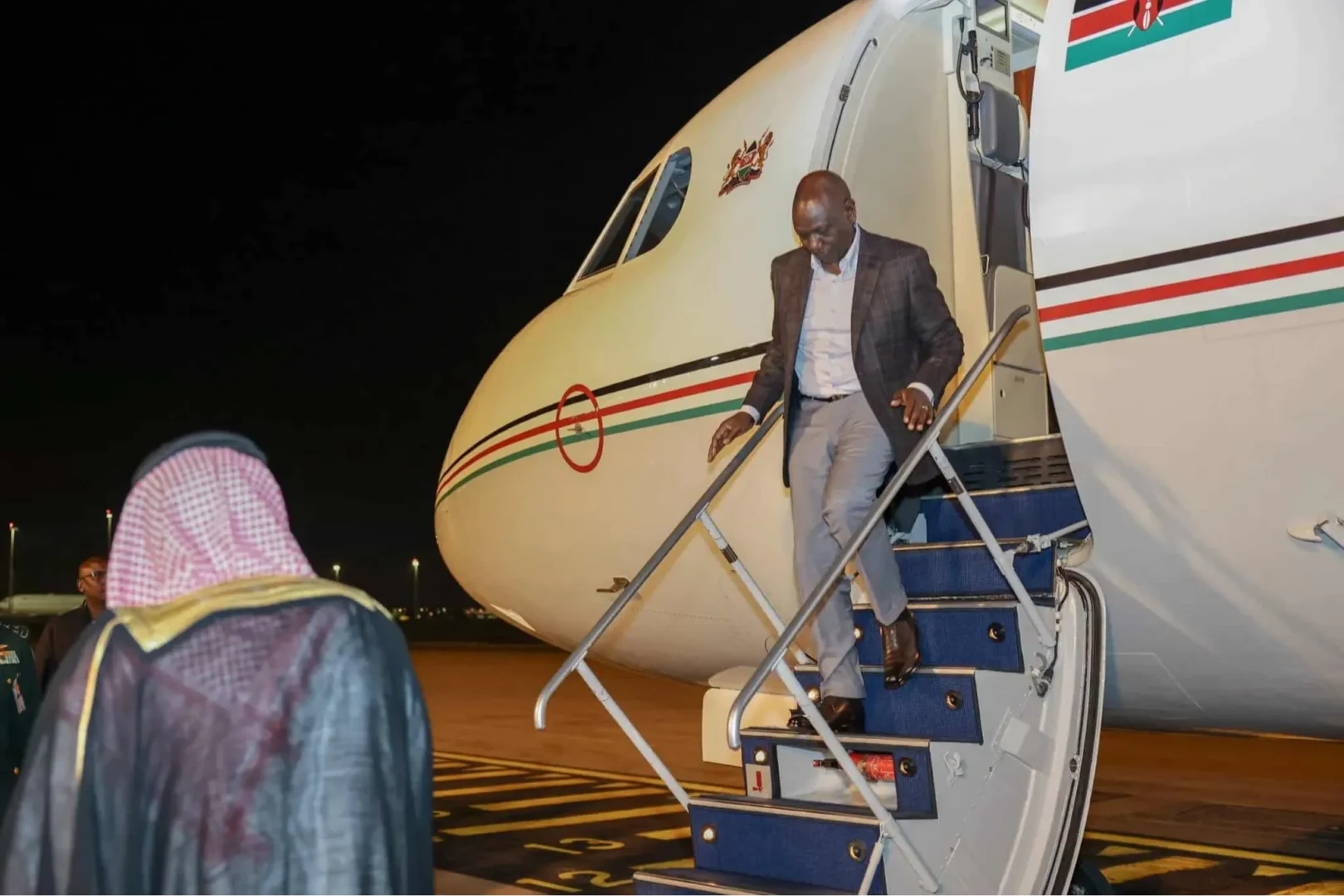
NAIROBI, Kenya — When President William Ruto boarded yet another chartered executive jet for his recent state visit to South Africa, it did not arrive as an isolated moment of presidential logistics. It landed instead into an already charged national conversation, one that has been building quietly with each foreign trip, each aircraft sighting, and each unanswered question about cost.
For his supporters, the flight was unremarkable, even necessary. A head of state, they argue, must move efficiently across continents to secure trade, diplomacy and investment in a competitive global order.
But for critics, the image of a luxury executive jet carrying Kenya’s president abroad has become harder to separate from the realities at home: rising taxes, stretched households, and repeated appeals for public restraint in the name of economic stability.
The discomfort is not rooted in a single journey. It is rooted in repetition.
Over the past two years, chartered aircraft have steadily become a defining feature of Ruto’s international travel. His latest trip to South Africa was undertaken aboard a Boeing 737-800 BBJ2 executive jet operated by UAE-based Empire Aviation Group, part of a pattern that has replaced Kenya’s traditional reliance on a dedicated state aircraft with a growing dependence on private charter arrangements.
That shift, however, is not entirely a matter of choice. It is a consequence of absence.
Kenya’s official presidential aircraft—the State House Fokker 70 acquired in 1995—has been grounded since August 2025 after being flown to the Netherlands for extensive maintenance. What might have been a routine overhaul has instead exposed a deeper structural problem.
The aircraft is old, its manufacturer collapsed nearly three decades ago, and spare parts have become increasingly difficult to source. In effect, the plane that once symbolised presidential mobility now sits at the edge of obsolescence, with no publicly declared replacement plan to fill the vacuum.
In that gap, chartered jets have become the default solution.
And they are not cheap.
Industry estimates consistently place the cost of luxury executive aircraft used for head-of-state travel between Sh1.1 million and Sh1.7 million per flight hour, depending on aircraft type, routing, and operational conditions.
On larger Boeing Business Jets, the figure can climb even higher. What appears on the surface as a logistical decision quickly becomes a multimillion-shilling calculation once distance and duration are factored in.
It is this arithmetic that has repeatedly pulled presidential travel into public scrutiny.
The debate reached a peak during Ruto’s 2024 visit to the United States, when media reports estimated that the chartered Boeing Business Jet used for the trip may have cost as much as Sh194 million.
The President rejected the figure, insisting that the aircraft had been secured at a significantly lower cost, around Sh10 million, through facilitation arrangements.
Yet the absence of a detailed public breakdown left the matter unresolved in the court of public opinion, where perception often fills the space left by documentation.
That moment proved pivotal, not because of the aircraft itself, but because of what it revealed: a widening gap between official explanation and public verification.
Since then, the pattern has persisted.
Ruto’s administration has defended its foreign travel agenda as an essential pillar of economic diplomacy, arguing that international engagement is necessary to attract investment, expand export markets, and secure Kenya’s position in global negotiations.
A Kenyan popular newspaper, the Standard, nicknamed Mr Ruto the “Flying President”. It said “so great is his love for flying that it appears that he cannot pass up any opportunity” despite pressing domestic demands, such as dealing with the high cost of living.
Kenyan foreign policy analyst Prof Macharia Munene acknowledges that some trips are necessary but says others are undoubtedly “wasteful”.
“You have presidents who love to be in the air… Some of these trips are personal glorifications, not so much for the country,” he told Vivid Voice News.
The logic is straightforward: capital, partnerships and influence are built through presence, not distance.
Yet that argument now exists alongside a more difficult domestic reality. The government has repeatedly justified tax increases and austerity measures as unavoidable steps toward stabilising public finances and managing debt pressures.
Citizens have been told, in various forms, that restraint is necessary for the country’s long-term survival.
It is in that contrast that tension emerges.
Because while fiscal discipline is being demanded at home, the optics of high-cost executive travel abroad have become increasingly difficult to ignore.
Even when expenditure is justified within legal frameworks, perception in politics does not operate on legal thresholds alone. It responds to symbolism, timing and context.
And in Kenya’s current economic climate, context is everything.
The President’s political identity adds another layer to that perception. Ruto rose to power on the strength of the “hustler” narrative, a political framing built on proximity to economic struggle and the promise of leadership that understood ordinary hardship. That narrative was not merely rhetorical; it was foundational to his electoral appeal.
Today, however, critics argue that repeated imagery of luxury executive jets risks eroding that symbolic alignment, particularly at a moment when many households continue to face rising costs of living, unemployment pressures, and tightened disposable incomes.
But reducing the issue to symbolism alone would miss the broader structural reality.
Presidential travel is not optional theatre. It is a functional instrument of statecraft. Modern diplomacy is conducted through constant movement—through summits, bilateral meetings, investment forums, and security engagements that require physical presence at high levels.
Kenya’s foreign policy under Ruto has leaned heavily into this model, with an increasingly ambitious diplomatic calendar spanning Europe, Africa and multilateral platforms.
His upcoming engagements in Belgium, Finland and France, followed by participation in the G7 Summit, underscore that trajectory. These are not ceremonial visits.
They are strategic attempts to position Kenya within global economic and political decision-making spaces.
Supporters of the administration argue that such engagement is precisely what developing economies must do to remain competitive in a fragmented global order where investment flows follow visibility and access.
But even that argument circles back to the same unresolved question: at what cost, and with what level of public accountability?
Because while investment pledges are often announced after foreign visits, systematic public reporting on outcomes remains limited.
Citizens are told what has been promised, but rarely shown what has been delivered. The gap between announcement and implementation remains largely untracked in the public domain.
That gap is where suspicion grows.
And suspicion, once established, does not require confirmation to persist.
Across many democracies, executive travel is not treated as immune from scrutiny. It is routinely audited, debated and disclosed in detail—not because leaders are presumed to be wasteful, but because transparency is treated as a safeguard of trust.
Also Read: Ruto defends foreign trips, says global engagements are elevating Kenya’s influence
Kenya’s debate is therefore not unusual in substance. What makes it more intense is the absence of consistent, accessible disclosure that allows citizens to independently assess value for money.
In that vacuum, every chartered flight becomes more than transport. It becomes evidence in a larger argument about governance.
The uncomfortable reality facing the administration is that this debate is no longer about aviation logistics or diplomatic necessity. It is about trust—how it is earned, how it is maintained, and how easily it can be strained when perception and policy drift apart.
Because in a country where economic pressure has become a defining feature of daily life, leadership is judged not only by what it does, but by what it appears to do.
And as long as that tension remains unresolved, every takeoff will carry more than passengers. It will carry questions.
