


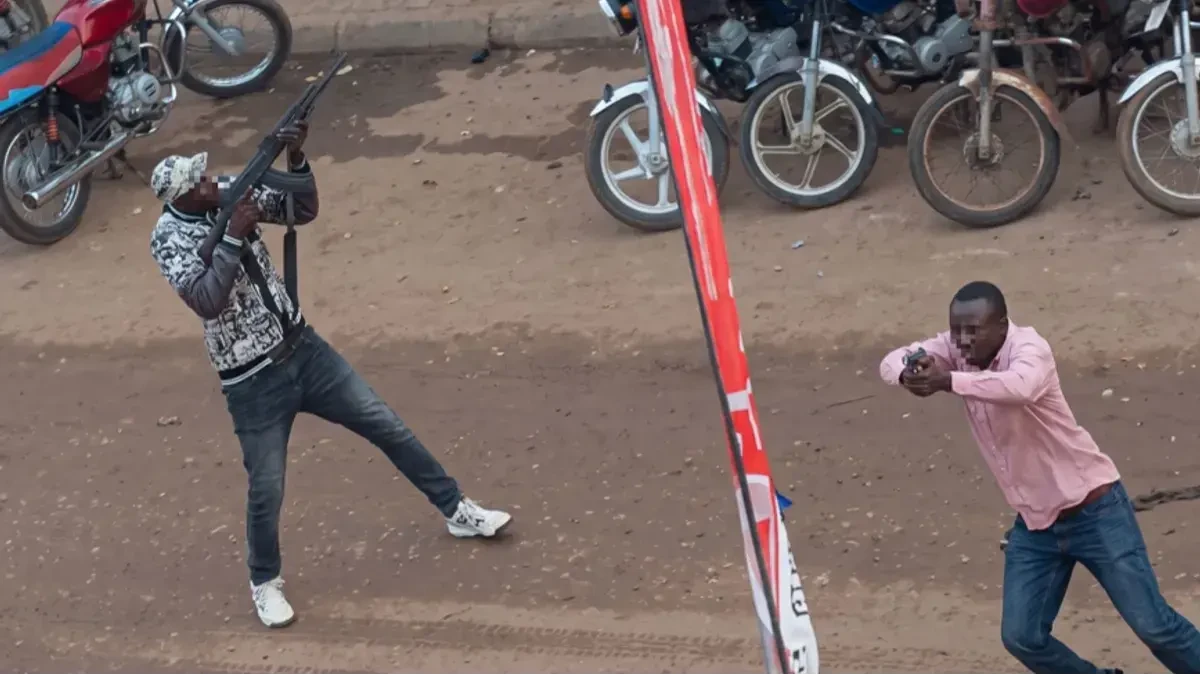
KAMPALA, Uganda — For nearly an hour on Monday 20, July 2026 afternoon, the familiar soundtrack of Kiseka Market—metal clanging against engines, mechanics bargaining over spare parts, boda bodas weaving through narrow lanes and traders calling out to customers—was replaced by something far more alarming.
Gunfire.
Shoppers scattered. Mechanics abandoned half-repaired vehicles. Steel shutters slammed shut across arcades as hundreds of traders fled for safety, uncertain whether they were witnessing a police operation, an armed robbery or something even more dangerous.
By the time calm slowly returned, business at one of Kampala’s busiest commercial hubs had ground to a halt. What remained was a marketplace filled with unanswered questions about how security operations are conducted in crowded civilian spaces and whether the methods increasingly used to combat crime are themselves becoming a source of public fear.
The confrontation at Kiseka Market has since become more than an isolated security incident.
It has reopened a national conversation about the controversial use of plain-clothed security operatives travelling in the now familiar “drone” minibuses, whose appearance has long generated anxiety among sections of the public.
A routine afternoon turns chaotic
According to traders, the incident began with what appeared to be a targeted arrest operation inside the Original Kiseka Spare Parts Centre Arcade.
Security operatives, dressed in civilian clothing, reportedly entered a spare parts shop on the building’s second floor intending to arrest one of the traders.
What happened next illustrates the growing dilemma facing Uganda’s security agencies.
In environments where officers arrive without uniforms or immediately identifying themselves, many civilians struggle to distinguish legitimate law enforcement officers from criminals.
One trader, who requested anonymity for fear of reprisals, said confusion quickly escalated after the suspect questioned those attempting to arrest him.
“The officers appeared to be in a hurry and were unwilling to answer any questions,” the trader said.
“When they tried to forcefully drag him downstairs, other traders began shouting, asking who they were and where they were taking him.”
Within moments, curiosity transformed into confrontation.
Voices echoed through neighbouring shops as traders demanded answers.
Then the gunfire began.
When uncertainty becomes panic
Eyewitnesses say additional armed operatives emerged from a waiting “drone” minibus parked outside the arcade.
Instead of calming the growing crowd, the situation deteriorated rapidly.
“People from other shops started shouting, ‘Who are you? Where are you taking him?’ Then six more men jumped out, took positions and started shooting in the air and at the sixth floor where mechanics were running and screaming. When they fired, people in the next arcade started throwing stones at them,” the trader said.
The exchange illustrates how rapidly mistrust can transform an arrest operation into a public security incident.
Security experts have long argued that visibility and identification are among the most important elements of effective policing. When civilians cannot immediately identify officers carrying firearms, instinct often replaces cooperation.
Rather than dispersing immediately, some members of the crowd reportedly resisted the operation, throwing stones as panic spread throughout neighbouring buildings.
Business comes to a halt
For traders whose livelihoods depend on every hour of business, Monday’s events carried immediate economic consequences.
Joseph Akiiki, a motorcycle spare parts dealer, said traders abandoned their businesses almost instantly.
“We are left with many questions,” Akiiki said.
“We shut our shops and fled to save our lives. We do not understand the reason for the indiscriminate gunfire. Had their intention been to arrest criminals, they would not have come in plain clothes, as the public tends to resist unknown persons. Furthermore, why was there shooting inside the buildings? Innocent people could have been killed.”
His concerns reflect a broader anxiety shared by many business owners.
Kiseka Market is not merely another commercial centre.
It serves as one of Kampala’s largest automotive spare parts markets, attracting thousands of traders, mechanics, transport operators and customers daily.
Any prolonged disruption affects not only individual businesses but an entire commercial ecosystem.
According to traders, commercial activity remained largely paralysed for more than two hours as uncertainty lingered even after the shooting subsided.
A retreat—and a return
Witnesses say the operation did not end immediately after the first exchange.
According to several accounts, the operatives initially withdrew after encountering resistance, driving towards Nabugabo Police Station before unexpectedly returning.
They reportedly fired additional shots into the air before eventually leaving the area.
The reasons for the apparent withdrawal and subsequent return remain unclear.
Military Police personnel later arrived and secured the scene, allowing frightened traders to begin reopening their businesses.
Although some witnesses believe arrests were made, several traders acknowledged they could not independently verify who, if anyone, had ultimately been taken into custody.
Police defend the operation
Uganda Police have maintained that officers acted lawfully.
Police spokesperson ACP Kituuma Rusoke confirmed that security personnel had been conducting an operation targeting suspected offenders inside the Original Kiseka Spare Parts Centre.
According to police, resistance from sections of the public forced officers to respond.
“The officers fired warning shots in the air to disperse the violent crowd and enable the operation to continue safely,” he said.
From a policing perspective, warning shots are sometimes used to restore order when officers believe a situation is becoming uncontrollable.
However, security specialists generally caution that discharging firearms in densely populated commercial environments carries inherent risks, even when officers intend only to disperse crowds.
Projectiles can ricochet unpredictably.
Panic itself can produce injuries as civilians scramble to escape.
The balance between operational necessity and civilian safety therefore remains a central challenge for modern policing.
The continuing controversy surrounding “drone” operations
Monday’s confrontation also revived scrutiny of Uganda’s increasingly controversial “drone” operations.
The Toyota Hiace minibuses—popularly nicknamed “drones”—have become closely associated with intelligence-led arrests conducted by plain-clothed security personnel.
Government officials have consistently defended such operations as essential tools against organised crime and serious security threats.
Human rights organisations, however, have repeatedly criticised the lack of visible identification during many arrests, arguing that civilians often cannot distinguish genuine security officers from armed criminal gangs.
That ambiguity, critics argue, increases the likelihood of public resistance precisely because people instinctively intervene when they believe someone is being abducted rather than lawfully arrested.
Monday’s events appear to reflect that very dilemma.
The cost of public distrust
Perhaps the most significant consequence of the Kiseka incident is not simply the disruption of business or even the exchange of gunfire.
It is what the confrontation reveals about the fragile relationship between citizens and law enforcement.
Effective policing depends not only on legal authority but also on public legitimacy.
When communities trust officers, arrests are more likely to proceed peacefully.
When uncertainty dominates, routine operations can rapidly become volatile confrontations.
Security experts note that visible identification, clear communication and transparent procedures often reduce the likelihood of escalation before force becomes necessary.
A broader national conversation
Videos recorded by bystanders quickly spread across social media, exposing millions of Ugandans to dramatic images of armed men firing inside one of Kampala’s busiest commercial districts.
The footage has intensified debate over whether current enforcement methods are adequately balancing operational effectiveness with civilian safety.
Beyond Uganda’s borders, analysts also note that highly publicised security incidents can influence international perceptions.
Also Read: President Museveni urges Ugandans to embrace wealth creation and end idleness
Foreign investors, tourists and development partners often assess not only crime levels but also how states manage public order.
Some Ugandans argue that operations involving heavily armed plain-clothed officers in crowded civilian areas risk undermining confidence in state institutions while reinforcing concerns frequently raised in international human rights assessments.
Supporters of tougher security measures counter that criminal networks have become increasingly sophisticated and require equally adaptive policing strategies.
That debate is unlikely to disappear soon.
Questions that remain
For traders returning to Kiseka Market, Monday’s events are unlikely to fade quickly.
The broken routine of an ordinary business day has become another reminder of the tension between security operations and everyday civilian life.
No civilian deaths or injuries were officially reported.
Yet many traders insist the outcome could easily have been different.
Their questions remain unanswered.
Why were heavily armed officers operating in plain clothes?
Could clearer identification have prevented the confrontation?
Was such extensive gunfire necessary inside one of Kampala’s busiest commercial centres?
As investigations continue, the incident may ultimately become less about one attempted arrest and more about the evolving relationship between security agencies and the citizens they are mandated to protect.
