


PHNOM PENH, Cambodia — The Government of Cambodia has dismissed as false and fabricated viral claims alleging that all African nationals, including Kenyans, had been ordered to leave the country by the end of May.
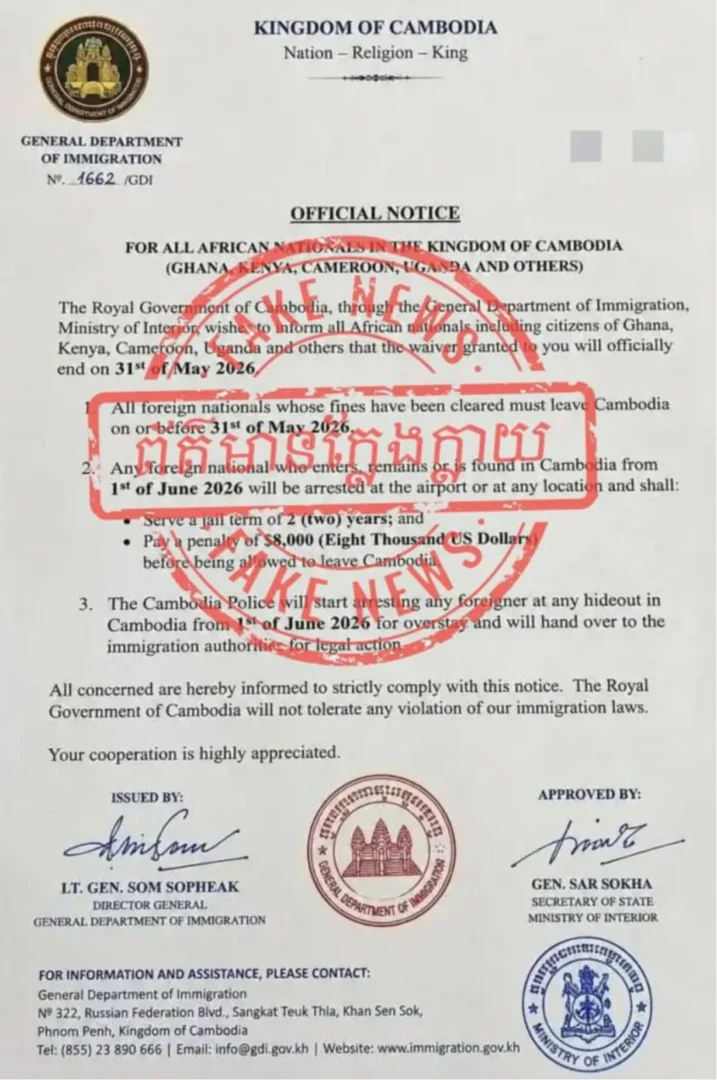
The clarification came after several online platforms and social media accounts circulated what appeared to be an “official notice” purportedly issued by Cambodia’s Immigration Department directing African nationals to exit the country by May 31, 2026.
The fake document claimed that Africans remaining in Cambodia beyond the stated deadline would face arrest and prosecution under the country’s immigration laws.
“Any foreign national who enters, remains or is found in Cambodia from June 1, 2026, will be arrested at the airport or at any location,” the fake notice alleged.
The document further claimed that individuals violating the directive would face a two-year prison sentence, a fine of approximately Ksh1 million, or both penalties.
However, Cambodian authorities on Friday issued an official statement strongly denying the claims and warning the public against spreading misinformation.
In a clarification released by the General Department of Immigration under Cambodia’s Ministry of Interior, the government stated that the circulating notice did not originate from any official institution and described the reports as entirely false.
“It is fake news fabricated to distort the situation and mislead domestic and international audiences,” Ministry of Interior spokesperson Touch Sokhak said.
The department specifically referenced online publications carrying headlines suggesting Cambodia had ordered Africans to leave the country, stressing that no such directive had been issued by the government.
Authorities urged both Cambodian citizens and foreign nationals living in the country to rely only on verified government communication channels for immigration-related information.
Also Read: Ghana repatriates citizens from South Africa over anti-immigrant protests
The viral claims had triggered anxiety among African communities in Cambodia, including students, traders, workers and businesspeople, many of whom expressed concern over the possibility of sudden immigration restrictions.
Cambodia hosts a growing number of African nationals involved in education, tourism, trade and small-scale business activities, particularly in major urban centres and commercial districts.
The incident highlights the growing challenge governments face in combating misinformation and fake official documents circulating online, especially on sensitive issues involving immigration and foreign nationals.
Officials have not indicated whether investigations have been launched to identify the source of the fabricated notice.
