


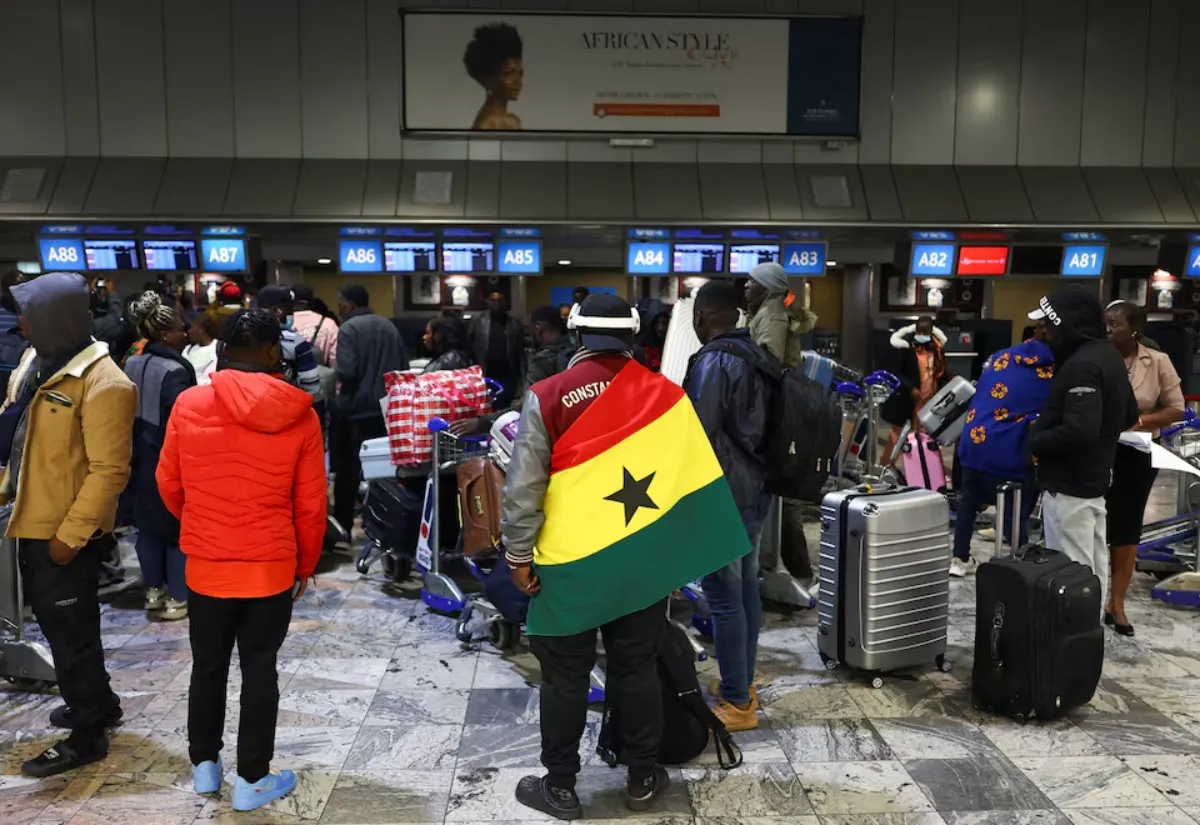
JOHANNESBURG, South Africa — Ghana has begun repatriating its citizens from South Africa, with the first group of around 800 people registered for evacuation due to growing fears of anti-immigrant tensions in the country.
On Wednesday morning, dozens of buses chartered by the Ghanaian embassy were seen arriving at Johannesburg’s OR Tambo International Airport at around 03:00 local time (01:00 GMT), ferrying men, women, and children ahead of departure.
BBC reporters observed that while most passengers arrived by bus under embassy coordination, a smaller group was brought in a police van and kept separate under security supervision.
The evacuation comes amid a recent surge in protests against illegal immigration across several South African cities, which has raised concerns about a possible resurgence of xenophobic violence.
Ghanaian authorities said the initial phase would see about 300 people flown out on Wednesday morning, with additional registered citizens to be repatriated after further screening.
Few of the departing passengers agreed to speak publicly, but one man, identified as Rudolph, who has lived in South Africa for 10 years and runs a salon business, said the deteriorating atmosphere left him with little choice.
“It’s not comfortable for us to stay here anymore, so we have to go. I think we will find peace at home,” he said.
South Africa is home to an estimated 25,000 Ghanaian nationals.
The recent demonstrations have been driven by a group known as March and March, which describes itself as a citizen-led movement pushing for immigration reform. The group has demanded that undocumented migrants leave the country by 30 June, a deadline some fear could heighten tensions.
Rudolph warned that the situation could escalate further.
“The protests started in Durban and have spread to other provinces. Something bad could happen,” he said, adding that he would not return to South Africa.
Ghana’s High Commissioner to South Africa, Benjamin Quashie, said the repatriation exercise was driven by concerns for citizen safety.
He said the government acted after receiving reports from Ghanaians who felt increasingly unsafe and unable to carry out their economic activities.
“It is the responsibility of every government to ensure that its citizens are taken care of both at home and abroad,” he said.
Quashie also noted that Ghana had put in place a reintegration plan to support returnees, including assistance to restart businesses.
He added that removing undocumented migrants would also help clarify migration status issues affecting host economies.
Also Read: Malema condemns xenophobic attacks in South Africa, rejects blame on migrants
Analysts say the renewed anti-immigrant sentiment in South Africa may be linked to broader socio-economic frustrations and the political climate ahead of local elections scheduled for November.
South Africa has experienced deadly waves of xenophobic violence in the past, including incidents in 2008, when 62 foreign nationals were killed, and in 2019, when at least 12 people died in related attacks.
While organisers of the current protests insist they have been peaceful, the South African government has condemned criminal acts targeting foreigners while acknowledging the need to address illegal immigration more effectively.
