


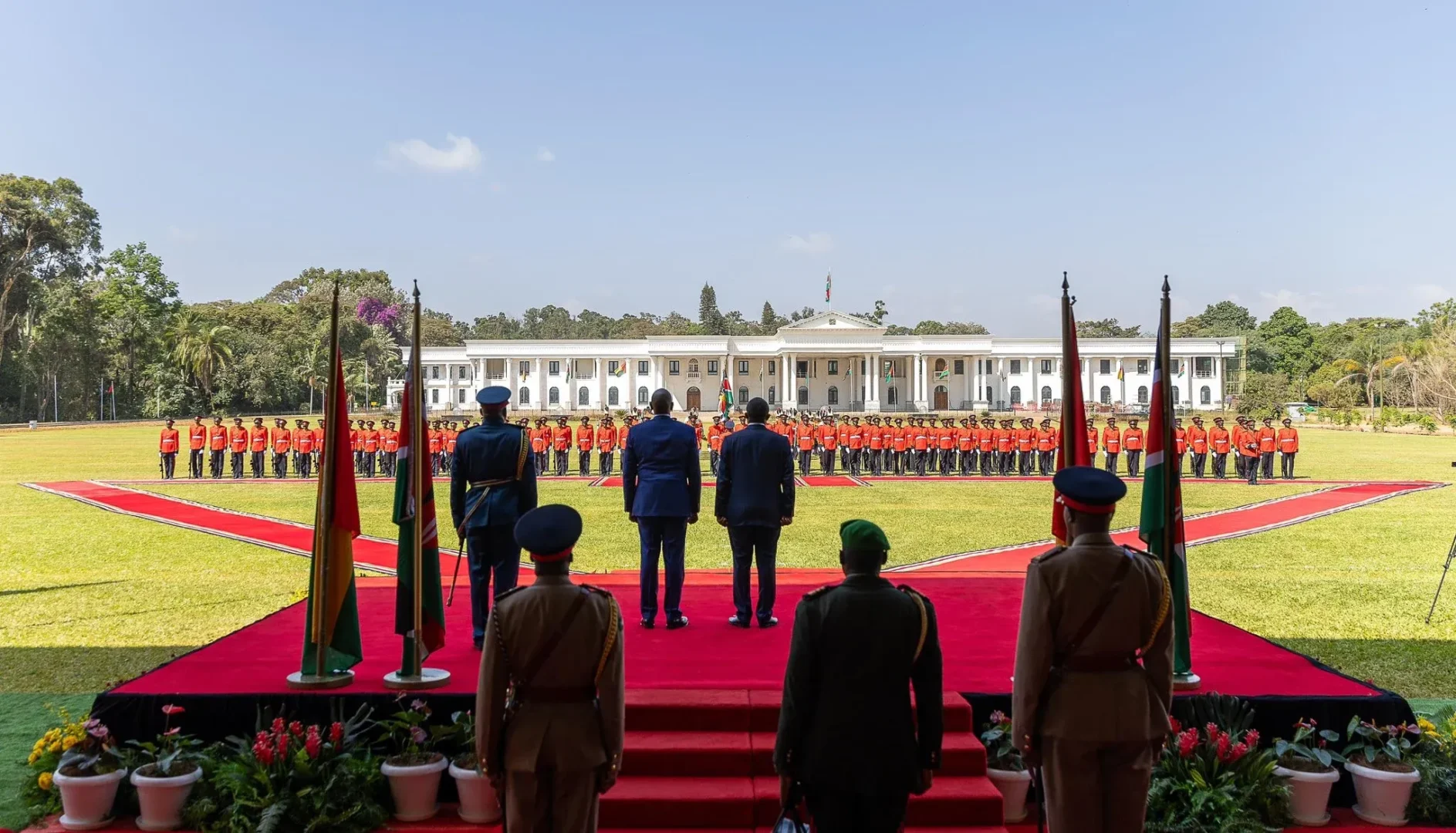
NAIROBI, Kenya — President William Ruto has ordered the demolition of a section of the State House perimeter wall along Kirichwa Road in Nairobi after it was found to encroach on protected riparian land.
Speaking during an address to the Nairobi County Assembly on Thursday, the President said the decision followed a formal notice indicating that part of the wall extends into the riparian reserve along the Kirichwa Kubwa River.
“State House has received a notice that part of the State House boundary wall along the Kirichwa Kubwa River falls within the riparian reserve. And it must come down,” Ruto said, adding, “They have told me at least 15 metres from the high mark. I promise you that wall will come down.”
Riparian reserves are legally protected zones along rivers and waterways where construction is restricted to safeguard ecosystems, prevent flooding and maintain water quality.
The directive follows a letter dated April 7, 2026, from the Nairobi Rivers Commission addressed to State House Comptroller Katoo Ole Metito.
The letter, signed by Brigadier (Rtd) Joseph Muracia, indicated that a multi-agency team established under Gazette Notice Vol. CXXVIII No. 261 had inspected the river corridor and identified a possible encroachment of between 10 and 15 metres.
“During the exercise, it was established that the perimeter wall may have encroached the riparian zone by approximately 10 to 15 meters. The Multi-Agency team wishes to access the grounds, State-House, which is a protected area, to properly demarcate the riparian zone. Thereafter, you will be requested to adjust the wall in compliance with the demarcation notice issued by the Multi-Agency team in compliance with the gazette notice,” reads the letter.
Officials have requested access to the highly restricted State House grounds to conduct formal demarcation, after which compliance measures will be enforced.
The President used the incident to underscore a broader policy stance on urban planning and enforcement, warning that illegal developments, regardless of ownership, would be removed.
“If illegal structures must come down, they will come down. And if systems must be reorganised to restore order, they will be reorganised,” he said.
Ruto framed the demolition order within a wider push to restore order in Nairobi, citing longstanding challenges including flooding, poor waste management, congestion and inadequate drainage systems.
“The great cities of the world became great because leaders chose discipline over disorder, long-term planning over short-term politics, and public interest over private convenience. A serious city guarantees mobility, water, sanitation, safety, protects green spaces, manages waste, and creates a dignified environment for enterprise and opportunity,” he said.
In his address, his first to the County Assembly as Head of State, Ruto emphasised Nairobi’s central role in Kenya’s economy and governance.
“It is the capital of the Republic of Kenya, the seat of our sovereignty, the face of our nation, and the engine of our economy. When Nairobi works, Kenya works. When Nairobi fails, Kenya pays the price,” he said.
Government data indicates Nairobi contributes approximately 27.5% of Kenya’s GDP, over KSh4.1 trillion annually, highlighting the stakes involved in improving urban management.
Also Read: High Court blocks Ruto from building permanent church at State House
The President also acknowledged deep social inequalities, noting that more than 60% of Nairobi’s residents live in informal settlements. He cited areas such as Mathare Mabatini as examples where targeted interventions, including education and infrastructure development, are required.
Reiterating his administration’s stance, Ruto linked urban disorder to entrenched cartel networks operating across sectors.
“We have confronted sugar, fertiliser, coffee and fuel cartels to restore fairness and ensure proper payment to farmers and workers. We must take the cartels in Nairobi head-on, whoever they are, however powerful,” he said.
Analysts say the decision to order the demolition of a structure linked to State House could signal a broader effort to demonstrate accountability and consistency in enforcing planning regulations, though its implementation will be closely scrutinised.
