


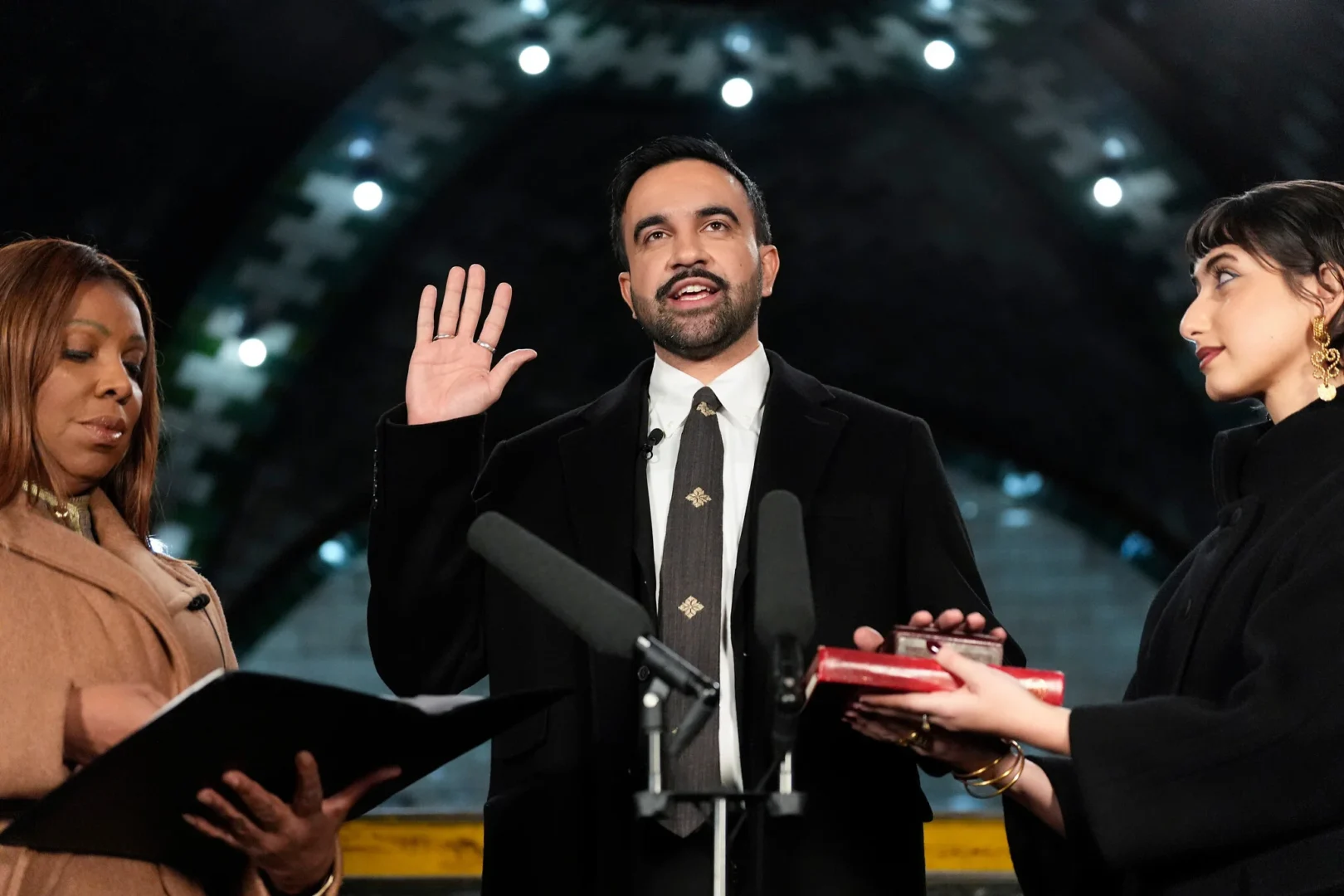
NEW YORK, United States — Zohran Mamdani, a 34-year-old Ugandan-born politician, made history on January 1, 2026, when he was sworn in as the 112th mayor of New York City, taking the oath of office with his hand on the Quran, marking a first in the city’s long political tradition.
The ceremony took place just after midnight in a private swearing-in at the decommissioned Old City Hall subway station beneath Manhattan’s City Hall Park — one of the city’s original subway stops, closed to the public since 1945.
“This is truly the honor and the privilege of a lifetime,” Mamdani said after taking the oath in the intimate setting, surrounded by family and close allies.
A series of historic firsts
Mamdani’s inauguration was emblematic of several historic milestones:
- He becomes the first Muslim mayor in New York City’s history.
- He is the first South Asian to lead the city.
- He is the first African-born mayor, having been born in Kampala, Uganda, before moving to the United States at age seven with his family.
- At 34, he is one of the youngest people to hold the office in more than a century.
Oath taken on a Quran with deep symbolic roots
Unlike many of his predecessors — who traditionally used a Bible during their swearing-in — Mamdani chose to place his hand on a Quran, Islam’s holy book, highlighting his faith and the multicultural fabric of the metropolis.
For the private midnight ceremony, Mamdani used two Qurans: one belonging to his grandfather and a small, 19th-century copy loaned by the New York Public Library’s Schomburg Center for Research in Black Culture, originally part of historian Arturo Schomburg’s collection.
The Schomburg Quran — modest in size with simple black and red script — is believed to have been produced in the Ottoman era and was chosen for its accessibility and cultural significance, according to scholars.
“The importance of this Quran lies not in luxury, but in accessibility,” said Hiba Abid, curator for Middle Eastern and Islamic Studies at the library, underlining its parallel with New York’s diverse communities.
A second, public swearing-in ceremony was scheduled later Thursday outside City Hall, to be conducted by prominent figures including U.S. Senator Bernie Sanders and Representative Alexandria Ocasio-Cortez.
From political hopeful to city leader
Mamdani’s rise to the mayoralty was marked by a grassroots campaign that elevated him from relative obscurity.
After being elected to the New York State Assembly in 2020, he announced his mayoral bid and gained traction with a platform centered on affordability, public services, and economic equity — proposing measures such as universal childcare, free public transit, city-run grocery stores, and a rent freeze.
Throughout his campaign, Mamdani’s faith and identity were focal points. He openly embraced his Muslim heritage and South Asian background, actively engaging with diverse communities across the city’s five boroughs.
Also Read: Ugandans celebrate New York Mayor Zohran Mamdani’s rise — and his Ugandan roots
His victory over former New York Governor Andrew Cuomo and Republican Curtis Sliwa signaled a transformative shift in the city’s political landscape, underscoring a generational and ideological change in leadership.
Diverse reactions and future challenges
Mamdani’s groundbreaking inauguration has been met with widespread celebration across immigrant and Muslim communities while also drawing disparaging criticism from some political opponents who have targeted his progressive platform and identity.
In comments from his campaign trail, Mamdani affirmed that he would remain unapologetically rooted in his faith and values. “I will not change who I am… I will find myself in the light,” he said.
His new administration faces significant challenges, including addressing housing affordability, budget constraints, and service delivery across the city’s sprawling urban landscape.
However, his historic inauguration — particularly the symbolic use of the Quran — marks a defining moment for New York City as it ushers in a New Year and a new era of leadership.
