


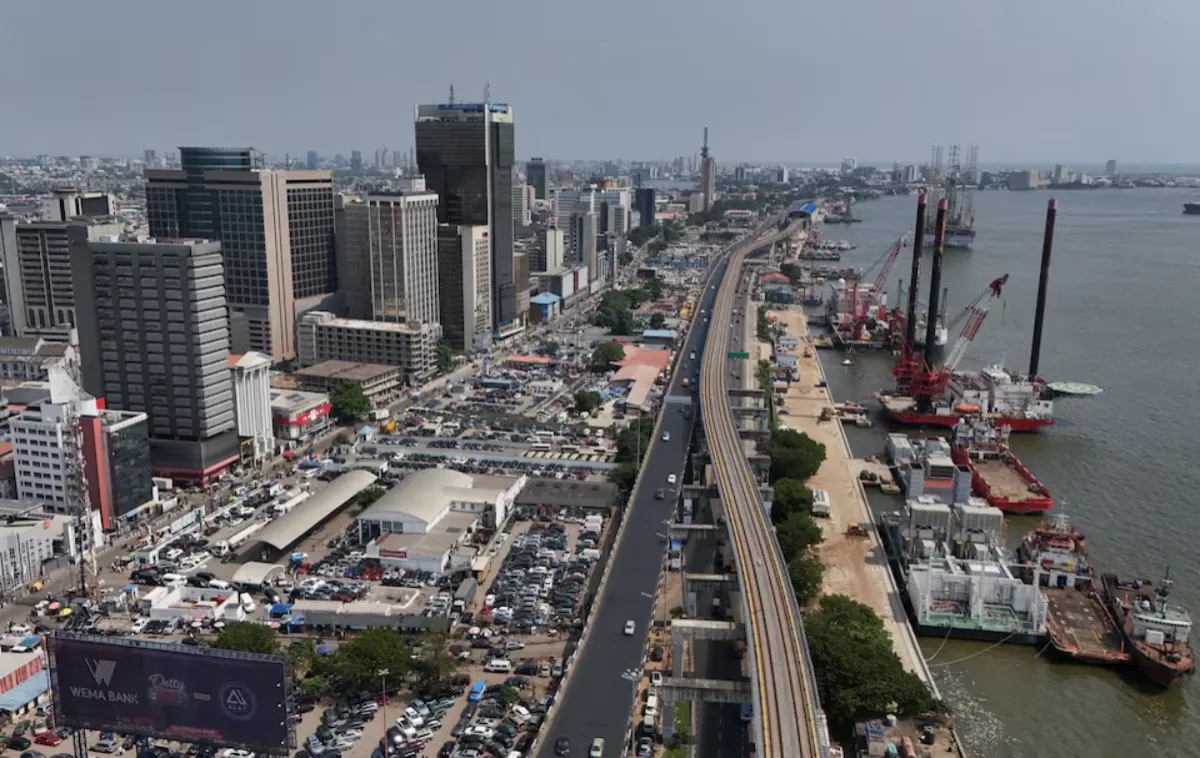
NAIROBI, Kenya — Some of Africa’s biggest coastal cities are sinking faster than previously estimated, exposing millions of people, buildings and valuable infrastructure to a growing threat of flooding as sea levels continue to rise, new scientific research has revealed.
The findings raise fresh concerns about the future of rapidly expanding coastal urban centres, including Lagos in Nigeria and Alexandria in Egypt, where the gradual downward movement of land is intensifying the effects of climate change.
A study led by researchers at Virginia Tech and published in the scientific journal Science Advances on November 27, 2026, examined land movement across 20 major African coastal cities using thousands of satellite radar observations.
The researchers found that Alexandria is sinking at a median rate of approximately six millimetres annually, while Lagos is experiencing land subsidence of about five millimetres per year.
Although these movements may appear insignificant over a short period, their cumulative effect can substantially increase the height of seawater relative to the land, making coastal settlements more vulnerable to flooding.
The study estimates that more than seven million people, one million buildings and assets valued at approximately $180 billion could be exposed to flooding by 2050 during an extreme sea-level event.
The findings highlight an often-overlooked dimension of Africa’s climate vulnerability: the danger is not only that oceans are rising, but that the ground beneath some of the continent’s largest cities is also sinking.
Satellite technology uncovers hidden land movement
For years, inadequate ground-monitoring infrastructure has made it difficult for scientists to establish how quickly different parts of Africa’s coastal cities are rising or sinking.
The new research addresses that gap through radar measurements from the European Space Agency’s Sentinel-1 satellite missions.
The researchers used a technique known as Interferometric Synthetic Aperture Radar (InSAR), which compares radar signals collected during repeated satellite passes to detect changes in the Earth’s surface.
Sentinel-1 satellites revisit the same areas at intervals of approximately six to 12 days, allowing scientists to identify even very small changes in ground elevation over time.
By analysing thousands of observations, the research team was able to develop detailed maps showing how land movement varies between different locations within individual cities.
Lead author Oluwaseyi Dasho said the effects of subsidence can remain unnoticed in everyday life but become significant over longer periods.
These changes, he explained, can substantially increase exposure to flooding even when the rate of sinking appears relatively small.
Senior author Manoochehr Shirzaei, a professor of geosciences at Virginia Tech, said the findings demonstrate why understanding future coastal flooding requires monitoring changes beneath the Earth’s surface as well as rising ocean levels.
The research also provides a more detailed picture of local conditions than assessments relying heavily on broad regional and global climate projections.
Lagos and Alexandria emerge as major sinking hotspots
Alexandria and Lagos emerged as two of the most significant subsidence hotspots in the study.
In Alexandria, Egypt’s historic Mediterranean port city, the median rate of land sinking was approximately six millimetres annually.
In Lagos, Nigeria’s commercial centre and one of Africa’s most populous urban areas, the corresponding rate was about five millimetres per year.
Luanda, Angola, also recorded substantial land subsidence, while other cities, including Durban in South Africa, showed comparatively stable conditions or modest upward land movement.
The differences demonstrate that Africa’s coastal flooding risks cannot be understood through a single continent-wide assessment.
Neighbourhoods within the same city may experience substantially different rates of land movement, depending on geological conditions, construction activity and the management of natural resources.
The researchers found that incorporating contemporary satellite measurements into existing sea-level projections could significantly change estimates of future coastal exposure.
For Alexandria, the revised projections indicate that relative sea-level rise under an intermediate greenhouse gas emissions scenario could be approximately 35.8 per cent higher by 2050 than estimates based on the original Intergovernmental Panel on Climate Change (IPCC) projections.
The estimated area exposed to flooding in the city could also increase by approximately 15 per cent.
This suggests that some earlier assessments may have underestimated the combined effects of rising seas and sinking land.
Human activities are accelerating the problem
While natural geological processes contribute to changes in land elevation, researchers say human activities are important drivers of subsidence in several rapidly developing cities.
One major concern is excessive groundwater extraction.
As urban populations expand, demand for water increases, often placing pressure on underground aquifers.
When large quantities of groundwater are pumped out, the sediments surrounding underground water reservoirs can compact, causing the surface above them to sink.
Rapid construction, heavy infrastructure and changes in land use can further contribute to ground instability, particularly in areas built on soft or reclaimed land.
In Lagos, the reclamation of land from the ocean to create artificial islands and the construction of buildings on loose ground are among the possible contributors to subsidence.
In Alexandria, the Aswan High Dam on the Nile has also been identified as a possible factor. By trapping sediment upstream, the dam reduces the amount of material reaching the Nile Delta, limiting the natural replenishment of land that has historically received river deposits.
These pressures can compound the effects of rising sea levels, increasing the likelihood that coastal communities will experience flooding during storms, unusually high tides and other extreme sea-level events.
Importantly, the researchers identify several potential drivers of subsidence rather than establishing that one specific activity is responsible for all the sinking observed in each city.
Seven million people face potential flood exposure
The scale of the projected threat is particularly concerning for governments, urban planners and communities whose homes, businesses and infrastructure are concentrated in low-lying coastal areas.
The study estimates that an extreme sea-level event could expose more than seven million people, over one million buildings and approximately $180 billion in assets across the 20 cities by the middle of the century.
These are modelled exposure estimates, not a prediction that all the people and assets identified will inevitably be flooded.
The researchers also note that the findings reveal how conventional sea-level assessments can overlook local land movement, creating gaps in the information available to governments when planning infrastructure and flood protection.
For rapidly urbanising African cities, the consequences could extend beyond residential neighbourhoods to roads, ports, airports, commercial districts and other essential infrastructure.
Flooding can damage property, disrupt transport and trade, contaminate water supplies and place additional financial pressure on already stretched municipal authorities.
The risks are particularly significant because many coastal cities are expanding faster than their drainage systems, land-use regulations and protective infrastructure can accommodate.
Mombasa among the cities examined
The research also has implications for Kenya, whose coastal economy and population are closely linked to the Indian Ocean.
Mombasa was among the 20 African coastal cities included in the satellite-based assessment, placing Kenya’s principal coastal city within the study’s broader examination of land movement and future flood exposure.
However, the headline findings for Alexandria and Lagos should not automatically be applied to Mombasa. The study identifies substantial differences between cities and even between neighbourhoods, making location-specific measurements essential.
Also Read: Travel YouTuber Kieran Brown calls night on Migingo Island his worst experience
For Mombasa, the findings reinforce the importance of monitoring coastal land movement alongside sea-level changes, drainage capacity, groundwater use and development in low-lying areas.
The city’s port, tourism industry, residential settlements and transport infrastructure make effective coastal planning important to Kenya’s wider economic interests.
The research offers a useful scientific framework for identifying areas that may require closer monitoring, although further local assessment is necessary to establish the precise risks facing individual neighbourhoods and infrastructure projects.
Scientists call for better planning and local interventions
Despite the scale of the threat, researchers say some causes of land subsidence can be addressed through targeted policies.
Better management of groundwater extraction, alternative water supplies and stronger monitoring of underground water resources could help reduce pressure on vulnerable land.
Urban authorities could also strengthen building regulations, improve drainage systems, restrict unsafe development in high-risk areas and incorporate updated satellite measurements into infrastructure planning.
Where sinking cannot be prevented, adaptation measures may include constructing flood barriers, elevating critical infrastructure and relocating essential facilities away from areas facing the greatest exposure.
Shirzaei argued that identifying where existing assessments have underestimated or overestimated risks could help governments direct limited resources towards the places where intervention is most urgently needed.
The study also highlights the importance of satellite monitoring for developing countries that have historically lacked comprehensive ground-based environmental measurement systems.
Its methodology could potentially be extended to other vulnerable regions, including Pacific island nations and coastal communities elsewhere in the Global South.
For African governments, the message is increasingly difficult to ignore: coastal protection cannot depend on rising sea-level projections alone.
As cities expand and demand for land, water and infrastructure increases, understanding what is happening beneath the ground could become just as important as preparing for what is happening in the oceans.
The researchers hope their findings will provide governments with better evidence to strengthen climate adaptation policies and protect vulnerable communities and future generations.
