


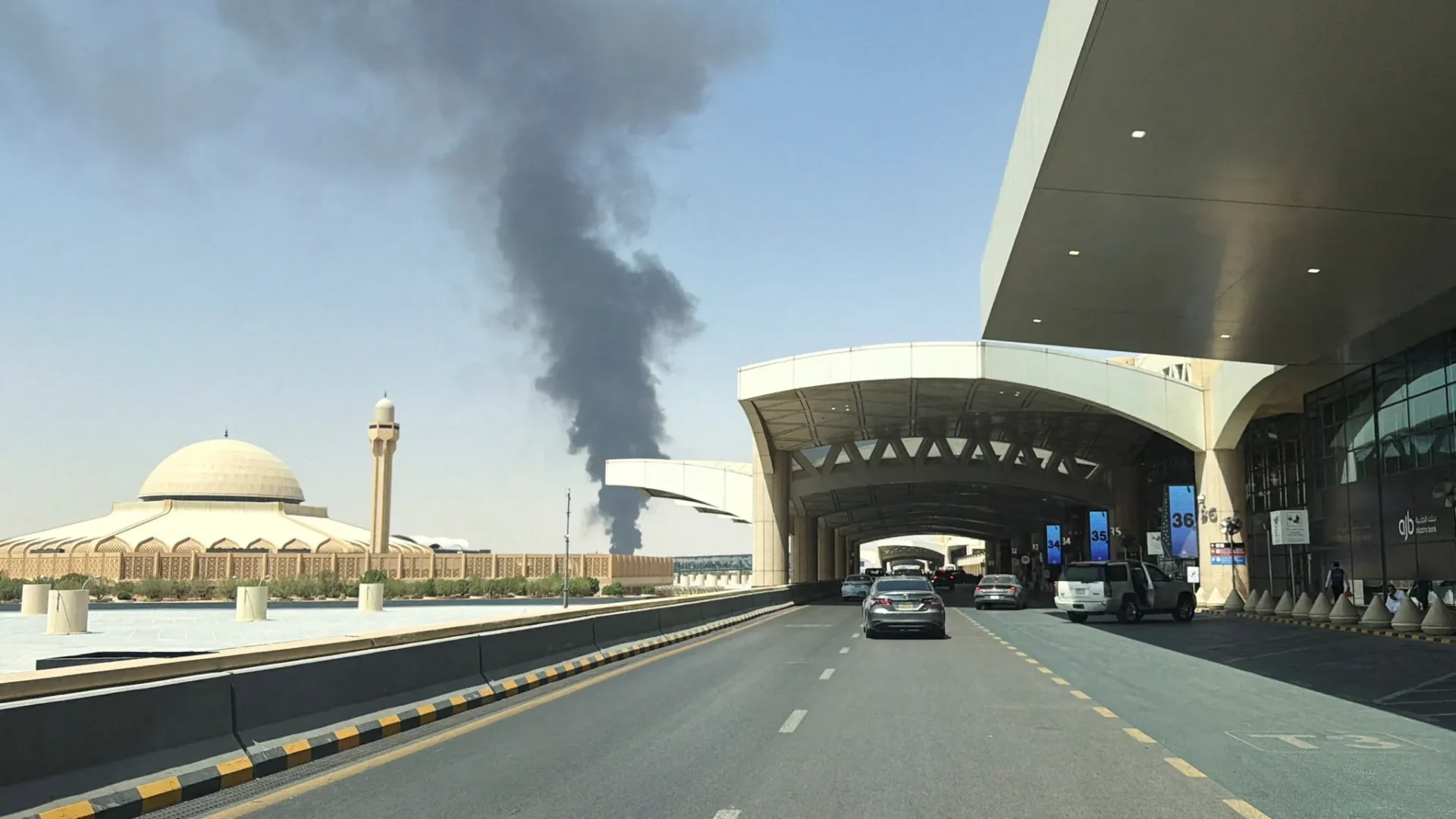
RIYADH, Saudi Arabia — Saudi Arabia is facing an escalating security crisis after Yemen’s Houthi movement launched another attack on Riyadh’s King Khalid International Airport on Sunday, October 11, killing a Pakistani resident and injuring 11 others.
The latest strike came less than 24 hours after a devastating attack on the airport killed at least 13 people and injured 309 others, according to Saudi authorities and subsequent reports. The back-to-back attacks have disrupted air travel and heightened concerns over the kingdom’s ability to protect critical infrastructure from missile and drone strikes.
Saudi Arabia’s General Authority of Civil Aviation confirmed the latest casualties, while the Saudi-led coalition fighting the Houthis reported that a projectile struck the airport and sparked a fire. Air defences intercepted another missile in the vicinity, according to the coalition.
The attacks mark a sharp escalation in the conflict between Saudi Arabia and the Iran-backed Houthi movement, which has threatened to continue targeting the kingdom’s airports and other strategic facilities.
The Houthis claimed responsibility for multiple attacks over a 24-hour period, including strikes targeting Riyadh and Dammam airports in eastern Saudi Arabia.
The group warned that Saudi Arabia’s transport infrastructure would remain a target, describing the kingdom’s transit hubs as a “theatre of operations for our forces”.
The threat raises fresh concerns for international airlines, passengers and foreign nationals travelling through Saudi Arabia, particularly as the kingdom’s main international gateway remains disrupted.
Saudi authorities extended the closure of King Khalid International Airport for another 24 hours, until 2100 GMT on Monday, October 12, according to flight-tracking service Flightradar24.
Residents of Riyadh reported hearing several explosions on Sunday, with witnesses describing the force of the blasts.
“The birds went into a frenzy after the sound. The whole house shook,” one resident of the Al-Aarid neighbourhood in northern Riyadh told AFP.
The Saudi-led coalition also reported a separate attack targeting Dammam airport, while air defences intercepted a drone in the kingdom’s eastern region.
Early Monday, the coalition said it had intercepted and destroyed a Houthi ballistic missile heading towards Khamis Mushait, a southern Saudi city that hosts a major military base.
The incidents suggest that the attacks are extending beyond a single airport, although the precise extent of damage from each reported strike remains subject to official assessments.
The latest attack followed Saturday’s devastating strike on King Khalid International Airport, which Saudi authorities initially reported had killed 12 people and injured 309.
The death toll rose to 13 after the Indian embassy in Saudi Arabia announced that one of its citizens, who had been wounded in Saturday’s attack, died on Sunday.
The victims of Saturday’s strike included four Saudi citizens, two Bangladeshis and nationals of the United States, Egypt, Jordan, Syria, Palestine and Sudan.
The attack was among the deadliest incidents on Saudi soil in more than a decade and represented a significant escalation in the country’s confrontation with the Houthis.
Witnesses described scenes of panic and severe injuries in the aftermath.
“Some had lost a hand or an arm. People were running while carrying injured people, covered in blood,” a 32-year-old Riyadh resident told AFP.
The repeated attacks have raised questions about the vulnerability of Saudi Arabia’s aviation infrastructure despite the kingdom’s substantial investment in military capabilities and air-defence systems.
Thomas Juneau, a security analyst at the University of Ottawa, said Saudi Arabia’s geographical size made it difficult to prevent every incoming attack.
Saudi air defences have intercepted some missiles and drones, but the latest incidents demonstrate the continuing threat posed by the Houthis’ ability to launch attacks against strategic targets.
The Saudi-led coalition condemned Saturday’s attack as a “full-fledged war crime” and vowed to respond decisively.
The warning raises the prospect of intensified Saudi military operations in Yemen, where Riyadh has supported the internationally recognised government against the Houthis since 2015.
The coalition’s response comes amid renewed fighting on the ground, with military sources reporting that Saudi-backed government forces were advancing against Houthi positions around the Bab al-Mandab Strait, a strategically important shipping route connecting the Red Sea to the Gulf of Aden.
The Houthis, however, claimed to have repelled the advances.
The competing accounts could not be independently verified, reflecting the difficulties journalists face accessing conflict zones and confirming military developments.
Houthi-run media also reported that Saudi strikes hit areas in the Sanaa governorate under the group’s control on Sunday. A spokesman for the Houthi-run health ministry said one of the strikes killed a civilian and wounded five others.
The claims have not been independently verified.
The latest exchanges illustrate the risk of a widening cycle of attacks and retaliation, with civilian infrastructure increasingly caught in the conflict.
As the confrontation intensifies, Iran has called for a political solution to the crisis.
Iranian Foreign Minister Abbas Araghchi discussed the situation with his Saudi counterpart, warning that continued reliance on military action could further complicate the conflict.
According to Iranian state media, Araghchi said Tehran was prepared to help initiate dialogue between Saudi Arabia and Yemen and facilitate a political settlement.
The offer comes against the backdrop of longstanding tensions between Riyadh and Tehran, which have supported opposing sides in Yemen’s conflict.
Although diplomatic engagement could provide a route towards de-escalation, the latest attacks and the coalition’s threat of retaliation suggest that an immediate resolution remains uncertain.
The Houthis’ continued attacks on Saudi airports, oil facilities and Red Sea shipping also threaten to widen the economic consequences of the conflict beyond Yemen and the Arabian Peninsula.
Saturday’s attack drew condemnation from the United Nations and several international leaders, including US President Donald Trump, who said he was considering whether Washington should join Saudi military operations against the Houthis.
Israeli Prime Minister Benjamin Netanyahu also denounced the attack as a “horrific terrorist attack”, despite the absence of formal diplomatic relations between Israel and Saudi Arabia.
The US, Canadian, German and Spanish embassies in Saudi Arabia warned their citizens to avoid Riyadh airport amid continuing security concerns.
Australia also condemned the attacks as “unacceptable” and had earlier advised its citizens in Saudi Arabia to remain indoors and shelter in place.
The international response reflects growing concern that continued attacks on civilian aviation infrastructure could trigger a broader military confrontation involving regional and international powers.
Any direct US participation in Saudi-led operations would represent a significant development, potentially increasing pressure on the Houthis while also raising the risk of further retaliation.
Saudi Arabia has led a military coalition supporting Yemen’s internationally recognised government since 2015, seeking to reverse Houthi territorial gains and restore the government’s authority.
The Houthis control substantial parts of northern Yemen, including the capital, Sanaa, and have developed the capacity to threaten targets well beyond their territory.
Also Read: Al-Qaeda-linked militants strike Niger airport, killing 11 soldiers and 2 civilians
The latest attacks come amid renewed fighting and growing tensions over control of strategic areas, including routes around the Bab al-Mandab Strait, through which significant volumes of international maritime trade pass.
The group’s warning that Saudi airports remain targets poses an immediate challenge to the kingdom’s efforts to maintain normal commercial and international travel.
For Saudi Arabia, the priority is likely to be containing further attacks while deciding how to respond without triggering a broader regional conflict.
For civilians, airline passengers and foreign residents, the immediate consequences are already evident in the loss of life, airport closures and mounting security warnings.
With the Houthis threatening additional strikes and the Saudi-led coalition promising retaliation, the coming days could prove decisive in determining whether the confrontation remains contained or develops into a wider regional escalation.
