


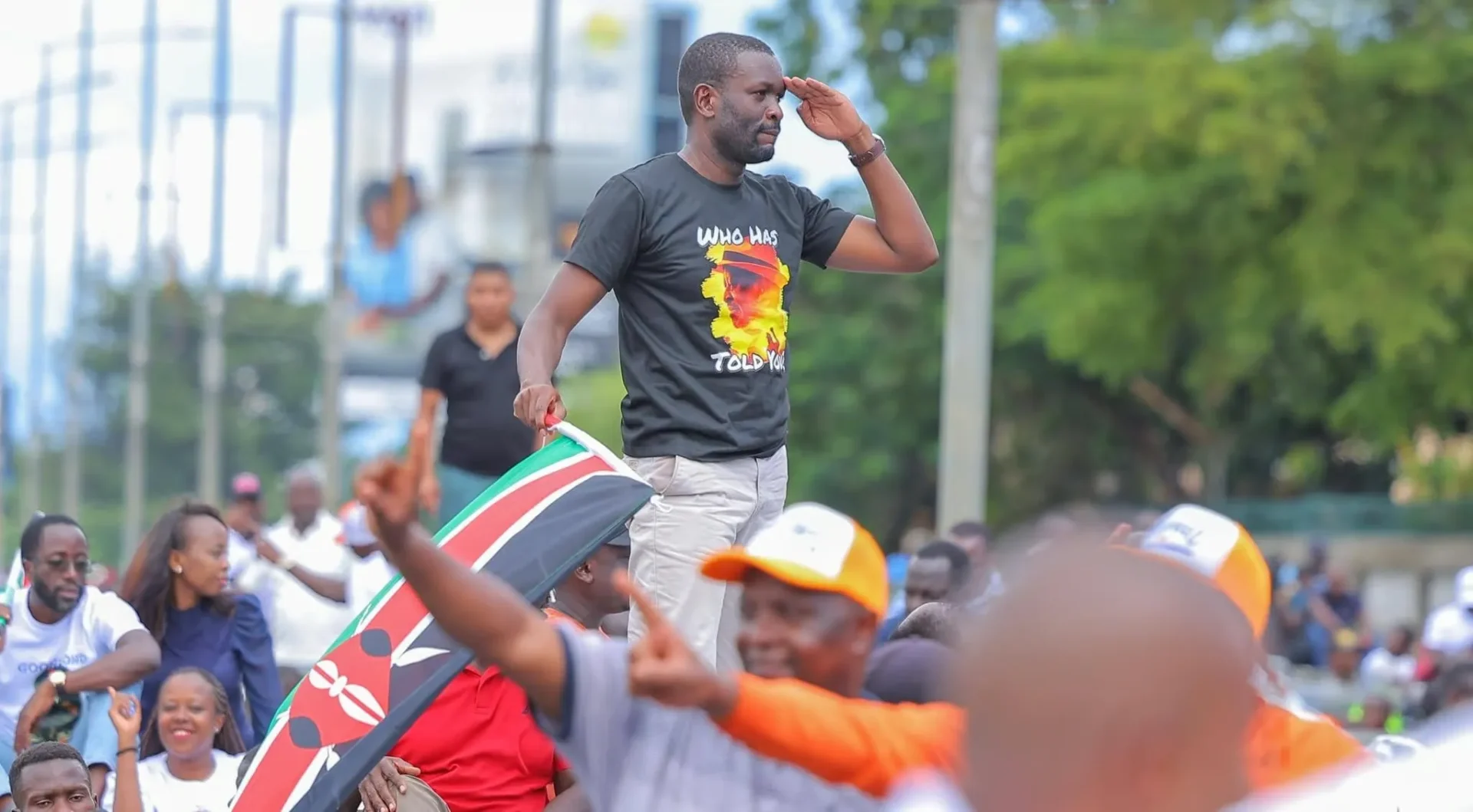
NAIROBI, Kenya — Nairobi Senator Edwin Sifuna is rapidly emerging as one of the most talked-about figures in Kenya’s evolving opposition politics, with growing public support placing him at the centre of speculation over who could challenge President William Ruto in the August 2027 General Election.
The 44-year-old lawyer has not made an unequivocal personal declaration that he will seek the presidency. However, his political allies have already positioned him as their preferred candidate, while his increasingly visible presence at rallies has fuelled calls among supporters for him to lead the country.
With his combative speeches, sharp political humour and ability to connect with younger audiences, Sifuna has become an unexpected force in a political landscape traditionally dominated by established national figures.
Some admirers have compared his appeal to that of former United States President Barack Obama, whose message of hope and change mobilised millions during his historic 2008 presidential campaign.
But the comparison also raises an important question: can Sifuna transform the enthusiasm surrounding his political message into the organisational strength, national alliances and electoral support required to win Kenya’s presidency?
Political analysts caution that his growing popularity, particularly online, should not automatically be interpreted as evidence of a nationwide electoral base.
Sifuna has himself been cautious about declaring his next political move, maintaining that his immediate priority is building a united opposition capable of defeating Ruto.
“Just hold your horses, those conversations will come way down the road,” he recently told journalists in Nairobi when questioned about his presidential ambitions.
Yet his political organisation has already taken steps that suggest preparations for a national contest are well underway.
From Raila Odinga’s political lieutenant to a potential presidential contender
Sifuna’s rise comes at a significant moment for Kenya’s opposition following the death of veteran opposition leader Raila Odinga, whose political influence shaped national politics for decades.
Odinga, who unsuccessfully contested the presidency five times, was Sifuna’s political mentor and played a central role in elevating him within the Orange Democratic Movement (ODM).
In 2018, Odinga appointed Sifuna as the party’s secretary-general, placing him among its most influential officials.
For years, Sifuna became one of Odinga’s most outspoken defenders, confronting political opponents through television interviews, parliamentary debates and public rallies.
His articulate but often confrontational style helped establish him as a recognisable political figure beyond the traditional ODM support base.
However, Odinga’s death exposed deep divisions within the party over its relationship with Ruto’s administration.
While a section of ODM’s leadership supported closer cooperation with the government, Sifuna opposed the arrangement, arguing that the opposition should scrutinise those in power rather than become part of the political establishment it was expected to hold accountable.
The disagreement eventually cost him his position as ODM secretary-general.
He was subsequently removed as Senate Deputy Minority Whip, further weakening his formal influence within the party and Parliament.
But the political fallout also created an opportunity for Sifuna to build an independent political platform outside the party that had shaped his rise.
His departure from ODM’s leadership has therefore become more than an internal party dispute. It represents a major turning point in his political career.
Linda Mwananchi taps into youth frustration
Sifuna’s growing prominence is closely associated with the Linda Mwananchi movement, whose name translates roughly as “Protect the Citizen”.
The movement has sought to build its identity around concerns over the cost of living, taxation, unemployment, corruption and what supporters describe as an increasingly disconnected political establishment.
Its message draws on some of the grievances that fuelled Kenya’s youth-led protests in 2024, when thousands of demonstrators took to the streets to oppose proposed tax increases and demand greater government accountability.
Those demonstrations, organised largely through social media and decentralised networks, exposed widespread dissatisfaction with political leadership across traditional party lines.
Although the protests were largely leaderless and there is no evidence that the wider Gen Z movement has collectively endorsed Sifuna, the senator has sought to position himself as a political voice for a generation demanding greater accountability and a different approach to governance.
The appeal is particularly significant because many young Kenyans have become increasingly sceptical of traditional political alliances, which they often associate with elite negotiations and electoral bargaining rather than meaningful policy change.
However, turning that frustration into a sustainable political organisation presents a different challenge.
A movement that attracts large crowds must eventually establish structures capable of recruiting supporters, mobilising voters, raising campaign resources and maintaining political engagement beyond high-profile rallies.
That is the test now facing Sifuna and his allies.
Sifuna builds his own political vehicle
Born on May 22, 1982, in Kakamega County, Sifuna trained as a lawyer before entering elective politics.
He first sought the Nairobi Senate seat in the 2017 General Election but lost to Johnson Sakaja.
Five years later, he returned to the contest and won the seat, establishing himself as one of the more prominent opposition voices in the Senate.
His public profile has since grown through a combination of parliamentary interventions, media appearances and political rallies.
Sifuna frequently uses humour, sarcasm and pointed questions to challenge government officials and political opponents, a style that has helped his speeches circulate widely on social media.
Unlike several established political figures, he is not publicly associated with the country’s most prominent wealthy political families. This has contributed to his appeal among supporters who want a new generation of leaders and a departure from what they regard as a recurring cycle of elite political bargaining.
His political ambitions have also moved beyond rhetoric.
In October 2026, Sifuna and his allies took over The Equitable Party (TEP), creating a formal political vehicle through which they could organise ahead of the next election.
The party subsequently rebranded as the Linda Mwananchi Party, with Sifuna emerging as its leader and preferred presidential candidate.
The move provides him with an established party structure rather than relying exclusively on a loosely organised political movement.
At the unveiling of the political vehicle, Sifuna and his allies presented the outfit as part of a broader effort to build an alternative government and consolidate opposition forces ahead of 2027.
The development has given his supporters a clearer organisational platform, although the party still faces the difficult task of establishing a credible nationwide presence.
Economic promises place Sifuna under scrutiny
Sifuna’s emerging political agenda focuses heavily on reducing the financial burden on ordinary Kenyans, tackling corruption and addressing concerns about government expenditure.
Among the proposals he has advanced are scrapping the housing levy, removing value-added tax on fuel and electricity, cutting wasteful public spending and expanding economic opportunities for young people.
He has also criticised deductions associated with the government’s new health insurance framework, arguing that households are already facing excessive financial pressure.
His argument is that fighting corruption and eliminating unnecessary government expenditure could create room for lower taxes and increased investment in public services.
The proposals speak directly to frustrations that have dominated public debate since the 2024 demonstrations.
However, promising tax reductions is considerably easier than demonstrating how a future administration would finance public services, manage national debt and meet its constitutional obligations.
Kenya’s fiscal position, including debt-servicing costs and pressure to finance essential services, means any presidential candidate promising substantial tax cuts will face questions about alternative revenue sources and spending priorities.
Sifuna has indicated that experts are working on a more detailed manifesto to explain how his proposals would be implemented.
That document could become an important test of whether his political message can evolve into a credible economic programme.
Ruto takes aim at Sifuna’s growing influence
Sifuna’s emergence has attracted increasingly sharp criticism from President Ruto, who has repeatedly targeted the senator during public rallies.
The President has mockingly referred to him as “Mr Empty” and “Mr Shiny Things”, while dismissing his political organisation as an outfit without a credible agenda.
Ruto has accused the senator of criticising government programmes without presenting workable alternatives.
He has also defended the affordable housing programme, warning that abandoning it would threaten employment and investment in the construction sector.
Another political controversy emerged when Ruto alleged that retired President Uhuru Kenyatta was financing Sifuna and the Linda Mwananchi movement to undermine his administration.
Sifuna has rejected the allegations and challenged the President to provide evidence of the alleged funding.
The increasingly personal exchanges illustrate how Sifuna has become part of the wider political contest ahead of the next election.
For a relatively young politician who has not previously contested a presidential race, attracting direct criticism from the Head of State also demonstrates how prominently he has entered the national political conversation.
However, public confrontation with the President does not automatically establish the organisational capacity required to defeat an incumbent.
Opposition unity faces a new presidential dilemma
Sifuna’s growing popularity is also complicating the calculations of established opposition leaders who have long positioned themselves as potential presidential challengers.
Former Vice-President Kalonzo Musyoka and former Deputy President Rigathi Gachagua have publicly welcomed his political influence and expressed willingness to work with him in a united opposition arrangement.
Gachagua has even suggested he would be prepared to serve as Sifuna’s running mate if the senator emerged as the strongest candidate.
Such remarks signal the extent to which Sifuna’s popularity has entered negotiations over the opposition’s possible presidential ticket.
But the prospect of a younger politician emerging as the opposition’s leading candidate presents a difficult choice for established political figures with their own national ambitions and regional support networks.
The central question is whether opposition leaders can agree on a candidate without alienating rival camps or splitting the anti-Ruto vote.
Political analyst Davis Ngemu has warned that the opposition must balance Sifuna’s youthful appeal against the established leaders’ regional networks and political influence.
“Their biggest challenge is agreeing on a single candidate without alienating rival camps or splitting the anti-Ruto vote,” Ngemu told the BBC.
“The dilemma is whether to rally behind Sifuna’s youthful appeal or rely on the established leaders’ regional support and political networks, which have traditionally been crucial to winning Kenyan elections,” he added.
The challenge is particularly significant in a country where presidential elections depend on building broad coalitions across communities and regions.
A candidate may attract strong support in urban centres and among younger voters but still struggle to secure the national geographical spread required to win.
Can social media popularity translate into votes?
One of the biggest questions surrounding Sifuna’s political rise is whether his popularity reflects a durable national constituency or a moment of intense public attention.
His speeches attract widespread circulation online, and his appearances at political rallies have drawn enthusiastic crowds.
But political analysts caution that digital engagement and physical attendance at rallies do not necessarily translate into votes on election day.
Political commentator Macharia Gaitho has described Sifuna as “the man of the moment”, arguing that he represents the energy and imagination of a generation seeking a different kind of leadership.
However, Gaitho has also warned that the senator’s political trajectory could either carry him towards the highest levels of national leadership or expose the limits of his current popularity.
Political analyst Barrack Muluka has similarly cautioned that Sifuna must turn the attention surrounding him into a sustainable political movement.
“If not, the senator will only be remembered as the flash in the pan that his detractors yearn for,” Muluka said.
“History is unkind to leaders who mistake the moment for the destination.”
Governance expert Professor Peter Kagwanja is among those sceptical that Sifuna’s current appeal can translate into presidential success.
He has described the senator as a “microwave politician”, arguing that his rise has been unusually rapid and that he lacks an established regional voting bloc.
“As a historian, there is nothing I can write about him. He is just a young lawyer and Nairobi senator known for nothing else,” Kagwanja told the BBC.
He also cautioned against treating enthusiasm among young people on social media as an organised electoral constituency.
“Young people on social media are not a constituency you can negotiate with when forming political alliances,” he said.
Kagwanja nevertheless acknowledged that Sifuna could become an important political asset, describing him as “powerful cabinet material, but not the president of Kenya”.
The competing assessments reflect the uncertainty surrounding the senator’s political future.
Supporters see an opportunity to introduce a new generation of leadership, while sceptics argue that Kenya’s electoral system demands more than popularity, eloquence and an ability to mobilise public frustration.
The electoral test ahead of August 2027
The 2027 General Election will provide the clearest indication of whether Sifuna’s political momentum can develop into a serious challenge to Ruto.
The Independent Electoral and Boundaries Commission has scheduled the presidential election for Tuesday, August 10, 2027.
Under the published electoral timetable, presidential aspirants must submit supporting signatures from at least 2,000 registered voters in a majority of Kenya’s counties by May 24, 2027. The presidential nomination and candidate registration period is scheduled to run from May 29 to June 11.
These requirements underline the organisational demands facing anyone seeking the country’s highest office.
Sifuna will need to demonstrate that his political platform can attract support beyond his traditional western Kenya roots and Nairobi’s politically active urban population.
Also Read: US-based Kenyans pledge Sh100 million for Sifuna’s 2027 presidential bid
He must also build a national campaign network, secure resources, develop a detailed policy programme and negotiate alliances with leaders whose political ambitions may not easily accommodate a new presidential contender.
His Luhya background could provide an important regional foundation, but a successful presidential campaign would require support from a much wider national coalition.
Ruto, meanwhile, retains the advantages of incumbency, established political networks and access to a nationwide governing party.
The opposition’s ability to agree on a common candidate could prove just as important as the popularity of any individual contender.
For Sifuna, the challenge is therefore twofold: convincing Kenyans that he can offer a credible alternative to the current administration while persuading established opposition leaders that his candidacy would strengthen rather than fracture their political alliance.
Kenya has witnessed charismatic politicians attract enormous crowds without ultimately securing the presidency. Even Raila Odinga, despite his decades-long political influence and repeated electoral campaigns, never occupied State House.
Sifuna now finds himself at the beginning of a potentially transformative political journey.
He has something many established politicians would like to possess: public attention, growing momentum and an audience eager to hear his message.
But whether he can convert that enthusiasm into a disciplined national movement, a united opposition and ultimately electoral victory remains the defining question of his emerging political career.
