


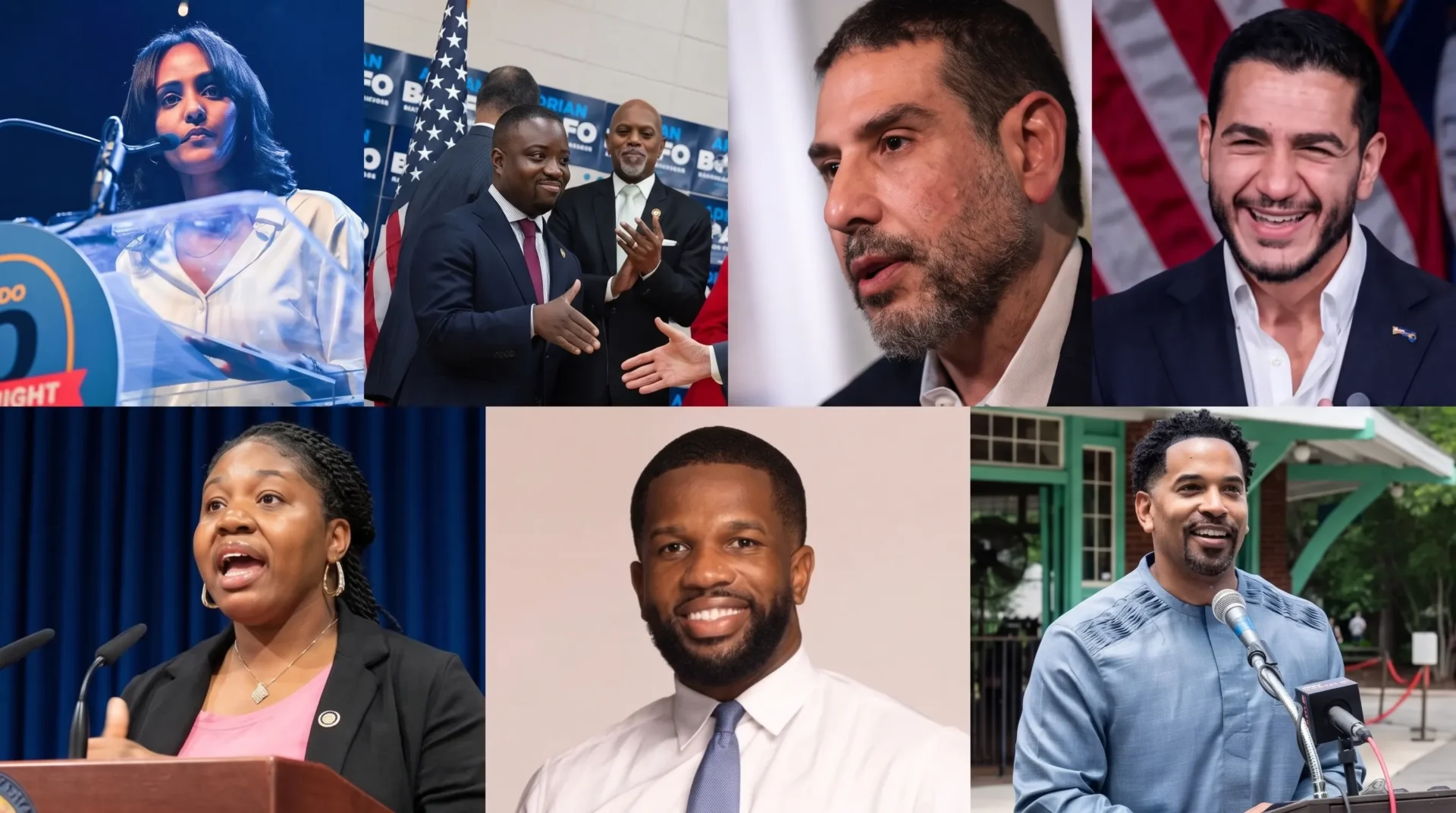
WASHINGTON, D.C., United States — An Egyptian-American Democrat’s victory in Michigan, an Ethiopian-born congresswoman’s breakthrough in Colorado and the election of politicians of Ghanaian and Nigerian heritage have highlighted the growing influence of Americans with African roots in the United States.
Among the most striking moments came at a Democratic victory rally, where Michigan senator-elect Abdul El-Sayed playfully addressed Vice-President JD Vance as “JD [Vance], habibi (my love)”.
The remark carried an added political significance. Vance had campaigned against El-Sayed, who will now take office in January and be sworn into the Senate by the outgoing vice-president.
El-Sayed, 42, defeated Republican Mike Rogers to win Michigan’s open Senate seat, making him the first Muslim elected to the US Senate.
Born to Egyptian immigrant parents, the former public health administrator faced repeated attacks during the campaign over his Muslim identity and political positions.
President Donald Trump and conservative commentators accused him of supporting the Muslim Brotherhood, allegations he rejected.
At his victory rally, El-Sayed responded to the attacks by introducing himself using his full name.
“My name is Abdul Rahman Mohammed El-Sayed,” he told supporters, speaking with an Egyptian Arabic accent.
His campaign focused on a progressive agenda that included Medicare for All, affordable housing and reducing corporate influence in politics.
He also criticised US military support for Israel, a position that drew opposition from some political groups and prominent Democrats.
El-Sayed relied heavily on social media to reach younger voters, using short-form videos, humour and online engagement to build support.
His campaign’s approach helped him connect with a generation increasingly drawn to political messaging outside traditional media platforms.
His victory came amid a wider Democratic breakthrough in the November 3 midterm elections, with the party winning control of both the House of Representatives and the Senate.
Ethiopian-born politician makes history
Another prominent winner was Melat Kiros, a 29-year-old Democrat who became the first woman from Generation Z elected to the US Congress.
Born in Addis Ababa, Ethiopia, Kiros moved to the United States with her family when she was a baby and grew up in Denver, Colorado.
She defeated 15-term Democratic incumbent Diana DeGette in the party’s primary before going on to win Colorado’s 1st Congressional District in the general election.
Her election also makes her the first Black woman to represent Colorado in the House of Representatives.
Kiros campaigned on issues including the rising cost of living, universal childcare, Medicare for All and reducing corporate influence in politics.
She also called for abolishing Immigration and Customs Enforcement (ICE) and ending US military aid to Israel.
Her criticism of Israel’s actions in Gaza became one of the most contentious aspects of her political profile. Kiros has said her criticism is directed at the Israeli state, rather than Jewish people.
Her political journey was also shaped by a controversy that cost her a legal job in 2023. While working at a prominent New York law firm, she refused to withdraw an open letter challenging law firms that had urged law school deans to take action against antisemitism during pro-Palestinian campus protests.
Kiros condemned antisemitism but warned against conflating “such bigotry with the geo-political question of Israel’s legitimacy”.
She has said the experience of losing her job prompted her to think more seriously about entering politics.
Ghanaian-American succeeds veteran Democrat
In Maryland, Adrian Boafo, 32, won the race to represent the state’s 5th Congressional District, succeeding veteran Democrat Steny Hoyer, who is retiring after more than four decades in Congress.
Boafo was born in Virginia and raised in Prince George’s County, Maryland. His parents immigrated to the United States from Ghana.
His political career began in local government, where he served on the Bowie City Council before joining the Maryland House of Delegates in 2023. He also worked for Hoyer before entering the race to succeed him.
Boafo’s campaign focused on the cost of living, childcare and protecting federal workers, an important constituency in a district close to Washington DC.
In his victory statement, he said representing his constituents had “never felt more urgent,” pointing to federal job cuts, rising living costs and the Trump administration’s immigration crackdown.
His election marks a generational change in a district represented by Hoyer since 1981.
Ilhan Omar secures another term
Somali-born Democratic Congresswoman Ilhan Omar also won re-election, securing a fifth term in the House of Representatives.
Omar, 44, first entered Congress in 2018, becoming the first Somali-American elected to the chamber and one of the first Muslim women to serve there.
Her latest victory came despite an ongoing federal investigation involving her immigration paperwork. Federal agents searched her Washington-area residence in October as part of the investigation. Omar has denied wrongdoing and has not been charged with a crime.
She has frequently clashed with Trump, who has repeatedly criticised her and other Somali immigrants in the United States.
The investigation and the political attacks against her have kept Omar in the national spotlight, but she retained the support of voters in her Minnesota district.
Nigerian heritage represented in state politics
The election also produced gains for politicians of Nigerian heritage at state and local levels.
Junior Ezeonu, 27, won a seat in the Texas House of Representatives after building his political career in Grand Prairie, where he became the city’s youngest-ever elected council member at 22.
Born in Nigeria, Ezeonu moved to the United States as a young child. He entered local politics in 2021 before seeking a seat in the state legislature.
Also Read: Democrats take control of US Congress in major midterm setback for Trump
In Pennsylvania, Carol Kazeem, 34, retained her seat representing the state’s 159th District. Kazeem, who has Nigerian heritage, was first elected to the Pennsylvania House of Representatives in 2022.
Their victories add to the growing presence of Americans with African ancestry in elected office across the country.
A message for Africa’s next generation?
The results have attracted attention beyond the United States, particularly in African countries where young people are increasingly debating political representation, leadership renewal and the role of younger generations in public life.
In Kenya and Nigeria, where general elections are due in 2027, the victories have been shared on social media as examples of political participation and generational change.
The candidates’ journeys, however, reflect different routes into public office. Some built their careers through local government and state legislatures, while others entered national politics after campaigning on issues that resonated with younger voters.
Their backgrounds also underline the diversity of the African diaspora in American public life, spanning people born in Africa and those born in the United States to African immigrant parents.
While their election does not necessarily translate into a shared political agenda, their success demonstrates the growing visibility of politicians whose family histories connect the United States to Africa.
For young Africans watching from abroad, the outcomes offer a reminder that political representation can emerge through sustained participation at local, state and national levels.
