


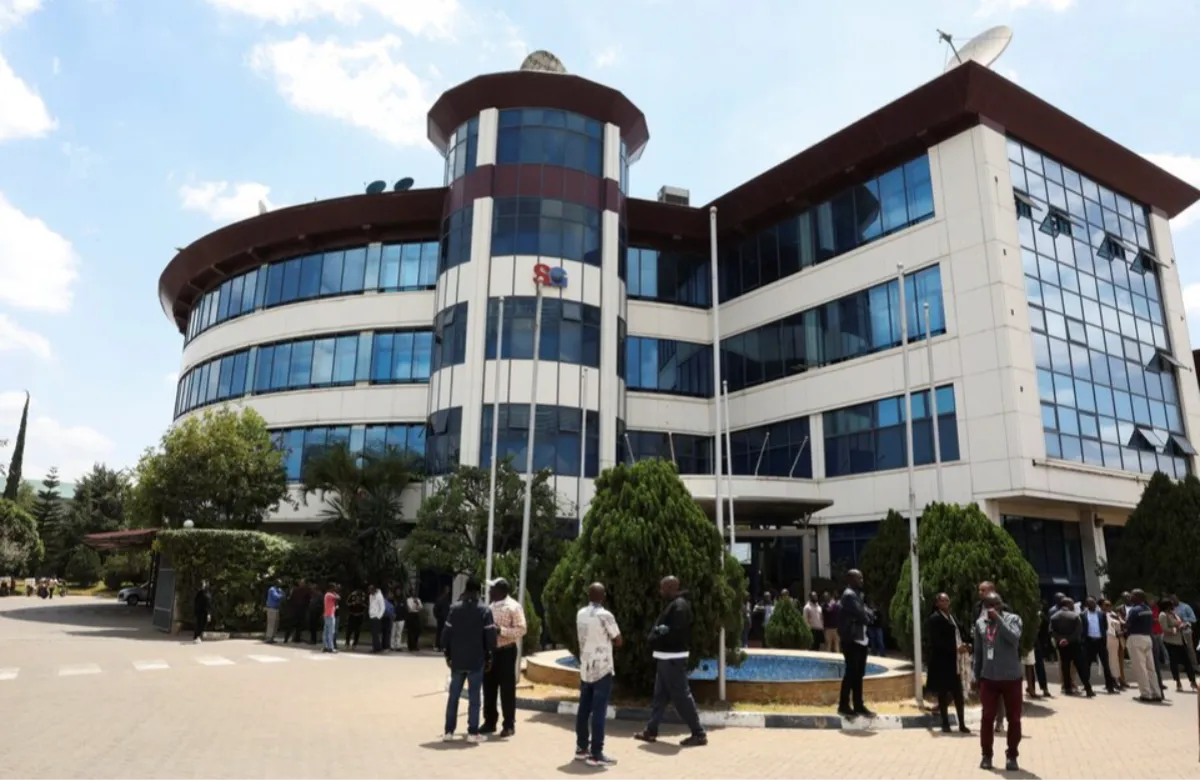
NAIROBI, Kenya — A Citizen TV investigation has raised questions about the organisation and financing of the October 2 protest outside Standard Group headquarters, alleging that two pro-government MPs were linked to a plan to mobilise demonstrators and pressure the media house over its reporting.
The investigation alleges that what appeared to be a protest against Standard Group’s coverage of President William Ruto’s administration was organised in advance, with mobilisers allegedly receiving money to bring demonstrators to the media house’s premises along Mombasa Road in Nairobi.
According to the investigation, a group of 11 individuals identifying themselves as “Tutam” held meetings in the days leading up to the protest, discussing plans that allegedly culminated in an attempt to enter the Standard Group premises on October 2.
The report places two unnamed Members of Parliament at the centre of the alleged operation, claiming one represents Nairobi while the other comes from the Rift Valley region.
It further alleges that the two lawmakers provided money to finance the mobilisation, with lead organisers reportedly receiving more than KSh400,000.
The claims have not been independently established in the material available for this report. The identities of the lawmakers, the alleged payments and the precise role of each participant remain matters requiring corroboration and responses from those implicated.
Meetings allegedly preceded the protest
The Citizen TV investigation traces the alleged mobilisation to late September, when photographic evidence reportedly showed 10 members of the group gathered at the Kenyatta International Convention Centre (KICC).
The meeting allegedly formed part of preparations for the demonstration against Standard Group, which operates The Standard newspaper and KTN television.
The investigation further reports that another meeting took place at Jimlizer Hotel in Buruburu at about 6pm on October 1, the evening before the protest.
Hours later, an individual identified in the report as “Planner 12” allegedly confirmed that resources had been secured to advance the plan.
The reported sequence of meetings, communications and resource mobilisation suggests that investigators are examining whether the demonstration was coordinated before participants arrived at the media house.
However, the existence of planning meetings alone would not establish who financed the operation or whether the alleged political sponsors directed the attempted entry into the premises.
Those questions would require verification of communications, financial records and the accounts of the individuals involved.
How protesters were mobilised
The investigation describes a coordinated effort to bring demonstrators from different parts of Nairobi to Standard Group headquarters on October 2.
According to the report, one participant said a group of 20 men arrived from Umoja on motorbikes, while another, identified as Gazemba, reportedly said 50 people had been mobilised from Kamukunji.
Others allegedly came from Bellevue and Ngong Road.
By approximately 10am, the investigation says, nearly 100 men had assembled in preparation for the protest.
The gathering followed days of online criticism of Standard Group over its coverage of the President and his administration.
On October 2, protesters accused the media house of publishing negative reports about Ruto and the government. Some attempted to enter the premises but were prevented from doing so as tensions rose outside the offices.
Standard Group condemned the incident, describing it as an attack on media freedom and an attempt to intimidate its journalists and staff.
The media house said it would continue its reporting despite the confrontation.
Payment disputes expose alleged mobilisation arrangements
One of the most significant elements of the investigation concerns complaints over payments made to people who participated in the protest.
According to Citizen TV, members of the group reconvened online at about 5pm on the day of the demonstration, with some expressing dissatisfaction over the organisation of the event and the distribution of money.
Gazemba was quoted as complaining that some participants had incurred losses while others received thousands of shillings.
“Some of us went home counting losses, others counting thousands. It’s not fair at all,” he reportedly said.
The investigation also cites an audio recording in which Sally Raghet allegedly complained that she had received only KSh5,000, an amount she said barely covered her personal security expenses.
The reported complaints raise questions about whether participants were recruited under an agreed payment arrangement, how the money was distributed and who controlled the funds.
Separate reporting by The Standard after the October 2 confrontation documented protesters complaining that they had not received the amounts they expected, with some saying they had spent their own money travelling to the demonstration. Others alleged that payments varied significantly between participants.
Those accounts provide additional context for the payment dispute, although they do not independently establish the identities of the alleged funders named in the Citizen TV investigation.
Two MPs allegedly linked to funding
The investigation alleges that two pro-government MPs, one from Nairobi and another from the Rift Valley region, supplied money for the mobilisation.
Lead organisers reportedly received more than KSh400,000, although the report’s claims would need to be supported by evidence establishing the source, recipient and purpose of the funds.
The allegations are politically significant because they raise the possibility that individuals connected to elected leaders financed a campaign targeting a major media organisation over its editorial coverage.
But the alleged payments do not, by themselves, establish that the MPs ordered an attempted intrusion or that every protester knew of the reported arrangements.
The identities of the lawmakers and their responses are essential to determining the credibility and scope of the allegations. No conclusion about their responsibility should be drawn without supporting evidence and an opportunity for them to respond.
Online platform under scrutiny
The investigation also examines the role of digital communications in promoting the protest.
A microphone bearing the KDN brand was reportedly used to broadcast content from the demonstration. Citizen TV traced the online platform to Philip Toroitich, also known as Toro, whom the investigation identified as the head of the group’s digital team.
The report alleges that the platform consistently amplified one political faction rather than offering balanced coverage.
If substantiated, the findings would raise questions about how online platforms can be used to coordinate demonstrations, promote political messaging and shape public perceptions of disputes involving the media.
However, political alignment or one-sided coverage is not, on its own, proof of participation in an unlawful scheme. Establishing the platform’s precise role would require examining its communications, published material and links to the people who allegedly organised the protest.
Standard Group protest raises press freedom concerns
The October 2 demonstration took place amid heightened tensions between sections of the political establishment and media organisations over coverage of the government.
Before the protest, a group identifying itself as Bunge la Mwananchi had threatened to mobilise demonstrators against Standard Group, accusing it of unfair reporting about the President and his administration.
The confrontation intensified when protesters arrived at the media house’s headquarters and some attempted to gain entry. Human rights activists and other members of the public gathered outside to defend the media organisation and condemn the intimidation of journalists.
Standard Group said the incident threatened the constitutional protections afforded to freedom of expression and the media.
Article 34 of Kenya’s Constitution protects the freedom and independence of the media, while Article 33 guarantees freedom of expression, subject to the constitutional limitations set out in the law.
The right to demonstrate does not confer a right to threaten journalists, intimidate employees or force entry into private premises.
Complaints about media coverage can be pursued through public debate, requests for correction, the Media Council of Kenya and other lawful channels.
Another protest reportedly planned for October 23
The Citizen TV investigation further reports that the alleged organisers are preparing another demonstration outside Standard Group headquarters on Friday, October 23, 2026.
The reported plan raises fresh concerns about the safety of journalists and employees, particularly following the earlier attempt by demonstrators to enter the premises.
The information available for this report does not independently confirm whether the proposed demonstration will take place, who is organising it or whether the relevant authorities have been notified.
Also Read: Standard Group condemns protest outside Mombasa Road offices over Ruto coverage
Any renewed protest should be assessed on the basis of verified information about its organisers, stated purpose and conduct, rather than assumptions about the intentions of everyone who may attend.
The police and other relevant authorities have a responsibility to protect public safety while respecting the constitutional right to peaceful assembly.
Questions that remain unanswered
The Citizen TV investigation has placed the alleged financing and coordination of the protest under renewed scrutiny. Yet several important questions remain.
Who provided the alleged funds, and can the payments be traced through documentary or financial evidence? What instructions, if any, were given to the organisers and participants? What role did the two MPs allegedly play, and have they responded to the accusations? Did the digital platform merely cover the demonstration, or did it also participate in its coordination?
The answers would help establish whether the protest was a privately organised political mobilisation, a campaign financed by identifiable political actors or something more complex.
For now, the allegations should not be treated as proof of criminal wrongdoing by the individuals named or implicated in the investigation.
What is clear from the October 2 events is that a protest over media coverage escalated into a confrontation at one of Kenya’s major media houses, prompting renewed concerns about press freedom and the safety of journalists.
If the reported financial and organisational links are substantiated, the findings could deepen scrutiny of political mobilisation tactics ahead of the 2027 General Election.
The central issue extends beyond one demonstration: whether political grievances against the press are being pursued through legitimate public debate or through organised pressure that risks undermining independent journalism.
