



KAMPALA, Uganda — A new government initiative to clean up Uganda’s streets has triggered widespread criticism, legal challenges, and allegations of heavy-handed policing.
Prime Minister Robinah Nabbanja introduced monthly National Cleaning Days requiring citizens to dedicate three hours to sanitation on the last Saturday of each month. However, the policy now faces scrutiny over state coercion and a lawsuit from the Seventh-day Adventist Church regarding mandatory work.
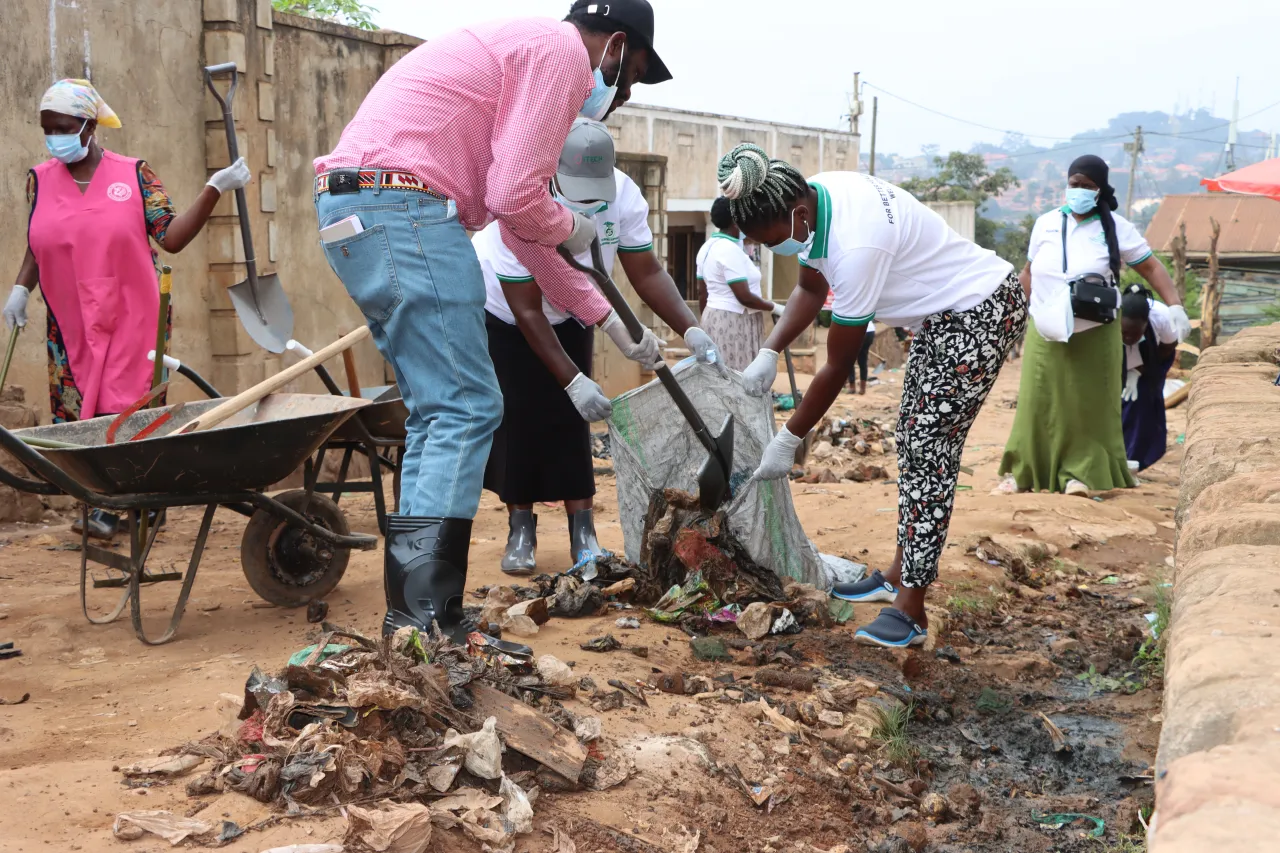
Every last Saturday of the month, Ugandans would put aside three hours to clean their neighbourhoods. Roads would become litter-free, drainage channels unclogged, markets sanitised and communities united around a common purpose.
Government described the initiative as an investment in public health and environmental protection, a civic responsibility that would help reduce disease outbreaks, flooding and urban decay.
Few questioned those objectives.
What many are now questioning is everything that followed.
Within hours of Uganda’s first National Cleaning Day on July 25, social media platforms filled with videos showing security officers confronting members of the public, chasing motorists, forcing people to sweep streets and, in some cases, physically assaulting civilians accused of failing to participate.
Instead of celebrating a national exercise in civic responsibility, many Ugandans found themselves asking a different question.
Can citizenship be enforced?
The answer to that question reaches far beyond sanitation.
It touches on constitutional rights, the role of government, police professionalism and the relationship between citizens and the state itself.
A good idea, poorly introduced?
Governments across the world routinely encourage citizens to participate in community service.
Public clean-up campaigns exist in countries ranging from Singapore to Japan and Rwanda.
Uganda itself has a long history of Bulungi Bwansi—community self-help initiatives where residents voluntarily come together to improve their surroundings.
The government’s National Cleaning Day was therefore not controversial because it encouraged cleanliness.
It became controversial because many citizens believe it transformed voluntary civic participation into compulsory state enforcement.
The programme was introduced through Cabinet Circular No. 1 of 2026, signed by Prime Minister Robinah Nabbanja, directing ministries, local governments, institutions, businesses and citizens to participate in organised monthly clean-up exercises.
Police later announced that movement would be restricted between 7:00 a.m. and 10:00 a.m., with only emergency and essential services exempted.
For many Ugandans, however, the first real notice came not through sustained public education campaigns but through heavily publicised police warnings and road enforcement operations only days before implementation.
That distinction matters.
Public policy specialists have long argued that successful behavioural change depends less on punishment than on public understanding, consultation and voluntary buy-in.
A law—or in this case, a Cabinet directive—may compel compliance.
It cannot automatically create civic culture.
The videos that changed the conversation
Throughout Saturday morning, images circulated widely showing security officers confronting members of the public in different parts of the country.
Some clips appeared to show officers forcing civilians to sweep roads.
Others appeared to capture physical punishment and intimidation.
The Uganda Police Force maintained that officers were enforcing government directives and ensuring compliance with movement restrictions during the exercise.
Yet the videos quickly became more influential than official statements.
Whether every clip reflected the full circumstances of each encounter became almost secondary.
Public perception shifted rapidly.
The national conversation moved away from sanitation.
Instead, attention focused on policing.
Could officers tasked with protecting citizens also compel unpaid community labour?
Had proportionality been observed?
Were officers demonstrating leadership—or simply exercising authority?
Those questions dominated online discussion throughout the day.
Leadership begins at the top
One of the most persistent criticisms emerging after the exercise had little to do with ordinary citizens.
It concerned public officials.
Many Ugandans asked why they saw comparatively few senior political leaders, cabinet ministers, heads of government agencies or security commanders visibly participating alongside ordinary citizens.
Leadership experts frequently argue that symbolic participation matters in public policy.
When leaders personally demonstrate the behaviour expected from citizens, compliance often becomes voluntary rather than coercive.
Rwanda offers perhaps the clearest regional example.
Its monthly Umuganda community service programme has become internationally recognised as one of Africa’s most successful civic participation initiatives.
Government ministers, military officers, local officials and ordinary citizens routinely work side by side.
Participation is highly visible.
The message is clear.
No one is above community service.
Uganda’s experience appeared markedly different.
Much of the public attention centred not on leaders cleaning communities but on police enforcing compliance.
That contrast has fuelled questions about whether government unintentionally undermined its own objective.
Can civic duty be compulsory?
The legal questions are becoming increasingly difficult to ignore.
Exiled lawyer and author Kakwenza Rukirabashaija has argued that Cabinet exceeded its constitutional authority by creating binding obligations through administrative directives rather than legislation passed by Parliament.
He also questioned whether the initiative duplicates responsibilities already assigned under existing legislation such as the Local Governments Act and the Public Health Act.
Those arguments may ultimately require judicial interpretation.
Uganda’s Constitution protects several fundamental rights, including freedom of movement, freedom of religion and protection from arbitrary treatment.
At the same time, governments possess legitimate authority to introduce public health measures where necessary.
Balancing those interests has historically proven difficult in constitutional democracies around the world.
The question is rarely whether governments may regulate public behaviour.
The more difficult question concerns how far enforcement may go before it begins infringing protected freedoms.
The Sabbath dispute
The Seventh-day Adventist Church introduced another constitutional dimension.
Church leaders formally requested accommodation because the exercise falls on Saturday—the Sabbath observed from Friday sunset until Saturday sunset.
Rather than rejecting National Cleaning Days, the church proposed alternative participation on Friday or Sunday.
Its position reflects an important principle recognised in many constitutional systems.
Accommodation.
Governments frequently adjust implementation where policies unintentionally conflict with sincerely held religious beliefs, provided public objectives remain achievable.
Whether such accommodation will ultimately be granted remains unclear.
The broader principle, however, illustrates that effective governance often depends upon flexibility rather than rigid enforcement.
Who is responsible for keeping Uganda clean?
The controversy has also revived another question.
If Ugandans already pay taxes, who carries primary responsibility for sanitation?
Institutions such as the National Environment Management Authority (NEMA), Kampala Capital City Authority (KCCA) and local governments receive public funding precisely because environmental management forms part of their statutory mandate.
Citizens unquestionably share responsibility for maintaining clean neighbourhoods.
Few dispute that.
What some Ugandans question is whether government agencies have consistently fulfilled their own obligations before shifting greater responsibility onto the public.
Overflowing drainage channels, uncollected garbage, illegal dumping and poor urban planning did not emerge overnight.
Many reflect years of institutional weaknesses, limited resources, inadequate enforcement and inconsistent local government management.
Critics therefore argue that mandatory community participation should complement—not replace—effective institutional performance.
The role of the police
Perhaps the greatest institutional challenge now facing government concerns policing itself.
Modern democratic policing increasingly emphasises community engagement, proportionality and public confidence.
Force remains a lawful tool under clearly defined circumstances.
Persuasion, however, generally produces stronger long-term legitimacy.
Where citizens perceive officers as acting fairly, voluntary compliance usually increases.
Where enforcement appears arbitrary or excessive, public cooperation often declines.
Several videos circulating online have therefore created reputational challenges extending beyond Saturday’s exercise.
Whether or not investigations ultimately establish misconduct in every case, public confidence depends not only upon legal authority but also upon perceived fairness.
Professional policing requires more than enforcing directives.
It requires maintaining legitimacy while doing so.
A lesson from Rwanda
Comparisons with Rwanda have become almost inevitable.
Yet simplistic comparisons risk overlooking important differences.
Umuganda did not become successful merely because participation is expected.
It evolved over decades into a deeply embedded civic institution supported by consistent leadership, sustained public education and broad community ownership.
Many Rwandans participate because it has become normal.
Not because they fear punishment.
Also Read: Rwanda’s Paul Kagame defends regulation of religious institutions
That distinction may ultimately determine whether Uganda’s National Cleaning Day succeeds.
Civic culture rarely develops through compulsion alone.
It grows when citizens believe public institutions apply the same standards to themselves that they expect from everyone else.
The bigger question
Uganda’s National Cleaning Day was never simply about collecting rubbish.
It became a test of governance.
The objectives remain widely supported.
Cleaner cities.
Better sanitation.
Improved public health.
Those goals enjoy broad consensus.
The disagreement concerns method.
Should governments compel civic participation through enforcement?
Or should they first persuade, educate and lead by example?
That debate is unlikely to end with the first National Cleaning Day.
Indeed, it may determine whether future exercises become nationally embraced civic traditions—or monthly reminders of a relationship between state and citizen that many Ugandans believe requires rebuilding.
Because ultimately, cleaner streets alone cannot build stronger societies.
Public trust can.
