

Close Menu
Vivid Voice NewsVivid Voice News
  • Home
  • News
    • Africa
      • East Africa
      • West Africa
      • Southern Africa
      • North Africa
      • Central Africa
    • Asia
      • China
      • India
    • Australia
    • Europe
    • Middle East
    • US & Canada
    • United Kingdom
  • Politics
  • Business
    • Economy
  • Culture
    • Lifestyle
    • Film & TV
    • Music
    • Art & Design
    • Books
  • Technology
  • Health
    • Fitness
  • Sports
    • Football
    • Athletics
    • Basketball
    • Boxing
    • Cricket
    • Golf
    • Rugby
    • Olympics
    • Motorsport
  • Travel
    • Tourism
    • Adventures
    • Culture & Experiences
    • Destinations

Latest Posts

Can East Africa afford its ambitious $80 billion spending plans?

United Opposition leaders begin Western Kenya political tour

Ugandan socialite Zari Hassan ends marriage with Shakib Cham after five years

Explore More
  • Home
  • Entertainment
  • Interviews
  • Opinion
    • Columnists
    • Cartoon
  • Supplements
  • Jobs & Tenders
  • Radio Show
    • Podcasts
  • Videos
Facebook X (Twitter) LinkedIn Instagram YouTube
  • Home
  • Entertainment
  • Interviews
  • Opinion
    • Columnists
    • Cartoon
  • Supplements
  • Jobs & Tenders
  • Radio Show
    • Podcasts
  • Videos
Facebook X (Twitter) LinkedIn Instagram YouTube RSS
Vivid Voice NewsVivid Voice News
  • Home
  • News
    • Africa
      • East Africa
      • West Africa
      • Southern Africa
      • North Africa
      • Central Africa
    • Asia
      • China
      • India
    • Australia
    • Europe
    • Middle East
    • US & Canada
    • United Kingdom
  • Politics
  • Business
    • Economy
  • Culture
    • Lifestyle
    • Film & TV
    • Music
    • Art & Design
    • Books
  • Technology
  • Health
    • Fitness
  • Sports
    • Football
    • Athletics
    • Basketball
    • Boxing
    • Cricket
    • Golf
    • Rugby
    • Olympics
    • Motorsport
  • Travel
    • Tourism
    • Adventures
    • Culture & Experiences
    • Destinations
Vivid Voice NewsVivid Voice News
Home » Africa » East Africa » Can East Africa afford its ambitious $80 billion spending plans?
East Africa

Can East Africa afford its ambitious $80 billion spending plans?

Michael WandatiBy Michael WandatiJune 12, 20264 Mins ReadNo Comments
Share Facebook Twitter LinkedIn WhatsApp Reddit Telegram Email Copy Link
Follow Us
Google News
Can East Africa afford its ambitious $80 billion spending plans?
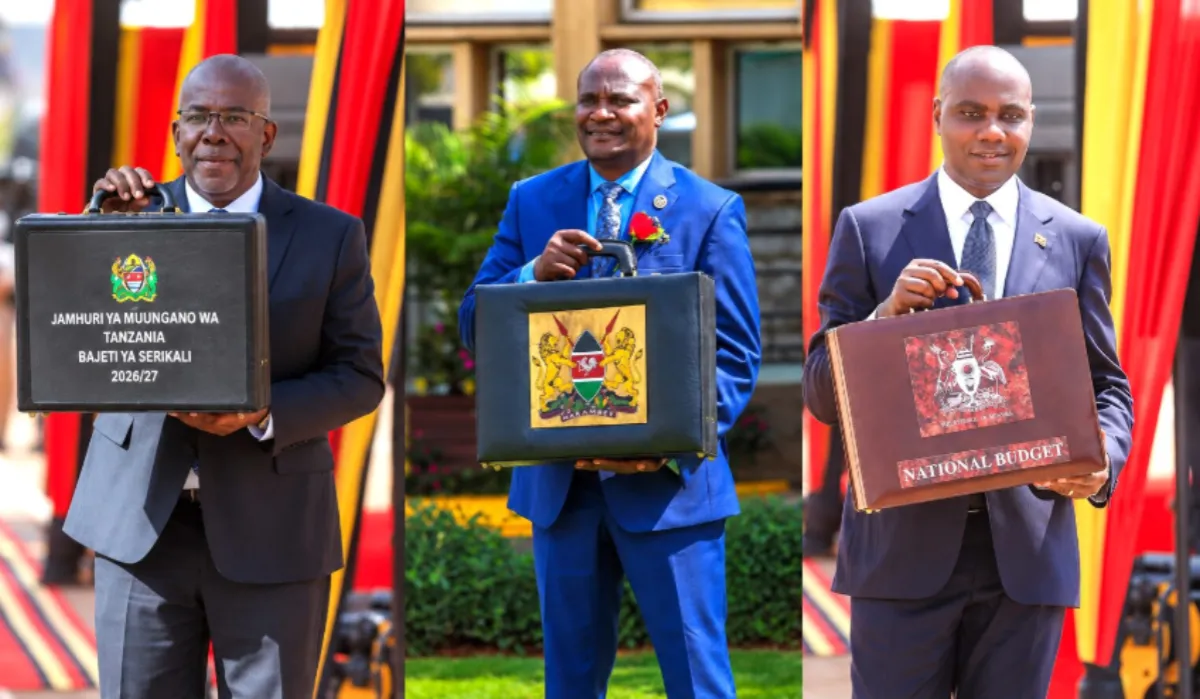
Finance Minister Ambassador Khamis Mussa Omar of Tanzania (left), Treasury Cabinet Secretary John Mbadi of Kenya (centre) and Finance Minister Henry Musasizi of Uganda (right) display their budget briefcases ahead of presenting their respective 2026/27 national budgets.

NAIROBI, Kenya — East Africa’s three largest economies are increasingly turning inward to finance development as Kenya, Uganda and Tanzania unveil ambitious spending plans aimed at sustaining growth amid rising debt pressures, global economic uncertainty and shifting geopolitical dynamics.

Together, the three countries have outlined budgets worth more than $80 billion for the 2026/27 financial year, signalling a broader regional shift toward domestic resource mobilisation as governments seek to reduce dependence on external borrowing and donor financing.

The move comes at a time when African governments are facing higher global borrowing costs, currency volatility and increasing pressure to strengthen fiscal sustainability.

ADVERTISEMENT

Kenya targets growth while avoiding new tax burdens

In Kenya, Treasury Cabinet Secretary John Mbadi presented a record KSh4.8 trillion budget focused on sustaining economic growth, supporting small businesses and financing key development programmes.

The spending plan includes a projected fiscal deficit of slightly over KSh1.1 trillion, which the government intends to finance largely through domestic borrowing and improved revenue collection.

Unlike previous years, the government has largely avoided introducing major new tax measures, opting instead to expand compliance through digitisation, enhanced tax administration and broader integration of government systems.

The cautious approach follows widespread public opposition to tax increases in recent years and reflects growing political sensitivity around the cost of living.

Kenya’s Treasury projects economic growth of more than 5 percent over the medium term, supported by agriculture, manufacturing, digital services and infrastructure investments. However, analysts warn that rising debt-servicing costs continue to limit fiscal flexibility.

Advertisement

Uganda positions oil as catalyst for economic transformation

Uganda has unveiled a Shs72.4 trillion budget anchored on the anticipated start of commercial oil production, which the government expects will help propel economic growth to 10.2 percent in the coming financial year.

Finance Minister Henry Musasizi described domestic revenue mobilisation as critical to Uganda’s long-term economic independence, with government targeting Shs45.6 trillion in domestic collections.

The budget prioritises infrastructure development, agro-industrialisation, energy projects and oil-sector investments, including continued development of the East African Crude Oil Pipeline (EACOP).

Government officials argue that oil exports, combined with increased industrial production and agricultural value addition, could significantly expand Uganda’s economic base over the next decade.

However, economists caution that long-term success will depend on effective management of oil revenues, economic diversification and maintaining macroeconomic stability.

Advertisement

Tanzania deepens self-financing strategy

Tanzania has similarly prioritised domestic revenue mobilisation as it seeks to finance major infrastructure projects, including railway expansion, energy investments and industrial development.

The government has increasingly emphasised tax administration reforms and stronger domestic collections to fund development programmes while limiting exposure to external financing risks.

The strategy reflects a broader trend across East Africa, where governments are seeking greater fiscal autonomy amid changing global aid flows and tighter international lending conditions.

Growing pressure on taxpayers and businesses

While governments argue that stronger domestic revenue collection is essential for economic resilience, business groups and civil society organisations have warned that aggressive tax enforcement could increase pressure on households and small enterprises already grappling with high operating costs.

Advertisement

Analysts note that the challenge for East African governments will be balancing fiscal consolidation with economic growth.

“Domestic resource mobilisation is necessary, but governments must ensure that revenue measures do not undermine private sector growth and household consumption,” regional economists have repeatedly argued.

The concern is particularly acute in economies where informal businesses account for a significant share of employment and economic activity.

Regional integration remains critical

Beyond national budgets, the success of East Africa’s development ambitions may depend on deeper regional integration.

The East African Community continues to push for the elimination of non-tariff barriers, improved transport networks and expanded cross-border trade as member states seek to create larger markets for locally produced goods.

Advertisement

Also Read: Speaker Wetang’ula defends Ruto absence at 2026/27 budget reading

Major projects such as the East African Crude Oil Pipeline, the Standard Gauge Railway and regional energy interconnections are expected to play a key role in improving competitiveness and reducing logistics costs.

However, external factors remain a major risk. Continued instability in global energy markets, supply-chain disruptions and geopolitical tensions could raise import costs and complicate economic planning across the region.

A defining fiscal moment

The 2026/27 budgets underscore a growing consensus among East African governments that future growth will increasingly depend on strengthening domestic revenue, expanding regional trade and building economic resilience from within.

Whether that strategy succeeds will largely depend on governments’ ability to deliver growth, create jobs and improve living standards while maintaining public support for fiscal reforms.

Advertisement

For Kenya, Uganda and Tanzania, the coming financial year may prove to be one of the most consequential tests yet of East Africa’s push toward greater economic self-reliance.

Domestic revenue mobilisation East Africa budgets 2026/27 East Africa development spending East Africa economic growth East Africa economy East Africa fiscal policy East Africa growth forecast East Africa infrastructure projects East Africa public debt East Africa self-reliance East African Community economy East African economies Government spending in East Africa Henry Musasizi budget Henry Musasizi budget speech John Mbadi budget John Mbadi budget speech Kenya Kenya budget 2026/27 Kenya economic outlook Khamis Mussa Omar budget Regional economic integration Tanzania Tanzania budget 2026/27 Tanzania economic outlook Uganda Uganda budget 2026/27 Uganda economic outlook Uganda national budget 2025/2026
Michael Wandati
  • Website
  • Facebook
  • X (Twitter)
  • Instagram
  • LinkedIn

Michael Wandati is an accomplished journalist, editor, and media strategist with a keen focus on breaking news, political affairs, and human interest reporting. Michael is dedicated to producing accurate, impactful journalism that informs public debate and reflects the highest standards of editorial integrity.

SPONSORED LINKS

Related Posts

Hustler Fund hits Sh87bn in loans to 28 million accounts, says Mbadi

By Imani TendoJune 11, 20263 Mins Read

Speaker Wetang’ula defends Ruto absence at 2026/27 budget reading

By Michael WandatiJune 11, 20263 Mins Read

Uganda projects 10.2% growth as oil production set to transform economy

By Michael WandatiJune 11, 20264 Mins Read
ADVERTISEMENT

Latest Posts

Can East Africa afford its ambitious $80 billion spending plans?

Michael WandatiBy Michael WandatiJune 12, 2026

United Opposition leaders begin Western Kenya political tour

Michael WandatiBy Michael WandatiJune 12, 2026

Ugandan socialite Zari Hassan ends marriage with Shakib Cham after five years

Amani NuruBy Amani NuruJune 12, 2026

Court orders Muhoozi to answer Besigye’s threat claims within seven days

Michael WandatiBy Michael WandatiJune 12, 2026

Kikuube residents accuse NIRA officials of charging illegal fees for national IDs

Michael WandatiBy Michael WandatiJune 12, 2026
ADVERTISEMENT
Trending Now

Breaking News Alerts

Get real-time breaking news alerts and stay up-to-date with the most important headlines from Africa, and around the world.

Vivid Voice News is an independent global news organization dedicated to factual reporting. Your trusted source for breaking news, bold opinions, and insightful stories from Africa and around the world. Stay informed, stay engaged.

We're Social. Connect With Us:

Facebook X (Twitter) Instagram YouTube LinkedIn

Subscribe for Updates

Get real-time breaking news alerts and stay up-to-date with the most important headlines from Africa, and around the world.

Contact Us

Regional Bureaus
🇰🇪 Nairobi, Kenya
📞 +254 714 172 393

🇺🇬 Kampala, Uganda
      Plot 65 Yusuf Lule Road
      P.O. Box 27258
📞 +256 394 516 614

✉️ Email: info@vividvoicenews.com

  • Home
  • About Us
  • Contact Us
  • Advertise With Us
  • Privacy Policy
  • Terms of Use
Copyright © 2026 Vivid Voice News. All Rights Reserved.

Type above and press Enter to search. Press Esc to cancel.