


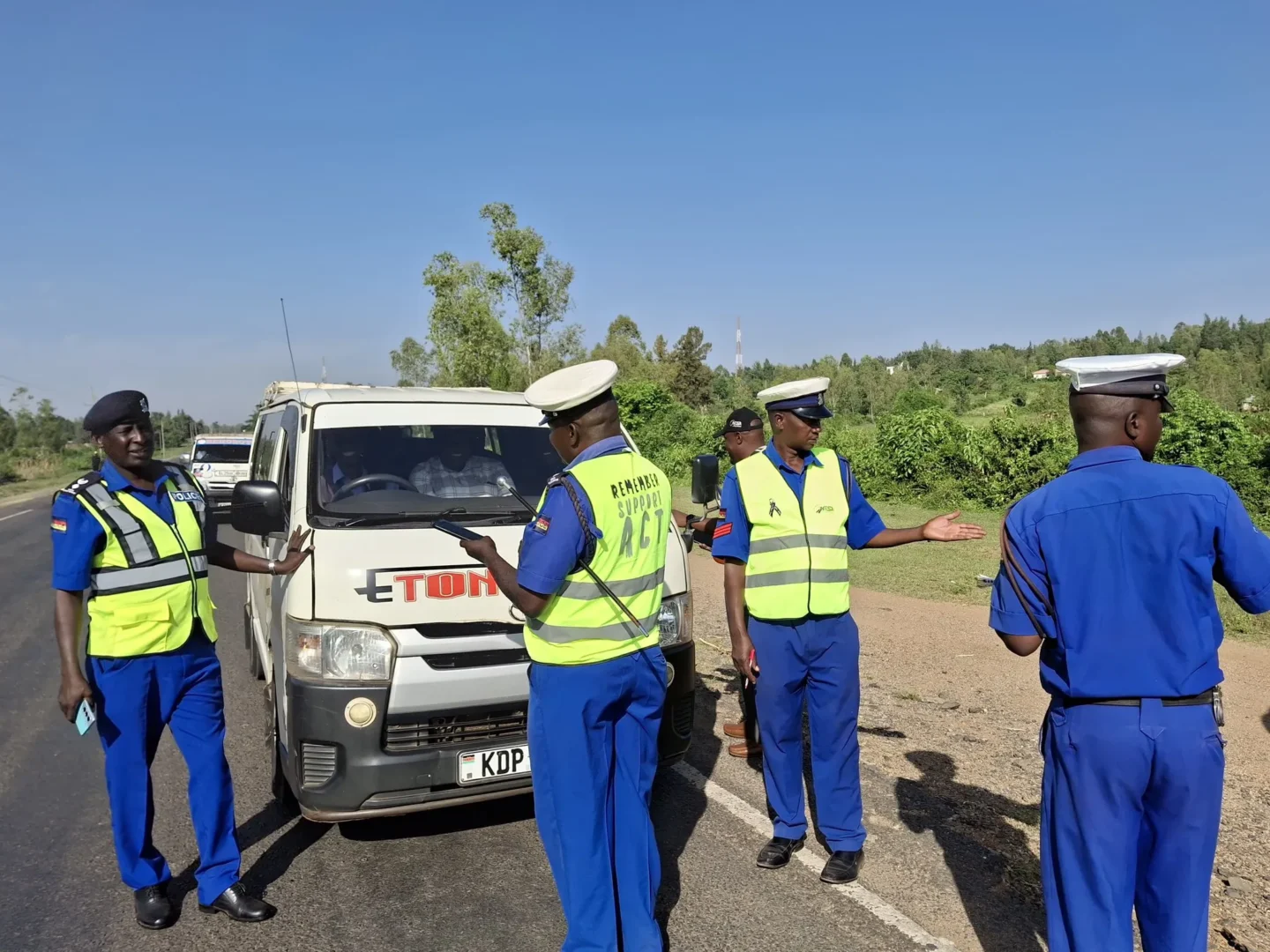
NAIROBI, Kenya — The National Transport and Safety Authority (NTSA) has reassured motorists that the country’s instant traffic fines system remains fully operational, despite ongoing court proceedings affecting a section of the programme.
NTSA Director-General Nashon Kondiwa said the orders issued by the Kiambu Law Courts only relate to the Public-Private Partnership (PPP) component of the initiative and do not affect enforcement under the Minor Traffic Offences Rules, which continue to be implemented nationwide.
Speaking amid growing public confusion over the status of the programme, Kondiwa said traffic offences are still being detected and processed through existing automated systems as well as police-issued notices.
“We have orders from the Kiambu Law Courts directing us to keep records of payments and another order suspending the implementation of the PPP component,” he said.
He emphasised that the court directives do not suspend the underlying regulations governing instant traffic fines.
“It is important to distinguish between the PPP implementation and the Minor Traffic Offences Rules implementation. They are not the same. No one has suspended the rules,” Kondiwa said.
According to NTSA, enforcement continues through surveillance systems installed by the Kenya National Highways Authority (KeNHA) and the Kenya Urban Roads Authority (KURA), alongside a digital enforcement application used by traffic police officers.
Motorists found in violation of traffic regulations can therefore still receive notices and are required to pay prescribed fines, even as the legal dispute over the PPP arrangement proceeds in court.
The instant fines system was introduced as part of broader reforms aimed at improving road safety, enhancing compliance, and reducing reliance on lengthy court processes for minor traffic offences.
Under the framework, offences such as speeding, running red lights, and lane indiscipline are captured through automated cameras or police digital tools and linked to vehicle registration details. Once verified, motorists receive notifications detailing the offence, location, and applicable penalty.
Also Read: NTSA’s new traffic fines regime sparks debate among Kenyan motorists
Drivers are then required to settle fines within a specified period, failure to which may attract further enforcement measures, including prosecution and possible restrictions on access to NTSA services.
Kondiwa dismissed claims that the system is primarily intended to generate revenue for the authority, insisting its core objective is improved discipline on Kenyan roads.
He further noted that the court orders have temporarily affected expansion plans under the PPP arrangement, which was expected to support the rollout of 1,000 additional enforcement cameras over two years.
The matter remains before the courts and is scheduled for mention on June 21 for further directions.
NTSA’s list of new traffic offences and fines
| Traffic Offence | Fines (in Ksh) |
|---|
| Driving without identification plates affixed or plates not fixed in the prescribed manner | 10,000 |
| Driving a vehicle without a valid inspection certificate inspected | 10,000 |
| Driving without a valid driving license endorsement in respect of the class of vehicle | 3,000 |
| Failure to renew a driving license | 1,000 |
| Driving a PSV while being unqualified | 5,000 |
| Failing to carry and produce a driving license on demand | 1,000 |
| Exceeding speed limit prescribed for class of vehicle | 500 |
| Exceeding speed limit of 50 kph or as prescribed by a traffic sign | 500 |
| Driving on or through a pavement or a pedestrian walkway | 5,000 |
| Failure of a driver to obey any directions given by а police officer in uniform | 3,000 |
| Failure of a driver to conform to the indications given by any traffic sign | 3,000 |
| Failure of a driver to stop when required to do so by a police officer in uniform | 5,000 |
| Causing obstruction by allowing a vehicle to remain in any position on the road | 10,000 |
| Failure to display reflective triangles or warning signs when a vehicle is obstructing traffic | 3,000 |
| Driver of motor cycle carrying more than one pillion passenger | 1,000 |
| Driving a vehicle on a footpath | 5,000 |
| Pedestrian willfully obstructing the free passage of vehicles | 500 |
| Unlicensed person driving or acting as a conductor of a PSV | 5,000 |
| Owner or operator of PSV employing an unlicensed PSV driver or conductor | 10,000 |
| Failure to refund fare paid for incomplete portion of journey for which full fare has been paid | 3,000 |
| Touting | 3,000 |
| Failure of a PSV driver or conductor to wear special badge and uniform | 2,000 |
| Motorcycle rider riding without protective gear | 1,000 |
| Motorcycle passenger riding without protective gear | 1,000 |
| Person who while not being the designated driver of a PSV drives the vehicle | 3,000 |
| The driver of a PSV who lets an unauthorized person to drive | 3,000 |
| Learner failing to exhibit “L” plates on the front and rear of the motor vehicle | 1,000 |
| Failure by owner of vehicle to have seat belts in motor vehicle | 1,000 |
| Failure to wear seat belt while motor vehicle is in motion | 500 |
| Failure of a conductor of PSV to keep seat belts in a clean, dry and generally wearable condition | 500 |
| Failure of a vehicle to carry reflective/warning signs (lifesavers) | 2,000 |
| Failure to fit prescribed speed governor in PSV and Commercial Vehicle | 10,000 |
| Driving or operating a PSV with tinted windows or windscreen | 3,000 |
| Failure of a PSV to carry functional fire extinguishers and fire kits | 2,000 |
| Driver using a mobile phone while vehicle is in motion | 2,000 |
| Drivers who pick or drop passengers at unauthorized bus stops or terminals | 3,000 |
| Passengers who alight or board a matatu at unauthorized bus stops or terminals | 1,000 |
| Travelling with part of the body outside moving vehicle | 1,000 |
