


MALAVA, Kenya — President William Ruto has directed government officials to explore the possibility of using part of Malava Forest for the expansion of Malava town, including the construction of a modern market and a hospital, raising fresh questions about the balance between infrastructure development and environmental conservation.
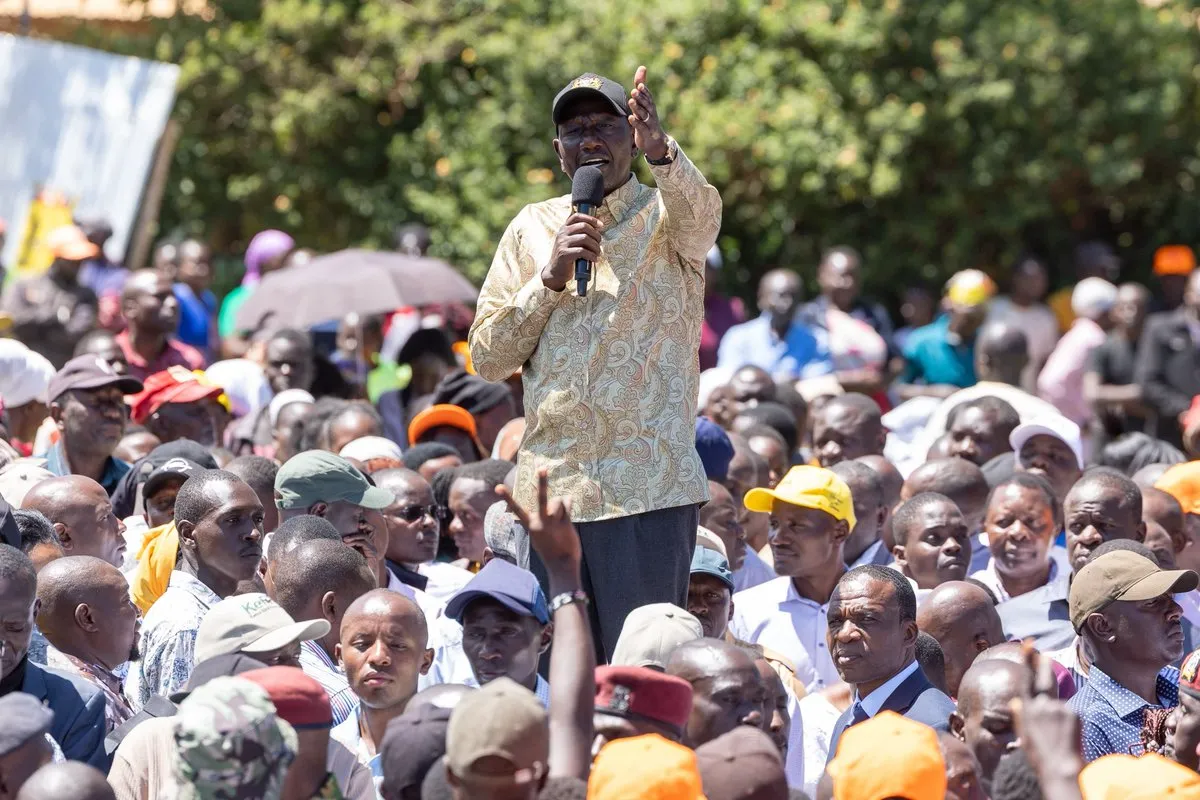
Speaking during an interdenominational church service in Malava on Sunday, November 29, 2026, Ruto instructed Prime Cabinet Secretary Musalia Mudavadi to engage the Ministry of Environment and other relevant agencies in developing a plan for the proposed expansion.
The President said the national government had discussed the market project with Kakamega Governor Fernandes Barasa and Malava MP David Ndakwa, who were expected to identify suitable land for the development.
However, he indicated that a portion of the nearby forest could be considered if the county government and local leaders failed to secure an alternative site.
“I asked him together with the governor, to look for land for the project and if it’s impossible, we can give you a portion of the forest,” Ruto said, adding that the proposal would be handled through a structured government process.
He cautioned residents against interpreting his remarks as permission to start cutting down trees, insisting that the relevant ministries would first establish how the proposed expansion could be undertaken.
“We are going to discuss with the relevant ministries so that we come up with a clear plan so that even Malava Town can be expanded for hospitals and markets. I will give instructions so that we can look at that,” he added.
The directive places Malava Forest at the centre of a development debate that could have implications for local businesses, public infrastructure, biodiversity and the protection of forest ecosystems in Western Kenya.
KSh140 million market plan puts forest land in focus
The proposed market is among the development projects the President wants implemented in Malava to improve trading facilities and support economic activity.
According to reporting by Vivid Voice News correspondent, Ruto said KSh140 million had been set aside for the modern market, which is expected to provide better facilities for traders and stimulate business growth in the town.
The President had tasked local leaders with identifying suitable land before the possibility of using forest land was considered.
However, the reported size of the proposed forest allocation remains unclear. While some media reports have referred to five kilometres, The Standard reported that the President mentioned five acres.
The distinction is significant and requires clarification from the original speech recording or an official government statement before the exact size can be established.
Beyond the market, the proposed expansion is expected to accommodate a hospital and other public amenities as Malava town grows.
For residents, the prospect of improved healthcare facilities and a modern trading centre could address important local development needs.
But the question is whether the projects can be delivered on alternative public land without placing additional pressure on an existing forest ecosystem.
Why Malava Forest matters beyond the town
Malava Forest is an indigenous forest area in Kakamega County, situated close to Malava town and connected ecologically to the wider Kakamega Forest landscape.
Its ecological importance extends beyond providing green space near an expanding urban centre.
Forest ecosystems help regulate local water systems, protect soils, store carbon and provide habitats for wildlife and plant species.
The Malava forest landscape is also associated with birds, monkeys, baboons and other wildlife, making the protection of its remaining natural vegetation important for biodiversity.
Any reduction in forest cover could therefore have consequences beyond the immediate construction site, particularly if development affects vegetation, drainage systems and habitats.
The extent of those risks would depend on the precise location and size of the proposed allocation, the ecological characteristics of the affected area and the mitigation measures adopted.
This makes a detailed environmental assessment important before any construction decision is implemented.
Environmental safeguards could determine whether the proposal proceeds
Ruto’s directive does not, by itself, amount to a completed legal decision to excise forest land or authorise tree felling.
The government must first establish the legal status and boundaries of the land under consideration, including whether the proposed site falls within a gazetted public forest or another category of land.
That distinction matters because the applicable legal requirements and approvals depend on the land’s classification.
Kenya’s Constitution places obligations on the state to protect the environment and conserve natural resources for present and future generations.
The Forest Conservation and Management Act, 2016, provides a framework for the protection and management of forest resources, while environmental assessment requirements under the Environmental Management and Co-ordination Act are relevant to projects likely to have significant environmental effects.
Consequently, any proposal involving forest land would need to comply with the applicable legal procedures, including the relevant environmental assessment and public participation requirements.
Environmental experts, affected communities and conservation stakeholders would also have an opportunity to scrutinise the proposed development, its location and potential ecological consequences through the appropriate processes.
The Ministry of Environment and the Kenya Forest Service will therefore face important questions about the forest’s legal status, the land being considered and the safeguards required before any decision is made.
Ruto’s 15 billion tree target faces a conservation test
The proposed use of Malava Forest land also raises questions about the government’s wider environmental commitments.
Ruto’s administration is pursuing the 15 Billion Tree Growing Programme, which seeks to restore 10.6 million hectares of degraded landscapes and increase Kenya’s national tree cover to 30 per cent by 2032.
The initiative is intended to strengthen climate resilience, restore degraded ecosystems, improve water resources and address biodiversity loss.
The government’s forestry strategy therefore places considerable emphasis on expanding tree cover and rehabilitating degraded landscapes.
Against that background, any proposal to allocate existing forest land for infrastructure development will require a clear explanation of how the government intends to protect ecological functions and meet its restoration commitments.
Tree planting elsewhere cannot automatically replace the biodiversity, mature vegetation and ecological functions of an existing indigenous forest.
The relevant question is not simply how many trees could be planted to compensate for those removed, but whether the proposed development is necessary, whether alternative sites are available and whether the environmental consequences can be adequately addressed.
Development versus conservation in Malava
The debate presents a familiar challenge for rapidly growing towns across Kenya: how to provide hospitals, markets, roads and other public facilities without undermining the natural resources that sustain surrounding communities.
Malava residents stand to benefit from improved public infrastructure, particularly if the proposed market creates better trading opportunities and the hospital expands access to healthcare.
Also Read: Ruto faces scrutiny over repeat launch of Sh3.3bn Busia road project
However, the development should not proceed on the assumption that forest land is automatically available whenever suitable public land cannot be identified.
The government must demonstrate that alternative sites have been properly assessed, the proposed land allocation is legally permissible and the environmental implications have been independently evaluated.
It must also clarify whether the market, hospital and wider town expansion will be developed as one integrated project or through separate phases.
For now, Ruto has instructed government officials to begin planning rather than announced a completed forest clearance.
The next steps will determine whether Malava’s expansion can proceed without compromising the forest’s ecological value.
The central question facing the government is whether it can deliver the promised development while protecting a natural resource that also serves the interests of future generations.
