


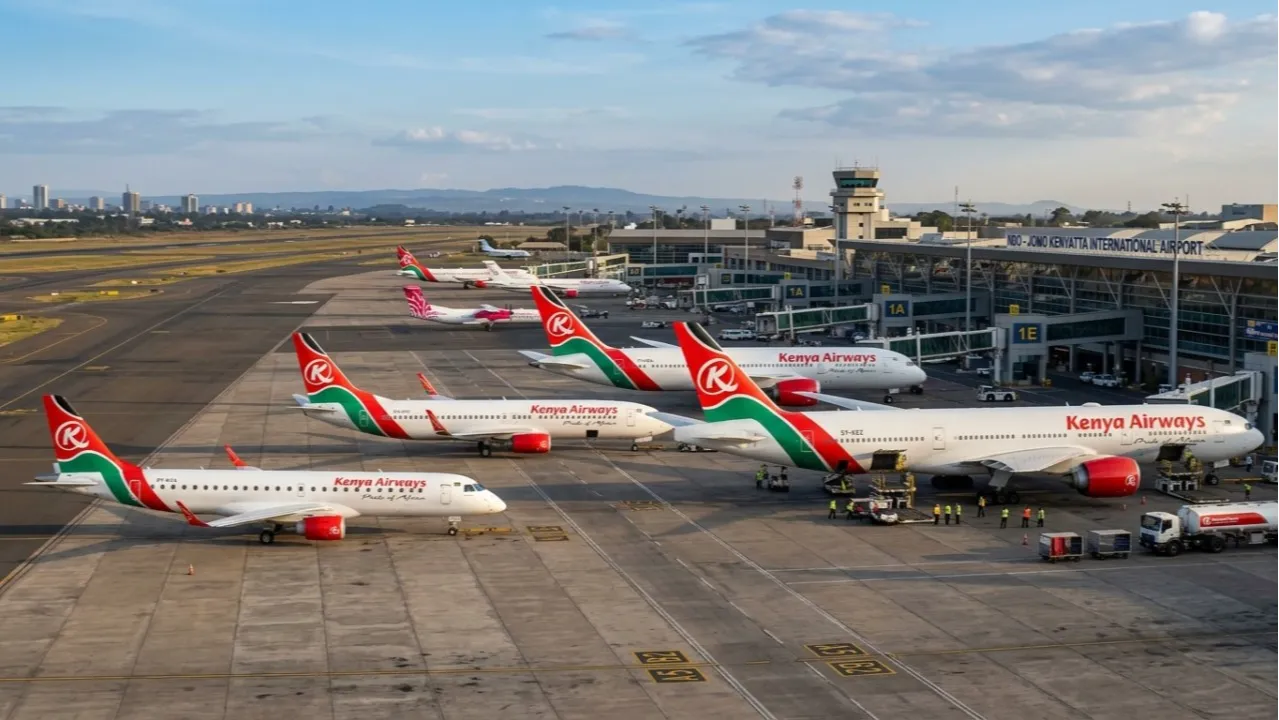
NAIROBI, Kenya — Kenya Airways (KQ) has warned passengers to expect possible flight schedule changes following temporary aviation restrictions affecting Nairobi on three dates, as the national carrier separately faces a projected decline of at least 25 per cent in its 2026 earnings.
The airline said the scheduled restrictions would take place on Friday, November 27, Friday, December 4, and Saturday, December 12, 2026, to facilitate national military activities.
In a customer advisory, Kenya Airways said the first closure would run from noon to 1:20pm on November 27. The restrictions scheduled for December 4 and December 12 would run from 10:30am to 12:30pm.
The airline cautioned that the temporary restrictions could affect flight operations, potentially resulting in adjusted departure and arrival times.
“We wish to inform our customers that Nairobi airspace will be temporarily closed on 27 November 2026, from 12:00 HRS to 13:20 HRS, and on 4 December and 12 December 2026, from 10:30 HRS to 12:30 HRS, to facilitate scheduled national military activities,” the carrier said.
Passengers travelling on the affected dates have been advised to confirm their flight status through the Kenya Airways website or mobile application before leaving for the airport.
The airline said it was coordinating with relevant authorities to minimise disruption and would communicate schedule changes directly to affected customers.
It also apologised for the inconvenience, urging travellers to allow for possible adjustments to their plans.
What passengers need to know
The temporary restrictions are expected to affect flight operations during the specified periods, although the airline has not indicated that all flights will be cancelled.
Travellers connecting through Jomo Kenyatta International Airport (JKIA) should pay particular attention to departure and arrival updates, especially where connecting flights, onward travel or airport transfers are involved.
Passengers should also ensure that their contact details are current in their bookings so they can receive any notifications from the airline.
An aviation notice separately lists Jomo Kenyatta International Airport as closed during scheduled periods on November 27, December 4 and December 12. The published notice gives the November 27 window as 12pm to 1:30pm East Africa Time, which differs by 10 minutes from the period stated in Kenya Airways’ customer advisory.
Passengers should therefore rely on direct flight-status updates from their airline rather than assume that every flight will operate according to its original schedule.
Kenya Airways issues 25 per cent earnings warning
The operational advisory comes as Kenya Airways faces a difficult financial outlook, with its board projecting that earnings for the financial year ending December 31, 2026, will be at least 25 per cent lower than those reported in 2025.
In a profit warning dated November 26, Board Chairperson Kiprono Kittony attributed the anticipated decline to higher aviation fuel costs, persistent global supply-chain disruptions and shortages of critical aircraft spare parts.
The airline said escalating conflict in the Middle East had pushed up fuel prices, increasing pressure on one of the aviation industry’s largest operating expenses.
It also pointed to delays in obtaining aircraft components, extended spare-parts delivery times and shortages of essential maintenance materials.
“These pressures include a surge in fuel costs driven by the escalating Middle East conflict. The ongoing global supply chain constraints, including shortages of critical spare parts, extended lead times, and delays in component availability, disrupted fleet availability and operational reliability. Collectively, these factors exerted sustained pressure on margins and overall network profitability,” Kittony said.
The distinction is important: the 25 per cent figure is a forecast decline in earnings compared with 2025, not a projection that passenger numbers or revenue will fall by the same proportion.
Rising costs undermine recovery despite passenger demand
Kenya Airways’ financial warning highlights the difficulty of converting stronger passenger demand into improved profitability when operating costs and aircraft availability remain under pressure.
The airline’s half-year results for the six months ended June 30, 2026, showed revenue rising by nine per cent to approximately Sh81 billion, despite the carrier operating with nine per cent less capacity.
However, its loss after tax widened to Sh16.1 billion, compared with Sh12.2 billion in the corresponding period in 2025.
Fuel costs increased by 32 per cent year-on-year during the first half of 2026, accounting for approximately 32 per cent of total operating expenses and 52 per cent of direct operating costs.
Overall operating costs rose by 14 per cent, putting further pressure on the airline’s margins.
The figures illustrate a challenge facing airlines globally: strong demand for air travel does not necessarily translate into higher profits when fuel, maintenance, aircraft leasing and other operating expenses rise faster than revenue.
For Kenya Airways, shortages of spare parts have added another layer of difficulty by limiting the number of aircraft available for commercial operations.
Aircraft that remain grounded or unavailable reduce the airline’s capacity to deploy flights, serve passengers and maximise revenue from its existing route network.
Fleet restoration and financial pressure
Restoring aircraft availability is among the priorities in Kenya Airways’ recovery strategy.
The carrier has previously identified cost controls, cash conservation, fleet restoration, debt reduction and capital raising as important measures for strengthening its financial position.
In its August 2026 half-year update, the airline said additional aircraft had returned to service after the reporting period, including a Boeing 787-8 and a Boeing 777-300ER.
Also Read: Kenya Airways suspends Dubai, Sharjah flights after UAE closes airspace
The board’s latest warning nevertheless indicates that supply-chain constraints and higher fuel costs continue to weigh on the business.
The financial outlook also raises questions about how quickly the airline can restore operational capacity while managing its debt obligations and funding requirements.
For passengers, the immediate concern is the possibility of schedule changes arising from the December aviation restrictions. For investors and the wider aviation industry, the larger issue is whether Kenya Airways can improve fleet reliability and control operating expenses sufficiently to reverse the projected decline in earnings.
The two developments place the national carrier under pressure on both its operational and financial fronts as it approaches the end of 2026.
