


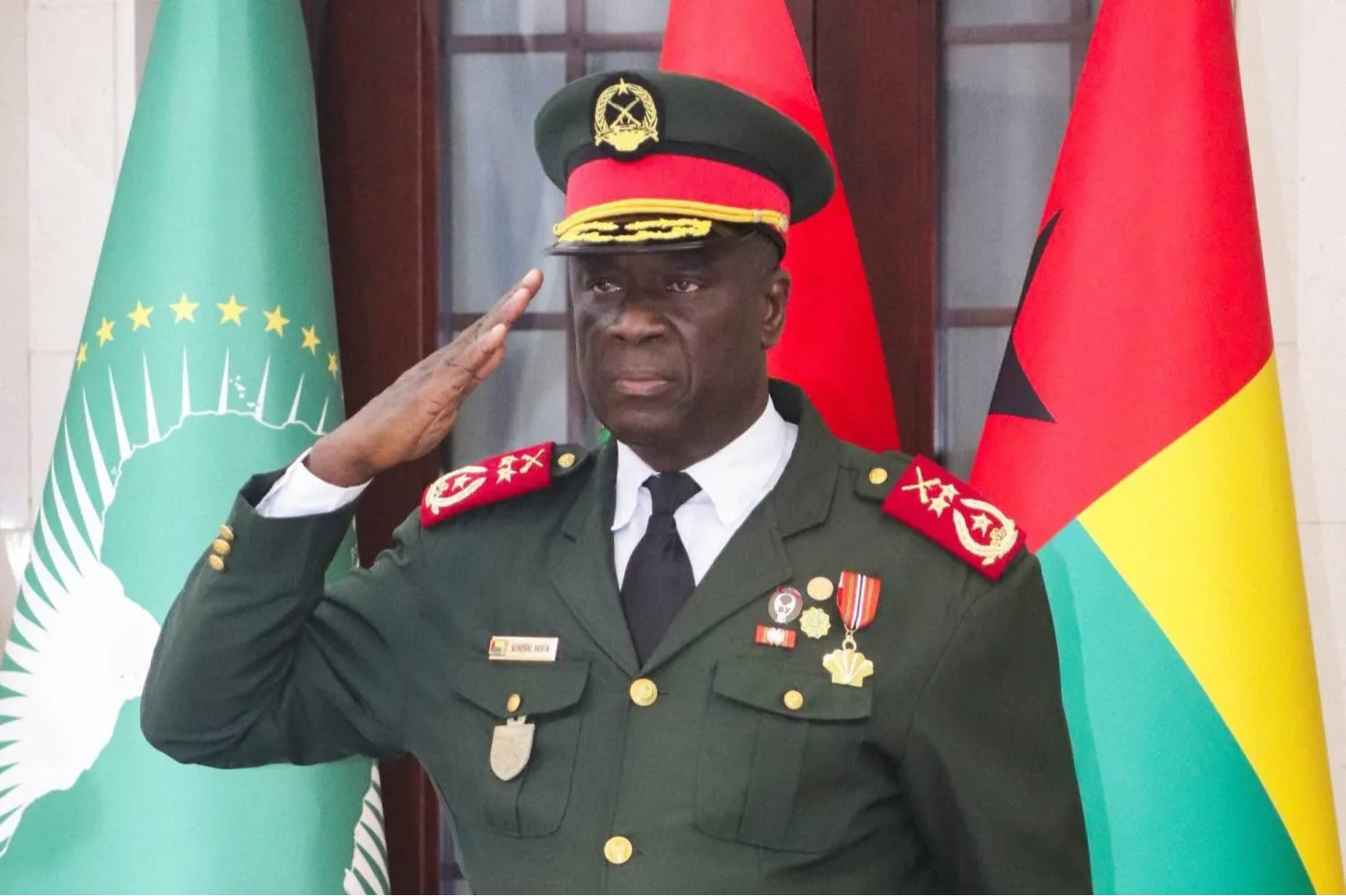
BISSAU, Guinea-Bissau — Guinea-Bissau’s military rulers have postponed presidential and parliamentary elections until November 2028, pushing back the country’s promised return to civilian government and extending military-led rule by approximately two years.
The announcement, made on Thursday, November 26, came exactly one year after the armed forces seized power in a coup that interrupted the country’s 2025 electoral process before official results could be declared.
The elections had initially been scheduled for December 6, 2026, and were expected to mark the end of a one-year political transition. However, a decree signed by transitional President and military leader General Horta N’Tam moved the polls to November 26, 2028.
The military administration cited inadequate technical, material and financial preparations as the reason for the postponement, arguing that the country was not sufficiently prepared to conduct a credible election.
N’Tam said additional time was necessary to guarantee the legality, transparency, inclusiveness and credibility of the electoral process.
The authorities also intend to organise the country’s first municipal elections, which the transitional leadership says are necessary to establish elected local government structures.
But the decision effectively means Guinea-Bissau will remain under military-led transitional arrangements for three years after the November 2025 takeover, raising concerns about how and when the generals intend to relinquish power.
A transition that has moved its goalposts
The postponement represents a major departure from the military’s original commitment to oversee a relatively short transition before returning the country to civilian rule.
The armed forces took control on November 26, 2025, just three days after presidential and legislative elections. The takeover occurred on the eve of the expected announcement of provisional results, abruptly suspending an electoral process in which both incumbent President Umaro Sissoco Embaló and opposition candidate Fernando Dias had claimed victory.
No official results were announced before the military intervened.
The coup removed Embaló from power and placed the country under a transitional administration led by General Horta N’Tam, who assumed the presidency after the military takeover.
The generals initially presented their intervention as a temporary measure, with elections expected to restore constitutional civilian government within approximately one year.
That timetable has now been abandoned.
The military’s latest justification centres on the need to reorganise the electoral system, conduct a nationwide electoral census and redraw constituency boundaries.
In an address to the nation, N’Tam said electoral constituencies would be reduced from 29 to 12, while the number of parliamentary seats would fall from 102 to 65.
The proposed changes, alongside preparations for municipal elections, are expected to require additional administrative and financial resources.
However, the extended timetable raises a fundamental political question: how can a military administration guarantee a credible democratic transition when it continues to control the institutions responsible for organising that transition?
Constitutional changes deepen concerns over civilian rule
The election delay comes after another consequential development in Guinea-Bissau’s political crisis: a constitutional referendum organised under military rule in August 2026.
The referendum approved changes that strengthened presidential authority and altered the country’s previous semi-parliamentary system.
The reforms have attracted criticism from opposition groups, which called for a boycott of the vote.
The changes are significant because they could reshape the balance of power between the presidency, parliament and other state institutions just as the country prepares for a future return to elected government.
The Africa Center for Strategic Studies warned before the referendum that the proposed constitutional changes risked consolidating executive authority and reversing previous efforts to strengthen power-sharing arrangements.
The combination of constitutional restructuring and the postponement of elections has therefore intensified scrutiny of the junta’s political intentions.
For critics, the concern is not simply that the military needs additional time to organise elections. It is whether the transition is being redesigned in ways that could influence the political environment and institutions in which future elections will take place.
The military leadership maintains that its objective is to establish the necessary conditions for a credible vote. However, the longer the transition continues, the greater the pressure will be for clear guarantees, an enforceable timetable and independent oversight.
Embaló’s removal left an unresolved election
The political crisis originated in the disputed November 2025 elections.
Embaló was seeking another term when the military intervened before the provisional results could be formally announced.
Both he and opposition challenger Fernando Dias claimed victory, leaving the country without an officially completed electoral process or a definitive outcome.
Embaló has since lived in exile in Morocco. He had indicated an intention to participate in the December 2026 elections, but the military administration barred him from returning to Guinea-Bissau, citing security and public-order concerns.
The postponement has further complicated the prospects of resolving the political dispute through an election.
Without the publication of the 2025 results or a clear process for addressing the competing claims, the country faces the prospect of entering another electoral cycle without fully settling the legitimacy questions surrounding the previous one.
That unresolved dispute remains central to the country’s political uncertainty.
A country with a long history of military intervention
Guinea-Bissau’s latest crisis reflects a wider pattern of political instability that has repeatedly undermined its democratic institutions.
The Portuguese-speaking West African country gained independence from Portugal in 1973, with independence formally recognised in 1974. Since then, it has experienced several coups and attempted coups, including major military interventions in 1980, 1998-99 and 2012.
Weak institutions, political rivalries and tensions between civilian authorities and the armed forces have repeatedly disrupted efforts to establish stable democratic government.
The country also occupies a strategically sensitive position along West Africa’s Atlantic coast, between Senegal and Guinea. Its location and limited state capacity have made it a significant transit point for cocaine trafficking routes connecting Latin America to Europe.
Persistent instability has complicated efforts to strengthen public institutions, attract investment and improve economic opportunities for its population.
The latest postponement risks deepening those challenges by prolonging uncertainty over the country’s political direction and the authority of its transitional institutions.
Regional and international pressure will matter
The election delay also places renewed attention on the role of regional and international organisations in securing a credible transition.
Following the November 2025 coup, Guinea-Bissau faced suspension from the decision-making bodies of the Economic Community of West African States (ECOWAS) and the African Union.
Both organisations have a history of opposing unconstitutional changes of government and pressing military authorities to establish credible pathways back to civilian rule.
Their response to the latest postponement will be important in determining whether the military faces meaningful diplomatic pressure to honour its transition commitments.
Also Read: Guinea-Bissau junta sworn in, blocks release of election results
International partners will also be watching whether the new electoral timetable is accompanied by practical preparations, including an independent electoral commission, transparent voter registration, freedom of political activity and credible monitoring arrangements.
Without such safeguards, simply announcing a new election date may do little to restore confidence among political parties and voters.
For Guinea-Bissau, the November 2028 deadline now represents a new test of the military’s stated commitment to civilian government.
The generals have gained another two years to reorganise the country’s political and electoral structures. But they must also convince a sceptical public and international community that the delay is genuinely intended to strengthen democracy rather than prolong military control.
A country that expected to return to civilian rule in December 2026 now faces another two years of uncertainty over when voters will once again choose their leaders.
