


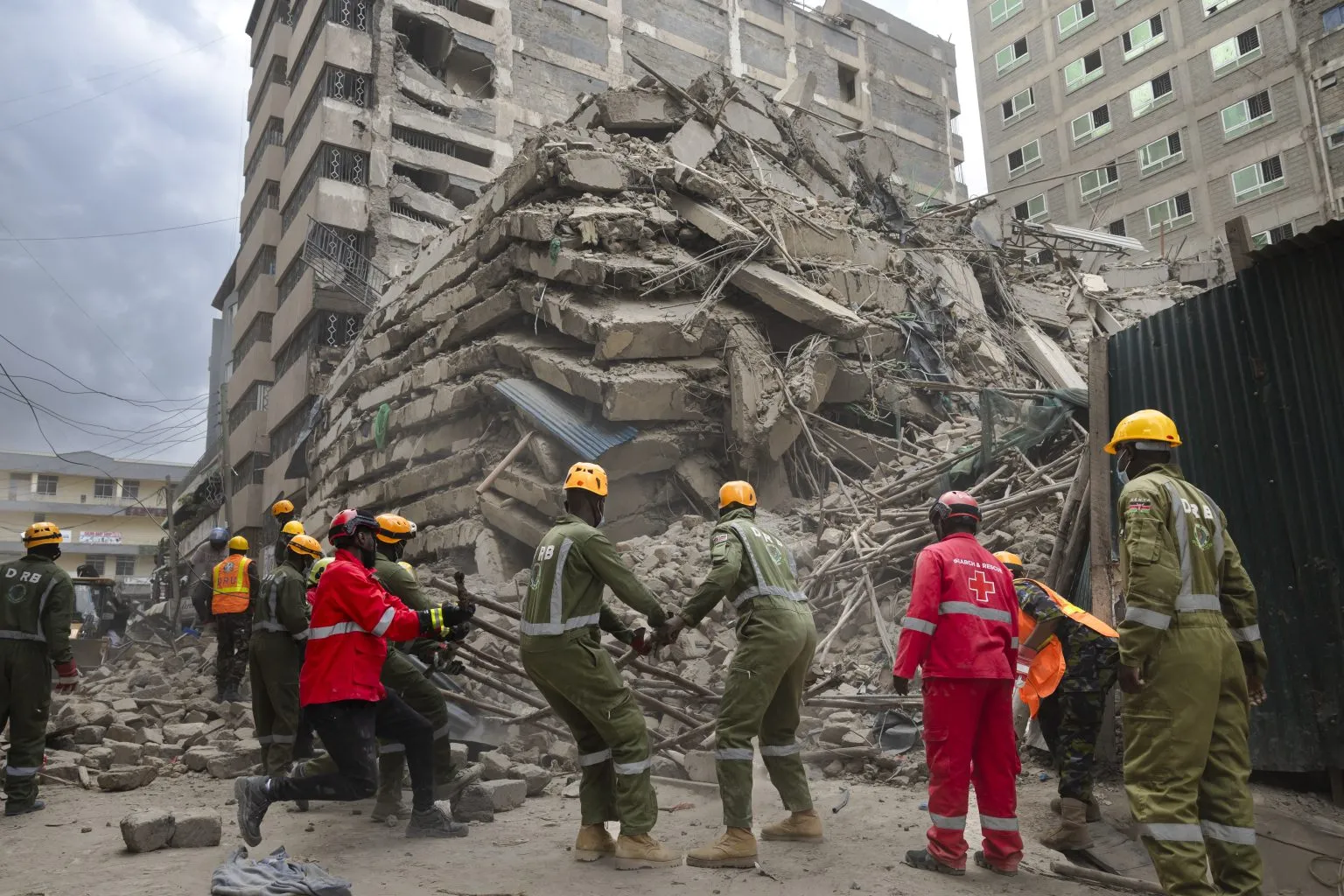
NAIROBI, Kenya — Families of people missing after the Eastleigh building collapse in Nairobi are growing increasingly desperate as rescue teams struggle to reach areas where specialised equipment has detected possible signs of life.
Six days after the building came down on Friday, October 23, authorities said 16 people remained unaccounted for, with mobile phone data indicating that nine had last communicated with relatives from the vicinity of the collapsed structure.
The prolonged wait has left families struggling with uncertainty, as heavy debris and restricted access continue to hamper efforts to reach people who may still be trapped beneath the rubble.
Ronald Mutua has spent six days at the site along Eastleigh’s Ninth Street, hoping for news of his wife and cousin, who were working in the building when it collapsed.
With no breakthrough in reaching the areas where his relatives are believed to have been, Mutua and other families have continued to demand faster action and additional resources.
His brother, Paul Muimi, questioned the pace of the operation and the amount of machinery deployed at the scene.
“How long are we going to wait?” Muimi asked, questioning why more machines had not been brought in to speed up the rescue effort.
He also expressed growing despair over the lack of progress.
“So far, hakuna mafanikio, hakuna matunda… mimi imefika mahali nimelose hope,” he said, meaning there had been no success or results and that he had reached a point where he was losing hope.
Signs of life detected beneath rubble
The National Disaster Management Unit (NDMU) has offered a measure of hope, saying specialised life-detection equipment has picked up indications that people could still be alive beneath the debris.
NDMU Director Dr Duncan Ochieng said acoustic life detectors had again indicated possible signs of life as teams worked to reach the affected sections.
“We have again used the specialised acoustic life detectors and still there is indication of life, we are making progress to be able reach those who are still trapped,” Ochieng said.
However, detecting possible signs of life has not translated into a rescue, with the configuration of the collapsed structure and limited access complicating the operation.
The equipment’s findings do not, on their own, confirm the number of survivors or establish their condition.
The reports have nevertheless intensified pressure on rescuers to reach the identified areas, as relatives fear that every delay could reduce the chances of finding their loved ones alive.
Phone data narrows search for missing people
Nairobi North County Commissioner Simon Osumba said authorities had reduced the number of unresolved missing-person cases to 16 following verification involving the Kenya Red Cross and the Directorate of Criminal Investigations (DCI).
Of the 16 cases, phone data placed nine people near the collapse site around the time of their last recorded communications with relatives.
“Kuna wengine wanne tunasubiri majibu, kuna watatu ambao bado hawajatupatia number za simu,” Osumba said, explaining that authorities were awaiting information in four cases while families had yet to provide phone numbers for three others.
The phone records are helping investigators establish the last known locations of the missing people. However, they do not independently confirm that all nine were inside the building when it collapsed.
Authorities are continuing to reconcile reports from families with information from telecommunications providers as they work to establish who may have been inside the structure.
Rescuers clear 80 per cent of debris
Rescue teams say they have cleared about 80 per cent of the debris, reaching the ground floor and basement, where several shops were operating before the collapse.
Some belongings have been recovered, but several shop occupants remain unaccounted for.
The operation has been complicated by the confined site, the weight of the debris and the need to avoid further endangering rescuers while removing unstable sections of the structure.
The slow progress has also fuelled questions about whether enough machinery and other resources have been deployed to accelerate the search.
Questions raised over building’s structural integrity
As rescue efforts continue, investigators are examining the circumstances surrounding the collapse, including the project’s approval, construction and compliance with building regulations.
Detectives have questioned one of the three developers associated with the building, alongside officials from Nairobi City County, the National Building Inspectorate and the National Construction Authority (NCA).
More people are expected to record statements as investigators seek to establish whether any failures in planning, approval, inspection or construction contributed to the disaster.
Yassin Munyanya, treasurer of the Architectural Association of Kenya, raised concerns about the availability of structural documentation and the condition of the building’s columns.
“From the first instance, there is no copy of the structural drawings, the columns is a sign of a structural failure,” Munyanya said.
His remarks raise questions about the documentation available for the project and the structural condition of the building. However, the cause of the collapse and any individual or institutional responsibility remain matters for investigators to establish.
The Office of the Director of Public Prosecutions has directed the DCI to investigate the collapse, including the roles of the developer, construction professionals and public officials involved in the project.
Attacks on truck drivers threaten rescue operation
Rescue teams have also raised concerns over reported attacks on truck drivers transporting debris away from the site.
The incidents are disrupting the movement of vehicles and slowing the removal of rubble, according to officials involved in the operation.
Also Read: Eastleigh building collapse: Police warn against livestreaming rescue efforts
The clearance of debris remains critical to reaching the remaining sections of the collapsed structure. Disruptions involving trucks and heavy machinery could further complicate an operation already constrained by limited access and difficult working conditions.
As the search continues, families remain at the scene waiting for answers. The reported signs of life have sustained hope that some of the missing could be found alive, but rescuers must still reach the areas identified by the equipment.
For relatives who have spent days waiting for news, the immediate priority is clear: reach the people who may still be trapped, account for everyone reported missing and establish what caused the building to collapse.
