


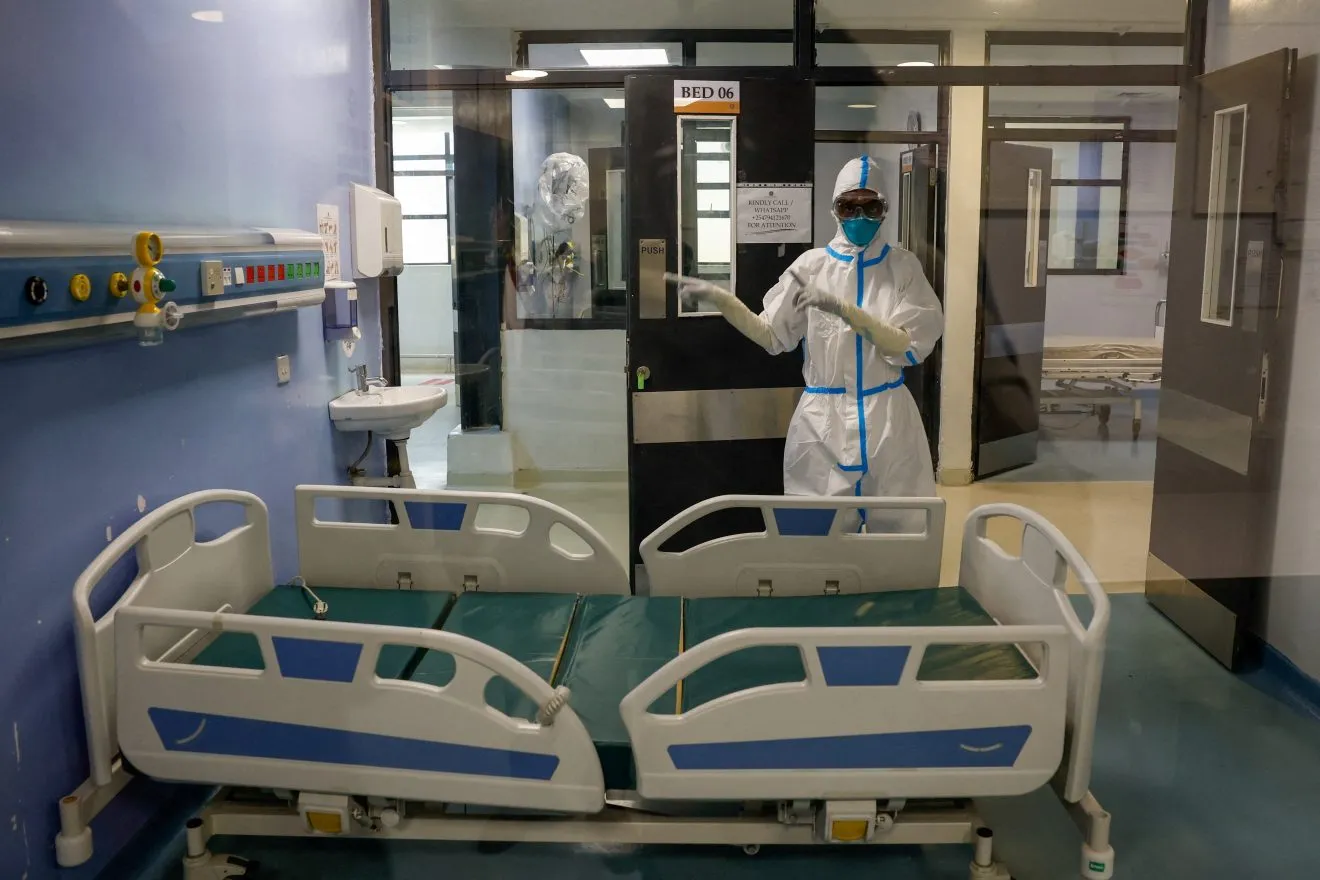
NAIROBI, Kenya — Kenya has reported no additional confirmed Ebola infections following the death of its first confirmed Bundibugyo virus disease patient, offering an encouraging early indication that containment efforts may be working. But with exposed contacts still under observation, health authorities have yet to establish whether the virus has been prevented from spreading beyond the initial case.
The Ministry of Health said on 11 October that it had identified and verified 122 contacts linked to the deceased patient. Of these, 108, representing 88.5 per cent, were in quarantine and undergoing daily monitoring, with none reported to have developed symptoms. Authorities had also tested 293 samples from 289 alerts, with only the imported case testing positive.
The figures suggest that Kenya has so far avoided a detected chain of secondary infections. They do not, however, establish that the risk has passed.
The distinction is important. An imported case occurs when a person contracts an infection elsewhere and brings it into a country. A locally acquired case would indicate that transmission had occurred within the country. Kenya’s immediate public-health priority is to establish whether the imported infection led to any further cases, while maintaining the capacity to detect and respond rapidly if it did.
The World Health Organization (WHO) says Bundibugyo virus disease has an incubation period of two to 21 days. People infected with the virus are not considered infectious before symptoms begin, but once illness develops, transmission can occur through direct contact with infected blood and other bodily fluids or contaminated materials.
For Kenya, therefore, the absence of new cases is a positive development—but the evidence remains provisional until the relevant monitoring periods are completed and surveillance continues to show no further transmission.
Why the 21-day period is crucial
The 21-day monitoring period is not an arbitrary deadline. It reflects the maximum recognised incubation period for Ebola, providing health authorities with a defined window in which to monitor people who may have been exposed.
During this period, contact-tracing teams seek to establish whether exposed individuals develop symptoms such as fever, fatigue, headache, muscle pain or sore throat. Other symptoms may include vomiting, diarrhoea and, in some cases, unexplained bleeding.
Anyone who develops symptoms consistent with Ebola and has a relevant exposure history requires prompt medical assessment and testing. Rapid identification can help health workers isolate a suspected case, provide appropriate care and trace any additional contacts before transmission spreads further.
The absence of symptoms during the first several days is encouraging, but it cannot rule out infection. The monitoring period must be completed according to each contact’s exposure history.
There is also an important distinction between being exposed, being infected and being infectious. Not everyone who comes into contact with a patient will contract the virus, and exposure alone does not mean someone is infected.
Equally, a person who remains well for several days cannot automatically be considered clear if the relevant observation period has not ended.
This is why the number of contacts under active monitoring matters alongside the number of positive tests. Testing suspected cases is essential, but identifying and following people who may have been exposed helps authorities detect possible infections before they develop into wider transmission chains.
The countdown does not begin on the same day for everyone
One of the most important details in Ebola contact tracing is that the 21-day period is calculated separately for each contact, starting from their last relevant exposure.
It does not automatically begin on the day the patient dies, when a burial takes place or when the government announces the confirmed case.
This distinction has practical implications for Kenya. Passengers who may have encountered the patient during his journey to Nairobi, relatives who assisted him and health workers who provided care could have different monitoring deadlines, depending on the nature and timing of their exposure.
Authorities must therefore establish who had a relevant exposure, determine when it occurred and ensure that follow-up continues for the appropriate period. Where additional exposure is identified, the monitoring schedule may need to be reassessed.
The Ministry of Health’s reported identification of 122 contacts is an important step. The next test is whether every relevant contact can be accounted for, monitored and appropriately assessed before being cleared.
Why 21 days is not the same as declaring an outbreak over
The 21-day observation period for individual contacts is frequently confused with the separate 42-day benchmark used to determine when an Ebola outbreak has ended.
WHO guidance generally uses 42 consecutive days without a new confirmed or probable case, calculated from the relevant endpoint of the last case, to establish that transmission associated with an outbreak has been interrupted.
In the case of a patient who dies and receives a safe burial, the countdown begins the day after the burial. Different criteria apply where the last patient recovers and is discharged following the required negative tests.
Kenya’s first confirmed patient died on 5 October and was given a safe and dignified burial on 6 October, according to the health authorities and WHO. The 42-day benchmark must be applied in accordance with the relevant outbreak-ending criteria, while the monitoring of individual contacts continues according to their respective exposure dates.
Completing a contact’s 21-day observation period does not, by itself, mean that the outbreak has ended. Nor does the absence of further positive tests over a short period establish that all possible transmission chains have been excluded.
These are different public-health milestones, and communicating that distinction clearly is essential to avoid both premature reassurance and unnecessary alarm.
Kenya’s response faces a cross-border test
The imported case also highlights the challenges of responding to an infectious disease that does not respect national borders.
The patient had travelled from the Democratic Republic of Congo (DRC) through Uganda before arriving in Nairobi on 3 October aboard Jambojet flight 8523 from Kampala. He was taken to Nairobi Hospital, isolated and treated, but died on 5 October. His sample tested positive for Bundibugyo virus disease, according to WHO and Kenya’s Ministry of Health.
The travel route meant that the public-health response could not be confined to the hospital where the patient received treatment. Authorities needed to establish possible exposures during travel, at healthcare facilities and among other people who may have had relevant contact with him.
Kenya has reported screening hundreds of thousands of travellers at its points of entry. Such screening can support early detection, particularly when combined with health declarations, referral systems and the capacity to investigate alerts. But screening alone cannot identify every infection, especially when symptoms have not yet developed.
Contact tracing, laboratory testing, surveillance at health facilities and cooperation between neighbouring countries therefore remain essential components of the response.
The wider regional context reinforces the need for vigilance. WHO reported that the Bundibugyo virus outbreak in the Democratic Republic of Congo (DRC) was continuing to expand as of its 8 October update.
The agency recorded 8,728 confirmed cases and 4,205 confirmed deaths in the country as of 6 October. Those figures relate to the situation in the DRC, not Kenya, but they demonstrate why cross-border preparedness remains important.
Kenya must therefore maintain a response that is proportionate to its own evidence while recognising that the risk of further imported cases will persist as long as transmission continues elsewhere.
The legal response must be matched by public-health capacity
On 12 October, Kenya declared Ebola a formidable epidemic disease and gazetted the Public Health Ebola Rules 2026, according to the information provided by the Ministry of Health.
The measures establish a legal framework for public-health interventions, including contact tracing and observation arrangements.
Such powers can help authorities respond quickly when a serious infectious disease threatens public health, but their effectiveness depends on clear procedures, proper implementation and public cooperation.
Restrictions or observation arrangements must be applied according to the law and relevant public-health evidence.
Officials should explain what affected individuals are required to do, why the measures are necessary and how people can obtain reliable information or assistance.
The ministry has said that travel, trade, transport and public gatherings remain unrestricted, while screening at entry points has been strengthened. This approach is consistent with the need to avoid treating an imported case as proof of widespread domestic transmission.
WHO has advised against general restrictions on travel to or trade with affected countries in its assessment of the wider Bundibugyo outbreak.
The emphasis is on surveillance, rapid detection, cross-border coordination and effective response rather than measures that are not supported by the evidence.
The challenge for Kenya is to enforce necessary health measures without disrupting everyday life more than the evidence requires.
Public trust is part of the containment strategy
Public communication will be as important as testing and surveillance.
Ebola can generate fear because of its severity, and uncertainty can create space for misinformation, stigma and rumours. People may avoid medical facilities, conceal symptoms or hesitate to disclose contacts if they fear discrimination or punishment.
Authorities need to provide regular, consistent updates that distinguish confirmed facts from risks that are still being investigated. They should explain what contact tracing involves, what symptoms require urgent medical attention and how people can seek assistance without exposing themselves or others to unnecessary risk.
Clear communication should also avoid suggesting that all travellers from an affected country are infected, or that people who have been identified as contacts are confirmed cases.
Exposure is not the same as infection, and a confirmed imported case does not automatically mean an outbreak is underway within the country.
At the same time, reassurance must not become complacency. If a contact develops symptoms or a new suspected case is identified, the public should be informed promptly, with the relevant evidence and response measures explained.
Trust is strengthened when official information is timely, transparent and consistent with what people observe on the ground.
What would demonstrate that Kenya is containing the risk?
The next stage of the response should be judged by clear operational indicators rather than reassurance alone.
Authorities need to account for all relevant contacts, maintain daily follow-up through each person’s monitoring period, investigate new alerts promptly and ensure laboratories can provide reliable results without unnecessary delays.
They must also maintain infection-prevention measures in healthcare facilities and continue coordination with Ugandan and Congolese counterparts.
The government’s reported screening of 667,675 travellers at 26 points of entry by 11 October demonstrates the scale of its surveillance effort. The reported availability of five laboratories, including mobile facilities at Lwakhakha and Busia, also points to the importance of testing capacity close to border areas.
Also Read: Kalonzo accuses Ruto government of Ebola preparedness failures
But the value of these measures ultimately depends on results: whether suspected cases are investigated, contacts are followed up and any new infection is detected quickly enough to limit further transmission.
The 108 contacts reported to be in quarantine or under daily monitoring on 11 October also leave a practical question for authorities: what happened to the remaining 14 identified contacts, and have all relevant individuals now been accounted for? The available figures do not, by themselves, establish their current status.
That is not evidence of a failure, but it is an important point for subsequent official updates to clarify.
Cautious reassurance, not premature victory
Kenya’s response to its first imported Bundibugyo virus case has so far produced an encouraging result: no additional confirmed infections had been reported in the latest figures reviewed, and hundreds of samples had tested negative.
But an effective containment response is measured not only by the absence of new cases at a particular moment. It also depends on whether every relevant contact is traced, whether surveillance remains sensitive enough to detect new infections and whether health authorities complete the required observation and outbreak-ending procedures.
The death of the first patient should not be treated as evidence that the virus has spread widely in Kenya. Equally, the absence of further cases in the first days of the response should not be mistaken for proof that all risk has passed.
For now, the evidence supports cautious reassurance and continued vigilance. Kenya’s task is to turn that early reassurance into a demonstrable public-health outcome through sustained monitoring, transparent communication and coordination across borders.
The decisive measure of success will not be how quickly the country declares itself safe, but whether it can complete the response without missing a further infection.
