


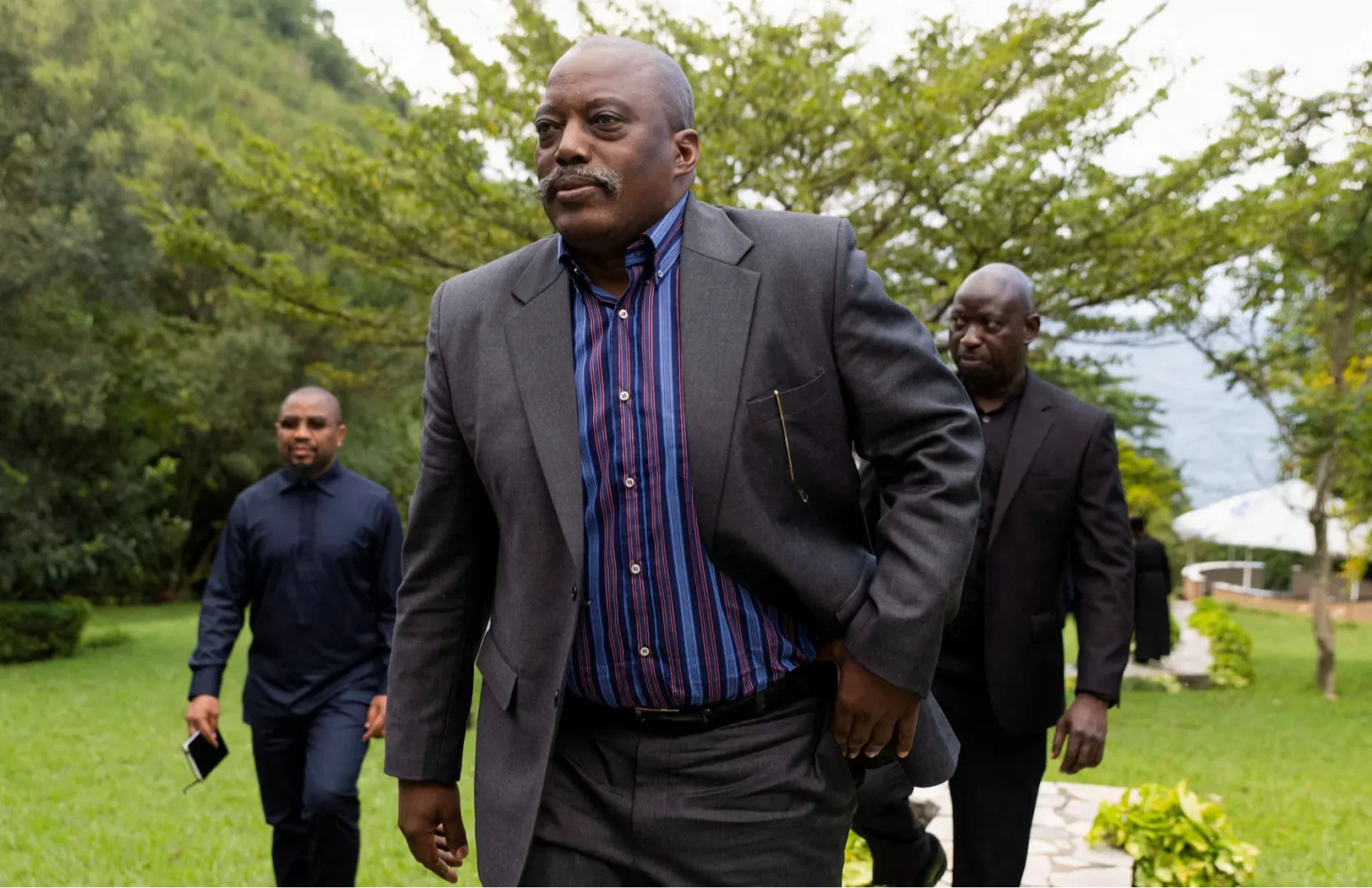
GOMA, DR Congo — Former Democratic Republic of Congo (DRC) President Joseph Kabila has taken the leadership of a new political-military coalition that includes senior figures from the M23 rebel movement, marking a significant shift in his confrontation with President Félix Tshisekedi’s government.
The coalition, known as the Front for the Refoundation of the Nation (FRN), was unveiled on Monday, October 12, at a press conference at Kabila’s residence in Goma, the eastern city that has been under M23 control since January 2025.
The movement says it intends to unite opposition and resistance forces to remove what it describes as tyranny in the country, explicitly stating that it will pursue its objectives “by any means necessary, including the use of force”.
The announcement places Kabila more directly at the head of an armed challenge to the government, after months of accusations from Congolese authorities that he was supporting the insurgency. Kabila had previously denied involvement with M23.
Reuters, Associated Press and Agence France-Presse reported the coalition’s formation and its links to figures from the AFC-M23 alliance.
M23 figures join Kabila’s new movement
The FRN brings together prominent political and military figures associated with the Alliance Fleuve Congo (AFC) and M23, the armed movement that has captured extensive territory in eastern DR Congo.
Among the senior figures named in the new coalition are Corneille Nangaa, a former head of the country’s electoral commission who became a leading figure in the AFC; Bertrand Bisimwa, a senior M23 leader; and military commander Sultani Makenga. Freddy Kaniki was also named in the coalition’s leadership structure, according to Reuters.
Coalition adviser Claude Ibalanky presented the FRN as a political-military platform intended to consolidate the forces opposing the government in Kinshasa.
The formation represents a reorganisation of the anti-government alliance at a time when international efforts to end the conflict remain fragile. It also raises questions about whether the new platform will change the insurgency’s military strategy or primarily consolidate its existing political and armed leadership.
Reuters reported that the FRN was launched to replace the AFC-M23 alliance in its fight against government forces.
Kabila intensifies criticism of Tshisekedi
The coalition’s launch followed a speech in which Kabila said he would outline how Congolese citizens should act to “rescue” their country.
On Friday, October 9, the former president accused Tshisekedi’s administration of disregarding proposals he had put forward the previous year to address the country’s political and security crisis.
Kabila also accused the government of corruption, economic mismanagement, deteriorating security and undermining constitutional rule. He alleged that political opponents and military officers had faced arbitrary arrests.
The government had not publicly responded to the coalition’s announcement or the latest accusations at the time of reporting. The allegations made by Kabila have not been independently established.
His move follows a prolonged deterioration in relations with Tshisekedi, who succeeded him in January 2019 after a disputed election. Kabila ruled the country from 2001 until the transfer of power.
Although he remained largely out of the public spotlight for several years, Kabila has increasingly challenged his successor’s leadership as fighting in the east has continued.
Death sentence and allegations of rebel links
Kabila’s decision to lead the new coalition comes against the backdrop of a military court ruling last year that sentenced him to death in absentia after convicting him of treason, war crimes and crimes against humanity over alleged links to the rebellion.
Kabila has rejected the case as politically motivated and denied the accusations.
The United States also imposed sanctions on him in 2026 over his alleged role in supporting rebel groups. The allegations have added an international dimension to his confrontation with Tshisekedi’s government.
The latest announcement is therefore a notable development: Kabila had previously denied backing M23, but the FRN now openly incorporates senior figures from the movement and presents itself as a vehicle for political and military resistance.
The allegations against Kabila and the legal proceedings against him should not be confused with an independent finding that every claim made by the government is established beyond dispute.
New uncertainty for peace efforts
The FRN’s emergence could complicate diplomatic attempts to end the conflict in eastern DR Congo, where armed groups have fought over territory, political influence and access to valuable natural resources for years.
M23’s advances have displaced civilians and weakened the government’s control over parts of the east. The United Nations and several Western governments accuse Rwanda of supporting the rebels, an allegation Kigali denies.
Also Read: DR Congo military court sentences former president Joseph Kabila to death
The new coalition also raises questions about planned negotiations. Associated Press reported that representatives of the Congolese government and the M23 movement were expected to meet in Qatar in November, although the formation of the FRN could complicate those efforts.
Whether the new movement broadens the insurgency or mainly consolidates existing rebel structures remains uncertain. Its stated willingness to use force, however, signals that Kabila’s return to the centre of Congolese politics is not confined to conventional opposition activity.
Political tensions deepen ahead of 2028
The development comes as DR Congo faces uncertainty over its political future ahead of the next presidential election, scheduled for 2028.
Tshisekedi’s second term is due to end that year. His remarks suggesting elections might not be possible while conflict continues, alongside discussions among his allies about changing the Constitution’s two-term limit, have fuelled concerns over the country’s democratic institutions.
Parliament has passed a bill that could open the way for a referendum on constitutional changes, including the presidential term limit. Proposed changes have drawn protests in the capital, Kinshasa.
The combination of renewed armed opposition, disputes over constitutional limits and uncertainty about the next election threatens to intensify an already volatile political environment.
For now, the FRN’s announcement establishes Kabila as the public leader of a coalition aligned with senior figures from the eastern insurgency. Its practical impact will depend on whether it changes the course of the fighting, reshapes negotiations and gains support beyond territory held by the rebel alliance.
